
The most famous street photography quote is Henri Cartier-Bresson's definition of the decisive moment: "the simultaneous recognition, in a fraction of a second, of the significance of an event as well as of a precise organization of forms which give that event its proper expression." Close behind is Garry Winogrand's "I photograph to find out what something will look like photographed."
I'm Olivier Duong. Years ago I built a list of more than 200 photography quotes on Inspired Eye, partly from old photography books I bought and read. Most quote pages online copy each other and get names wrong. So this list is shorter and stricter: every quote comes with where it was said or published. Quotes I couldn't trace to a source are in a separate section, marked as "often attributed to". Each one comes with a lesson you can take out on the street.
The five big ideas behind the best photography quotes
When I went through hundreds of quotes about photography, the good ones kept circling back to a few ideas. If you only take something small from this page, take these.
- Photographs are made, not taken. Pressing the shutter is easy. Deciding where to stand and when to press is the work.
- Your camera can't help you. I had a serious case of gear acquisition syndrome. New cameras never fixed my pictures. My eye did.
- Images are more than what you see. Photography is seeing, but also feeling and thinking. In my course we call this the Eye, Heart and Mind.
- Photography is about life. The more you live and pay attention, the better your pictures get. Photographs happen where life happens.
- Keep your mind open. Photographers often tell me there's nothing to shoot where they live. Usually they have a fixed idea of what their pictures should look like, and they walk past everything else.
Henri Cartier-Bresson quotes
Cartier-Bresson is the most quoted street photographer, and the most misquoted. These are traced to his own writing or published interviews, many collected in Henri Cartier-Bresson: Interviews and Conversations, 1951 to 1998.
- "The picture-story involves a joint operation of the brain, the eye and the heart." Source: preface to The Decisive Moment (1952), reprinted in The Mind's Eye (1999). Lesson: a technically good frame with no feeling or idea behind it is only half a photograph.
- "People who know how to look are as rare as those who know how to listen." Source: interview with Yvonne Baby, L'Express, 1961. Lesson: looking is a skill you train, not a gift. My guide on how to see like a photographer has exercises.
- "You have to look, and looking is so difficult. We are used to thinking." Source: conversation with Alain Desvergnes at the Rencontres d'Arles, 1979. Lesson: on the street, stop narrating in your head and watch shapes and gestures.
- "You need a lot of sand to discover a nugget." Source: conversation with Gilles Mora, Les Cahiers de la Photographie, 1986. Lesson: even he threw away most frames. Read my article on street photography hit rate before you judge yourself.
- "Shooting is a play between pickpocketing and tightrope walking." Source: same 1986 conversation. Lesson: street photography needs both stealth and balance, and it's supposed to feel tense.
For the full story of his most famous idea, read my guide to the decisive moment.
Street photography quotes from the masters
- "I photograph to find out what something will look like photographed." Garry Winogrand. Source: quoted by the Denver Art Museum; a close variant appears in his 1974 text "Understanding Still Photographs". He added that the real subject is "how the fact of putting four edges around a collection of information or facts transforms it." Lesson: don't prejudge a scene. Shoot and find out. More in my Garry Winogrand profile.
- "Get outside. It's all about getting out and walking." Daido Moriyama. Source: Daido Moriyama: How I Take Photographs (2019), with Takeshi Nakamoto. He goes on: "forget everything you've learned on the subject of photography for the moment, and just shoot." Lesson: volume and walking before theory. See my Daido Moriyama profile.
- "I go ahead and take photos one after another. If I fail, I take another one again. I do not look back on life. Photograph is the same for me." Daido Moriyama. Source: interview on Ricoh's GR blog, March 2019. Lesson: a missed shot is not a reason to stop.
- "I don't have a philosophy. I have a camera. I look into the camera and take pictures." Saul Leiter. Source: interview "Saul Leiter: The Quiet Iconoclast", Photographers Speak, 2009. Lesson: you don't need a concept to start. See my Saul Leiter profile.
- "It's quite possible that my work represents a search for beauty in the most prosaic and ordinary places." Saul Leiter. Source: same 2009 interview. Lesson: you don't need to travel. Your own street is enough. My street photography in a small town guide builds on this.
- "I never felt the need to do what everyone else did." Saul Leiter. Source: same 2009 interview. Lesson: style comes from ignoring trends. See how to find your photography style.
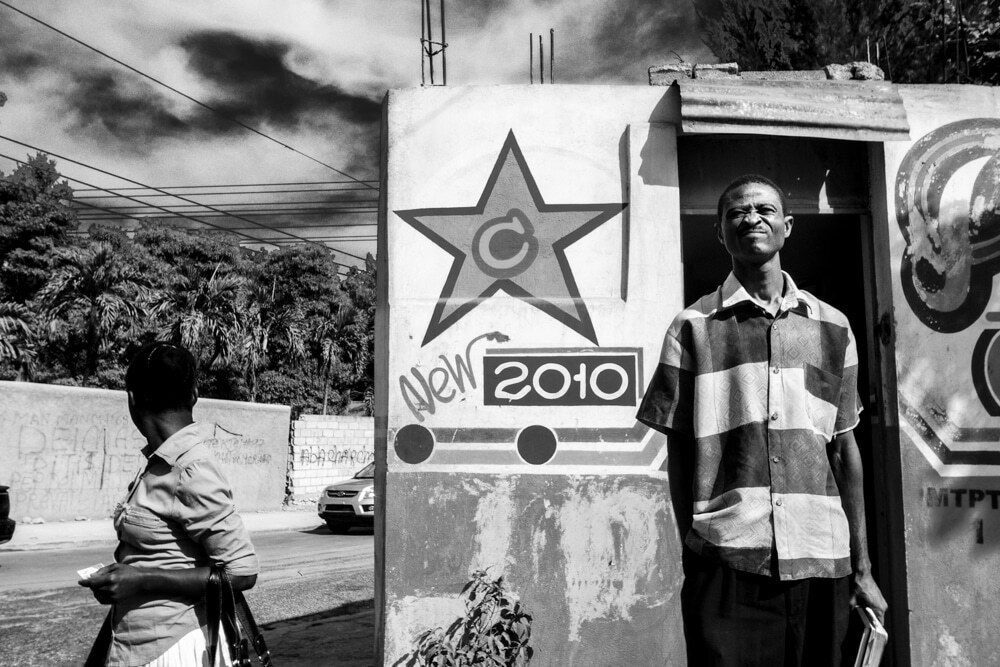
- "At the beginning you must find the ideal location. Then you must be patient to find the right subject that arouses your interest, even if it's just a cat." Fan Ho. Source: interview with The Independent, 2014. Lesson: find the stage and the light first, then wait. See my Fan Ho profile.
- "The maximum, that is what has always interested me." Josef Koudelka. Source: quoted by Magnum Photos. Lesson: commit fully to a subject. See my Josef Koudelka profile.
- "Every one of us is struggling with his own style. Changes don't come purely by will power alone, but they never come by being satisfied." Ernst Haas. Source: a letter to his Magnum colleagues. Lesson: if you feel stuck, that dissatisfaction is the engine. See my Ernst Haas profile.
- "The important thing is to do the picture." Walker Evans. Source: quoted in Bruce Jackson, Fieldwork (1987). He was answering students who felt uneasy pointing a camera at people, and said the motive has to be strong enough that the unease doesn't matter. Lesson: nerves are normal. Read my guide to overcome the fear of street photography.
Martin Parr summed up his whole approach in one line: "I make serious photographs disguised as entertainment." Robert Frank said little about his work, so the best way to learn from him is to study the sequence of The Americans.
Fan Ho's advice is the one I use most. Here the painted wall was the stage. I only needed someone to stand in the right place next to it.
Photography quotes about seeing
- "The camera is an instrument that teaches people how to see without a camera." Dorothea Lange. Source: Dorothea Lange: A Photographer's Life (1978). Lesson: the real gain from photography is attention, and it stays with you after you put the camera down. My guide to mindful photography builds on this.
- "One should really use the camera as though tomorrow you'd be stricken blind." Dorothea Lange. Source: quoted in Elizabeth Partridge, Dorothea Lange: A Visual Life (1994). Lesson: look at your street as if you'll never see it again.
- "I really believe there are things which nobody would see unless I photographed them." Diane Arbus. Source: Diane Arbus: An Aperture Monograph (1972). Lesson: your particular way of noticing is worth something.
- "My favorite thing is to go where I've never been." Diane Arbus. Source: Diane Arbus: Revelations (2003). Lesson: change your route. New places wake up your eye.
- "A great photograph is a full expression of what one feels about what is being photographed in the deepest sense." Ansel Adams. Source: "A Personal Credo" (1943), published in American Annual of Photography (1944). Lesson: ask what you feel about a scene before you ask what settings to use.
- "There are always two people in every picture: the photographer and the viewer." Ansel Adams. Source: Playboy interview with David Sheff, 1983. Lesson: design your frame for the person who will look at it.
- "To photograph is to appropriate the thing photographed." Susan Sontag. Source: On Photography (1977). Lesson: the camera has power. Use it with care. See is street photography creepy.
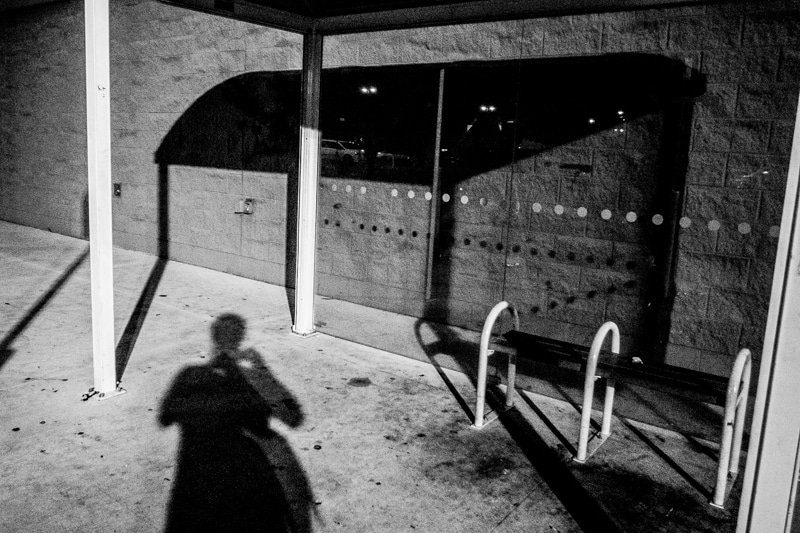
Sometimes the missing element in a frame is you. A shadow puts the photographer in the picture and reminds the viewer someone chose this view.
Inspirational photography quotes for when you're stuck
These are the ones I reread when my own photography stalls. All are sourced above or here.
- "I don't plan things. As a rule I prefer to see what happens." Saul Leiter, Photographers Speak, 2009. Lesson: drop the shot list for a day. Walk and react.
- "Photography is to capture all the things your eye sees within a certain period of time." Daido Moriyama, Ricoh GR blog, 2019. Lesson: everything in front of you counts, not only the "good" subjects.
- "I believe this award recognizes my lifelong commitment to photographing the streets and I look forward to taking many more street photographs." Daido Moriyama, on winning the Hasselblad Award, 2019. Lesson: at 80 he was still looking forward to the next walk.
- "You need a lot of sand to discover a nugget." Henri Cartier-Bresson, 1986. Worth repeating. Lesson: a bad day of shooting is part of the process.
If you are stuck for longer than a few weeks, my guides to photography creative block and how to push through a plateau go further, and my list of street photography ideas gives you something to shoot tomorrow.
Often attributed: famous quotes with no clear source
These are all over the internet. They may be genuine, but I couldn't trace them to an original book or interview. Use them, but don't cite them as fact.
- "If your pictures aren't good enough, you're not close enough." Often attributed to Robert Capa. Lesson: get physically and emotionally closer. My guide on how to photograph strangers helps with the physical part.
- "Your first 10,000 photographs are your worst." Often attributed to Henri Cartier-Bresson. Lesson: practice volume matters, whatever the number.
- "You don't take a photograph, you make it." Often attributed to Ansel Adams. Lesson: the core of my first big idea above.
- "There are no rules for good photographs, there are only good photographs." Often attributed to Ansel Adams. Wikiquote notes it appears without a source in a 2002 book. Lesson: rules are tools. See my guide to photography composition for which ones matter.
- "The marvels of daily life are exciting; no movie director can arrange the unexpected that you find in the street." Often attributed to Robert Doisneau. Lesson: real life beats staging.
- "A photograph is a secret about a secret. The more it tells you the less you know." Often attributed to Diane Arbus; it appears in books about her, but I couldn't check the first source. Lesson: leave some mystery in the frame.
- "Stare. It is the way to educate your eye, and more. Stare, pry, listen, eavesdrop. Die knowing something. You are not here long." Often attributed to Walker Evans, reportedly from his notes. Lesson: curiosity is the job.
- "I am not interested in shooting new things. I am interested to see things new." Often attributed to Ernst Haas. Lesson: familiar places are fine if you look differently.
- "One should not only photograph things for what they are but for what else they are." Often attributed to Minor White. Lesson: look for metaphor, not only description.
- "When subject matter is forced to fit into preconceived patterns, there can be no freshness of vision." Often attributed to Edward Weston. Lesson: my fifth big idea, in his words.
- On the label "street photography". Garry Winogrand is reported to have called the term stupid and joked that his book The Animals would make him a zoo photographer. The wording varies by source. Lesson: don't let a genre label limit what you shoot. See what is street photography.
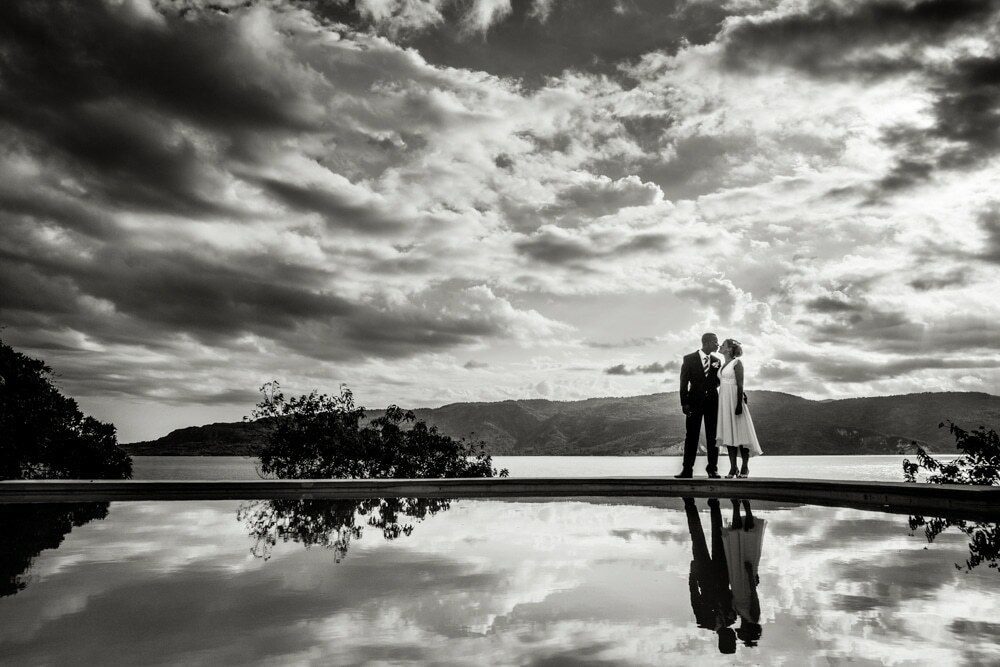
Minor White's line, whoever first said it, is how I think about reflections. The couple is the subject. The mirrored sky is what else it is.
How to turn a quote into an assignment
A quote on a wall does nothing. A quote you shoot with changes your pictures. Here's how I use them.
- Pick one quote a week. Write it on your phone's lock screen.
- Turn it into a rule. "Get closer" becomes "nothing farther than two meters today." "See what happens" becomes "no destination, only turns."
- Shoot one walk under that rule. Even a short one.
- Review with the quote in mind. Did the rule change anything? Keep the frames where it did.
This is close to how I teach. In my street photography course, Phototactic, ideas like the Eye, Heart and Mind become picture patterns and cheat sheets you can use on the street. There's also a bonus interview with my co-author Don Springer about what he learned from Garry Winogrand and Minor White. The course has no feedback on your own photos, so the practice is yours.
For the people behind these words, see my list of famous street photographers and the wider list of famous photographers. For their books, see the best photography books.
Frequently Asked Questions
What did Henri Cartier-Bresson say about photography?
His best known words define the decisive moment as the simultaneous recognition, in a fraction of a second, of the significance of an event and of a precise organization of forms that gives it its proper expression. That comes from the preface to The Decisive Moment (1952). He also said that people who know how to look are as rare as those who know how to listen.
What is a good short photography quote?
Dorothea Lange's "The camera is an instrument that teaches people how to see without a camera" is short and properly sourced to Dorothea Lange: A Photographer's Life (1978). Saul Leiter's "I don't have a philosophy. I have a camera" from a 2009 interview is another. Both work well as captions because they are about seeing, not gear.
Did Robert Capa really say "If your pictures aren't good enough, you're not close enough"?
It's one of the most repeated photography quotes and is always credited to Robert Capa, but I couldn't trace it to an original book or interview. Treat it as often attributed to Capa. The advice still holds: most weak street photos improve when you stand closer to your subject.
What is Garry Winogrand's most famous quote?
"I photograph to find out what something will look like photographed." The Denver Art Museum quotes it, and a close version appears in his 1974 text Understanding Still Photographs. He explained that the point is how putting four edges around a collection of facts transforms them. It's a reminder to shoot first and judge later.
Where can I find reliable photography quotes?
Go to the source: photographers' own books and published interviews. Collections like Henri Cartier-Bresson: Interviews and Conversations, and Wikiquote pages that list a citation for each quote, are useful. Be careful with image quote sites, which often copy each other and attach famous names to lines nobody can trace.