
To see like a photographer, study great photos until you can name why they work, then go out and hunt for one of those patterns at a time. Seeing is a trained skill, not a gift, and you can train it with daily drills that take minutes.
I'm Olivier Duong. One Reddit user described the problem perfectly: "When I'm on a street everything just looks very ordinary, and I can't seem to find things that stand out." The street isn't ordinary. Your brain has just learned to ignore it. This guide is about switching that filter off and pointing it at pictures.
What does it mean to see like a photographer?
Seeing like a photographer means noticing the visual structure of the world, not just its content. Most people see "a man at a bus stop." A photographer sees a dark shape against a lit wall, a diagonal shadow, a red bag that echoes a red sign, and a gap in the traffic where the man might step.
To see, you first have to slow down and observe. The photographer Paolo Sartori puts it as the difference between looking and seeing. Looking is taking in information. Seeing is noticing light and shape, and imagining how they'd sit inside a rectangle.
Alan Ross, who worked as Ansel Adams's assistant, describes seeing like a photographer as looking everywhere: in front, behind, above, below, near and far.
There's also a second layer: seeing the moment. Photographic vision means reading a scene well enough to guess what will happen next, so you're ready when it does. That's where composition meets timing, and it's what the decisive moment is built on.
Why everything looks ordinary: your brain's filter
Your brain can't process everything your eyes see, so it filters. Between the conscious and the subconscious mind sits a gatekeeper called the reticular activating system. Its job is to let through what you've told it matters and drop the rest. If you've never told it that shadows or gestures matter, it drops them.
You've seen this filter at work. Buy a new car and suddenly you see that model everywhere. The cars were always there. Your filter changed. Psychologists call this the frequency illusion.
The famous "invisible gorilla" experiment by Daniel Simons and Christopher Chabris showed the other side of it. Many people counting basketball passes in a video failed to notice a person in a gorilla suit walking through the scene. When your attention is set on one thing, you can be blind to the obvious.
The good news is that the filter can be reprogrammed. Tell your brain what to look for, often enough, and it starts flagging it for you. That's what training your eye really is.
Step 1: Learn the vocabulary of pictures
You can't look for what you can't name. The first step is building a visual vocabulary: the words for the things that make pictures work.
- Elements: line, shape, texture, colour, tone and space. See the elements of photography.
- Arrangements: leading lines, framing, layering, juxtaposition, negative space, repetition.
- Perception: figure-ground, proximity, similarity and closure, explained in Gestalt principles in photography.
- Light: direction, hardness, shadow, silhouette, reflection. See light and shadow photography.
- Moment: gesture, expression, interaction. See emotion in street photography.
I call these patterns "picture patterns." Once a pattern is installed in your mind, your subconscious starts spotting it on the street without you trying.
Step 2: Study great photographs until you can say why they work
Looking at great photos is how you install the patterns. But scrolling doesn't count. You need to look slowly and ask questions:
- Where does my eye land first, and why?
- Which way does it travel after that?
- What's the figure and what's the ground?
- What would happen if the photographer had taken one step to the side?
- Is there a gesture, and where is it in the frame?
John Szarkowski's book The Photographer's Eye, from his 1964 exhibition at the Museum of Modern Art, is a great place to start. He organised photographs around ideas that are specific to photography: the thing itself, the detail, the frame, time and vantage point. Reading it trains you to think in photographic terms rather than subject terms.
Then pick a few masters and live with their work. Lee Friedlander is a good choice if you think your surroundings are boring: he made everyday details interesting, and many of his photos could have been taken on your road to work. My list of famous street photographers gives one lesson from each.
Step 3: Hunt for one pattern at a time
This is the step most people skip. They go out trying to see everything and end up seeing nothing. Instead, pick one pattern per walk.
Today, only shadows. Tomorrow, only repetition. The day after, only hands. With one pattern in mind, your filter has a single job, and it does it well. You'll be surprised how many shadows appear when shadows are all you're looking for.
The free sample lesson uses exactly this idea with a 10 day repetition quest. The street photography ideas list has 50 more patterns and constraints you can use as daily assignments.
Daily drills to train your eye (no camera needed)
- Take mental pictures. Minor White encouraged photographers to take pictures in their mind. I do this constantly. A man glances up from his newspaper in a café and I see the frame in black and white, with the light on his beard. Nothing is recorded, but the eye gets a rep.
- Frame with your hands or phone. On a walk, make a rectangle with your fingers and move it around a scene. Notice how the picture changes as the edges move.
- Squint. Squinting kills detail and leaves tone and shape. It's the fastest way to see the structure of a scene, the same trick painters use.
- Describe light out loud. Where's it coming from? Hard or soft? Where are the shadows? Do this a few times a day and you'll start noticing light before subjects.
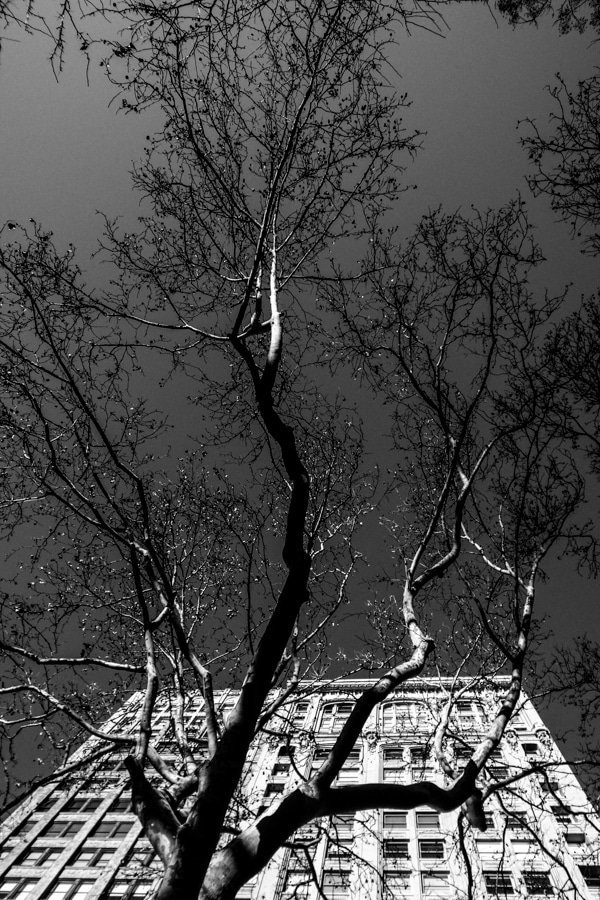
- Look up, look down. Most people only look at eye level. Ceilings, pavements, reflections in puddles and shadows on the ground are full of pictures nobody else sees.
- Sketch a composition. Draw a quick box and put the main shapes of a scene in it. You don't need drawing skill. The point is to think in two dimensions.
- Follow your curiosity. Leonardo da Vinci's first principle was curiosità, an insatiable curiosity. Ask why a shadow falls the way it does, or why one wall glows at sunset. Questions sharpen the eye.
- Rewatch a scene. Go back to the same spot at different times of day. Same place, different light. The spot teaches you what changes and what doesn't.
Treat each one as an exercise, not a chore. A few minutes of practice every day beats a long walk once a month.
Dorothea Lange is often quoted as saying the camera is an instrument that teaches people how to see without a camera. These drills are the "without a camera" part.
Step 4: Review your shots and name what you saw
After each walk, look at your photos and name the pattern in each one. "Repetition. Figure-ground." If you can't name anything, the photo probably doesn't have a structure yet.
Then look at the ones that almost worked. What was missing? A second layer? A cleaner background? A better moment? A closer position? That's your assignment for next time. Use the checklist in what makes a good photograph if you want a structure for this.
Garry Winogrand famously said he photographed to find out what something would look like photographed. Reviewing is how you close that loop. Over time, your prediction of how a scene will look as a photo gets better, and that prediction is photographic vision.
Stay open: your pictures are right in front of you
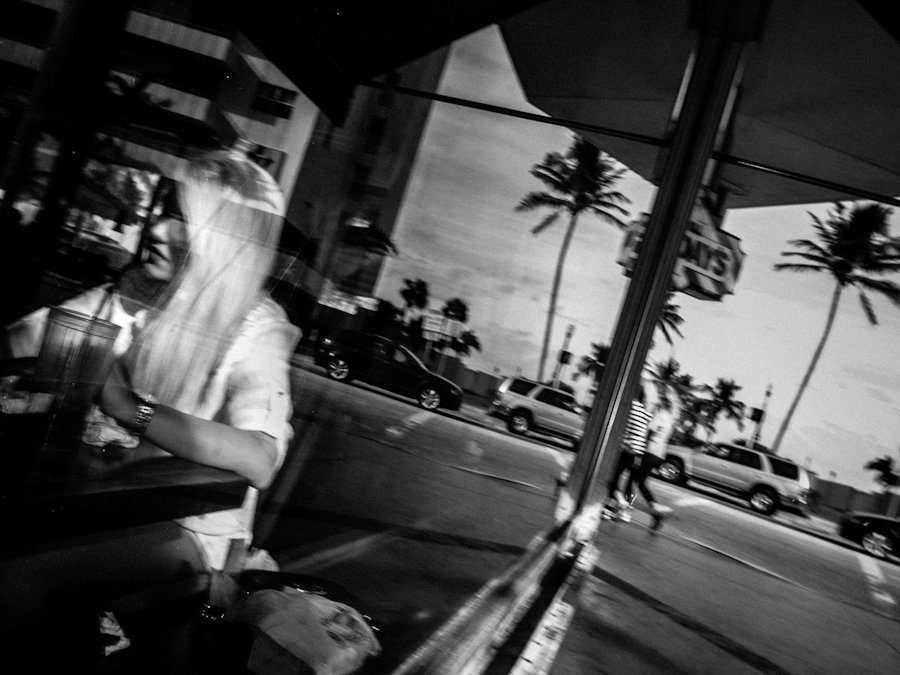
A bad mindset I used to have was a fixed idea of what a photograph should look like. It made me ignore the images right in front of me. I think of it like a radio: every station is broadcasting at once, but you only hear the one you're tuned to. Images are everywhere. You have to be tuned in for them to pop.
Familiarity breeds contempt. An exciting place is only exciting for a little while, then it becomes background. A visiting photographer can come to where you live and find good images, which proves they're there. If your town feels empty, read street photography in a small town.
Your state of mind matters too. When I go out to shoot, I leave everything else at home. Music helps me get into that zone. If your head is full of your to-do list, your filter is busy with that instead of pictures.
How long does it take to train your eye?
You'll notice a change in days if you practise one pattern at a time. Seeing it consistently takes longer, usually months of regular walks and review. It never really stops: photographers with decades of experience still find new things to see.
The fastest route is the combination of the steps above: vocabulary, study, one pattern per walk, review. Doing only one of them, like shooting a lot without studying, is much slower. If you feel stuck, why are my street photos boring? and the street photography plateau cover the common traps.
A course built around seeing
Phototactic, my online street photography course, is built on this method. The first module shows how to install picture patterns in your mind. The composition modules give you the vocabulary, the priming module prepares your brain before you shoot, and the Image Quest cheat sheet lives on your phone so you always have a pattern to hunt. One student, Gian Maagad, wrote: "By far the biggest benefit of this course is learning how to SEE."
It's self-paced video with no personal feedback on your photos. For the wider context, start at the photography composition hub.
Frequently Asked Questions
How do I train my eye for photography?
Study great photographs until you can name why they work, then go out and hunt for one of those patterns at a time, like shadows or repetition. Add daily drills such as mental pictures or framing with your hands. After each walk, review your photos and name the pattern in each frame.
What is photographic vision?
Photographic vision is the ability to see the world in terms of how it will look as a photograph: light, shape, lines and relationships inside a rectangle, plus the moment when they line up. It's a trained skill. Photographers build it by studying images and by reviewing their own work against specific patterns.
Why does everything look boring when I go out to shoot?
Your brain filters out familiar things so it isn't overwhelmed. Without a specific pattern to look for, everything blends into the background. Give yourself one assignment per walk, like hands or reflections, and your attention starts picking out images that were there all along.
Can you learn to see like a photographer without a camera?
Yes. Taking mental pictures, framing scenes with your fingers, squinting to reduce a scene to tone and shape, and describing light out loud all train the same skill. Minor White encouraged mental pictures for this reason. The camera then becomes a way to record what you've already learned to notice.
What book teaches you how to see as a photographer?
John Szarkowski's The Photographer's Eye is a classic. It groups photographs around ideas specific to the medium, such as the frame, the detail and vantage point. Many photographers also study the work of masters like Lee Friedlander, who showed how to make the mundane interesting.