
The best lens for street photography is a small prime with a 35mm full frame equivalent field of view. If you shoot close and like busy frames, go wider with a 28mm. If you like cleaner frames with fewer elements, a 50mm works too.
I'm Olivier Duong. I've shot street photography for years and run Inspired Eye with Don Springer. The lens matters less than most people think. But the focal length you pick does shape how close you get and how much of the scene ends up in your frame. So it's worth choosing on purpose.
Why a 35mm lens is the best all round choice
A 35mm lens sees a little wider than your eyes do when you focus on something. It's wide enough to show a person and their surroundings. It's tight enough that the person still matters in the frame.
That balance is why so many street photographers settle on it. You can shoot a single subject at a few meters. You can step in and build layered frames with a foreground and a background. You rarely feel stuck.
- Distance: you work at about 1.5 to 3 meters from your subject, close enough for intimacy without being in their face.
- Distortion: faces and bodies near the edges stay natural, unlike at 24mm.
- Size: most 35mm primes are small and light, so the camera draws less attention.
- Zone focusing: at f/8 you get a deep band of sharp focus, which makes quick shots easy.
If you're unsure, start here. You can always go wider or tighter once you know how you see.
Focal length comparison table
Here is how the common street photography focal lengths compare. The angle of view is the diagonal angle on a full frame sensor.
| Focal length (full frame) | Angle of view | Typical distance to subject | Best for | Drawback |
|---|---|---|---|---|
| 24mm | 84° | Under 1.5 m | Crowds and narrow streets | Edge distortion, hard to fill the frame |
| 28mm | 75° | 1 to 2 m | Close, busy frames | You must get close or the subject looks small |
| 35mm | 63° | 1.5 to 3 m | All round street work, people in context | Not as dramatic as wider lenses |
| 40mm | 57° | 2 to 3 m | A middle ground between 35mm and 50mm | Few lenses to choose from |
| 50mm | 47° | 2 to 4 m | Isolating one subject, cleaner frames | Harder to show context in tight spaces |
| 85mm | 28° | 4 m and more | Candid portraits, compressed scenes | Distant feel, and the lens is easy to spot |
Crop factor: how to find your 35mm equivalent
Focal lengths in street photography talk are almost always full frame numbers. If your camera has a smaller sensor, multiply the lens focal length by the crop factor to get its equivalent field of view.
| Sensor | Crop factor | Lens for 28mm look | Lens for 35mm look | Lens for 50mm look |
|---|---|---|---|---|
| Full frame | 1.0x | 28mm | 35mm | 50mm |
| APS-C (Fujifilm, Sony, Nikon) | 1.5x | 18mm | 23mm | 33 to 35mm |
| APS-C (Canon) | 1.6x | 18mm | 22mm | 32mm |
| Micro Four Thirds | 2.0x | 14mm | 17mm | 25mm |
So a 23mm lens on a Fujifilm body gives you the classic 35mm view. The Fujifilm X100VI has that view built in. A 17mm lens on a Micro Four Thirds camera does the same. The field of view matches, but depth of field at the same aperture is deeper on the smaller sensor. For street work that's often a plus.
35mm vs 50mm for street photography
This is the question I get most. Here's the short version.
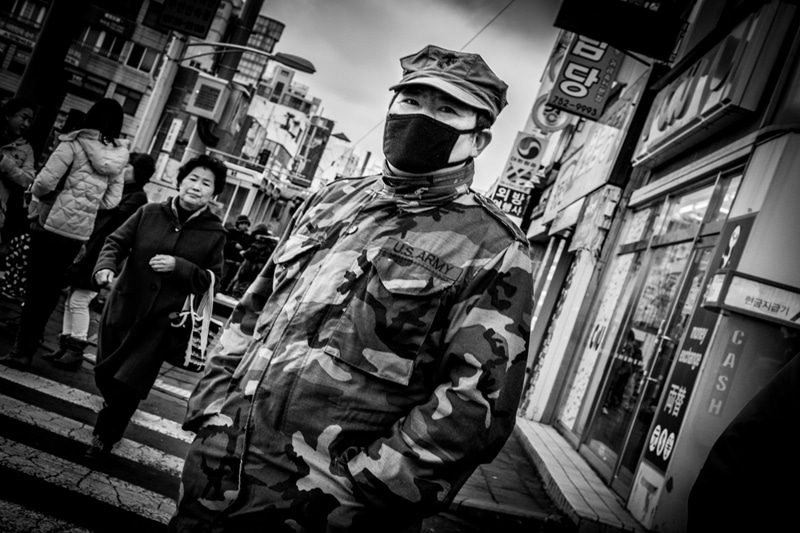
Pick 35mm if you want to show where things happen. It forces you to get closer, and it lets you stack a subject in front of a busy background in one frame. It's more forgiving when the scene is moving fast.
Pick 50mm if you like to simplify. A 50mm lens crops out clutter and puts the focus on one person or one gesture. It feels closer to what you notice with your eyes, so what you see is often what you get. It also lets you work from a bit further back.
A 50mm is popular for good reasons. It's cheap and small. It's also the lens Henri Cartier-Bresson favored on his Leica for most of his career. His contact sheets show he used a 35mm at times too. The focal length didn't make his pictures. How he arranged the frame did.
If you have both, try a split test. Shoot the same street for an hour with each. Look at which set has more keepers. That tells you more than any review.
Is 28mm or 24mm too wide?
A 28mm lens is not too wide. It's a classic street focal length. Bruce Gilden has long worked with a Leica and a 28mm lens, often with flash, right in people's faces. Daido Moriyama shot much of his work on Ricoh GR film compacts with a fixed 28mm lens, and he still uses the digital GR today.
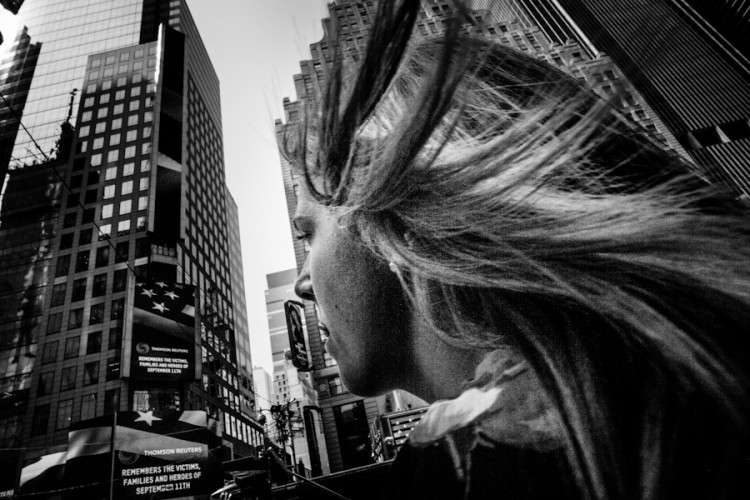
The catch is distance. A wide angle lens for street photography only works if you get close. Stay at 4 meters with a 28mm and your subject becomes a small figure in a big empty frame.
A 24mm lens is wider still. It's great in crowds and narrow streets. But people near the edges stretch and faces distort. I'd only pick 24mm as a main lens if you already love working very close.
Is 85mm good for street photography?
An 85mm lens can work, but it's a different kind of street photography. You shoot from far away. The subject is isolated and the background blurs or compresses. The results often look like candid portraits.
The downside is that you lose context, and you lose the feeling of being part of the scene. You also need more light because you need faster shutter speeds to avoid shake. I see it as a second lens, not a first one.
What to look for in a street lens
Focal length comes first. After that, a few specs decide whether a lens for street photography is a joy or a chore.
- Size and weight: a compact and lightweight lens gets carried every day. A big lens stays home. Small lenses also make you less visible.
- Maximum aperture: f/2 or f/2.8 is plenty. You'll shoot at f/5.6 to f/8 most of the day for depth of field. A faster aperture lens like f/1.4 helps at night, but it adds size and cost.
- Autofocus: fast and silent autofocus helps when you shoot moving people. Many street photographers still prefer zone focusing, so a clear focus ring with a distance scale is a bonus.
- Weather sealing: if the lens is weather sealed, you can keep shooting in rain, which is often when the streets look best.
Bokeh matters less than gear reviews suggest. In street photography the background is usually part of the story, so you want it readable, not melted away. Image quality from almost any modern prime lens is more than good enough. Don't pay extra for sharpness you won't see.
Best street photography lenses by camera system
Every lens below is a small prime that I'd happily carry all day. I've listed the full frame equivalent for each. No affiliate links here.
Fujifilm X (APS-C)
- Fujifilm XF 23mm f/2 R WR: 35mm equivalent. Small and weather resistant. My default pick for Fujifilm.
- Fujifilm XF 27mm f/2.8 R WR: about 41mm equivalent. A pancake lens that makes the camera nearly pocketable.
Sony E mount (full frame)
- Sony FE 35mm F1.8: a true 35mm with a fast aperture for low light.
- Sony FE 40mm F2.5 G: tiny and light, a good middle ground between 35mm and 50mm.
- Sony FE 24mm F2.8 G: a compact wide option for close shooters.
- Sony FE 50mm F2.5 G: the 50mm in the same compact series, for cleaner frames.
Canon RF (full frame)
- Canon RF 35mm F1.8 Macro IS STM: a 35mm with image stabilization, useful at dusk.
- Canon RF 28mm F2.8 STM: a pancake about an inch long. Very discreet.
Nikon Z (full frame)
- Nikon NIKKOR Z 28mm f/2.8: light and affordable, also sold in an SE version with retro styling.
- Nikon NIKKOR Z 40mm f/2: small and bright, a nice 35mm vs 50mm compromise.
Leica M
- Leica Summicron-M 35 f/2 ASPH: the classic documentary lens, compact and sharp.
- Leica Summicron-M 28 f/2 ASPH: for those who shoot close and wide.
Micro Four Thirds
- OM System M.Zuiko 17mm f/1.8: about 34mm equivalent, with a clutch focus ring that shows a distance scale for zone focusing.
- Panasonic Leica DG Summilux 15mm f/1.7: about 30mm equivalent, sharp, with a physical aperture ring.
Fixed lens compacts
- Ricoh GR IV: 28mm equivalent, fits in a jacket pocket.
- Ricoh GR IIIx: 40mm equivalent, same small body.
Still choosing a body? See my guide to the best camera for street photography.
Prime or zoom?
Use a prime. A zoom makes you think about framing with your fingers instead of your feet. With one fixed focal length you learn exactly what the frame will hold before you lift the camera. After a few weeks you start to see in that frame.
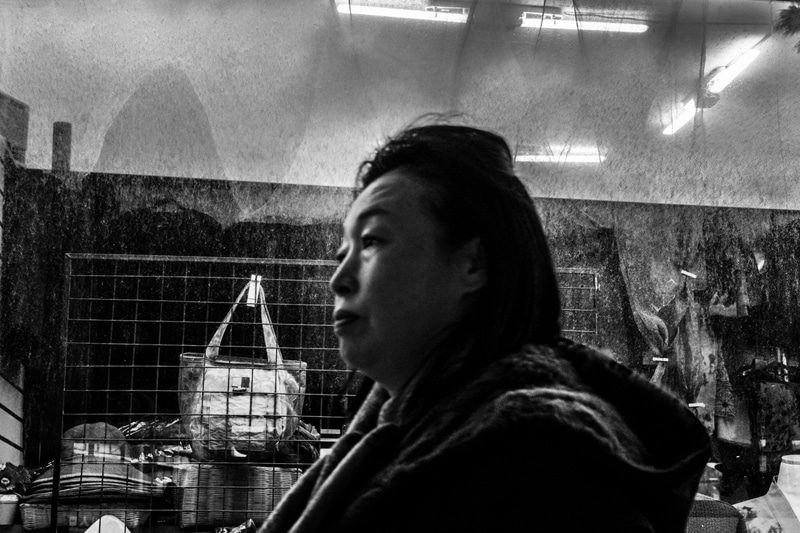
Primes are also smaller and faster. A small camera with a small lens draws less attention, so people keep doing what they were doing.
A zoom lens does have one use. If you don't know your focal length yet, the kit zoom that came with your camera lets you test. Shoot a few weeks, then check which focal length shows up most in your best frames. Buy that prime.
If you already own a zoom, tape it at 35mm or 28mm and don't touch it for a month. Then set up your camera with the right street photography settings so focus and exposure take care of themselves.
Which focal length suits how you see
Here's the truth most gear lists skip. A new lens won't fix weak pictures. What makes a street photo work is the frame: where you place people and what you leave out.
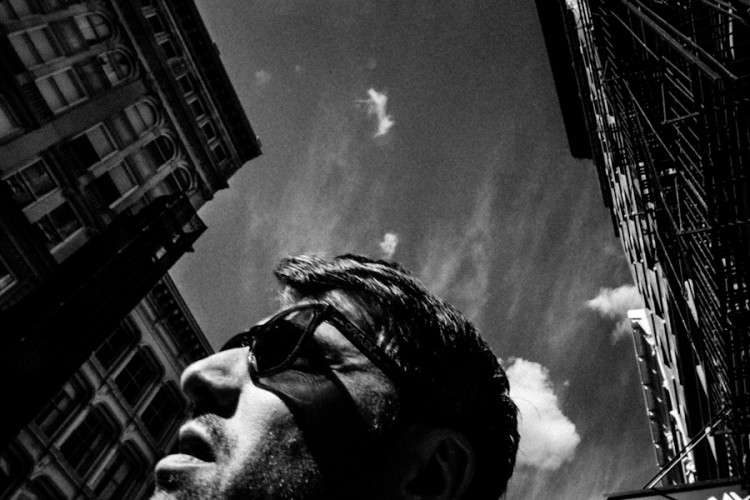
That's what Don Springer and I teach in Phototactic, our online street photography course. It's built from short daily videos on composition and seeing, including frame dynamics and 8 arrangement principles you can use with any lens. It's $297 as one payment with a 60 day money back guarantee.
The course also includes a bonus interview with Don about Garry Winogrand's favorite focal length and why it suited the way he worked. If you're new, start with street photography for beginners, or compare options in our list of the best street photography courses. When you're ready to train your eye, the street photography course is here.
Frequently Asked Questions
What is the best lens for street photography?
A small prime with a 35mm full frame equivalent is the best all round lens for street photography. It shows your subject and their surroundings without distortion. On Fujifilm that's a 23mm lens, and on Micro Four Thirds it's a 17mm. If you shoot very close, a 28mm is a great alternative.
Should I use a 35mm or 50mm lens for street photography?
Use a 35mm if you want context and like layered frames with a foreground and background. Use a 50mm if you prefer simpler frames built around one subject. Beginners usually find 35mm more forgiving. The best test is to shoot the same street with both and count your keepers.
Is 24mm too wide for street photography?
For most people, yes, as a main lens. A 24mm works in crowds and narrow streets, but you must stand very close and people near the edges distort. A 28mm gives you most of the wide look with less distortion, which is why it's the more popular wide choice.
Is 50mm or 85mm better for street photography?
A 50mm is better for most street photography. It keeps enough context to tell a story and it's small and cheap. An 85mm isolates people from far away, so the results look more like candid portraits. It also needs faster shutter speeds. Treat 85mm as a second lens.
What lens do most street photographers use?
Most street photographers use a prime between 28mm and 50mm full frame equivalent, with 35mm the most common. Bruce Gilden is known for a 28mm, and Henri Cartier-Bresson mostly used a 50mm. Pocket cameras like the Ricoh GR, with a fixed 28mm equivalent lens, are also very popular.
Why is a 50mm lens so popular?
A 50mm lens is cheap and small, usually with an aperture of f/1.8 or brighter. Its field of view feels close to what you notice with your eyes, so framing feels natural. Henri Cartier-Bresson favored it, and that history keeps it popular with street photographers today.
What focal length is 35mm on a crop sensor?
To get a 35mm look on a crop sensor, divide 35 by the crop factor. On Fujifilm, Sony or Nikon APS-C (1.5x) use about a 23mm lens. On Canon APS-C (1.6x) use about 22mm. On Micro Four Thirds (2x) use a 17mm lens.