
Most boring street photos have no clear subject and no moment. Pick one subject, then wait for a gesture in front of a clean background, and your photos stop looking random.
I'm Olivier Duong, and I've been there. Early on I could not tell you if my pictures were good or not. I would post them and get crickets. If you feel your photos are "a bit boring and random", as one Reddit beginner put it, the problem is almost never your camera. It's what you point it at and when you press the shutter. That part can be learned, and you can improve your photography with the camera you already own.
Why do street photos feel boring?
Street photos feel boring when the viewer can't tell what the photograph is about. A person walking past a wall is a record of a street. It becomes a photograph when something happens, or when shapes, light and people line up in a way that makes the eye stop.
The streets look ordinary to you because you see them every day. Your brain has tuned them out. A visiting photographer could walk down your block and find pictures, because the images are there. You just stopped noticing them.
The same thing happens to travel photographers. Another Reddit user admitted their shots were "travel photos that look like a hobbyist took them while on vacation." New places don't fix the problem, because you take photos the same way you always did. If you always shoot the way you always shot, you'll always get the images you always got. So try a different way of seeing, not a different street.
Use this table as a quick critique of your last 20 frames. Most uninteresting frames fail on one or two rows.
| Symptom | Likely cause | Fix |
|---|---|---|
| "What am I looking at?" | No single subject | Pick one subject and fill more of the frame with it |
| People just walking | No moment or gesture | Wait for a verb: a glance or a jump |
| Busy, messy frame | Background competes with subject | Move a step left or right until the background is clean |
| Flat, gray frames | Flat light, no contrast | Shoot in side light and look for light against dark |
| Everything is dead center | No arrangement | Look for shapes and repeated colors first |
| Nice but forgettable | No feeling behind the shot | Shoot what pulls at you, not what street photos "should" look like |
| Too many similar frames | No editing | Cull hard and let photos rest before you judge them |
Fix 1: Decide what the photograph is about
A good street photo has one clear subject, so decide what that subject is before you raise the camera. If you can't say it in a few words ("the man and his shadow", "two red coats"), the viewer can't either.
One of the most upvoted critiques on r/streetphotography says it plainly: "I struggle to understand what the photograph is about." It's the most common reason I see when photos are boring. The frame holds a street, some people, a sign, a car. Nothing is in charge.
Before you shoot, name the focal point. Then ask if everything else in the frame helps it or fights it. This is what I call intent, and it's the word I think matters most in all of photography. A snapshot happens to you. A photograph is something you decided to make.
Being intentional doesn't mean every photo has to tell a story. Some photos are about a shape or a color. But you should know which one you want to capture before you compose the frame.
Fix 2: Look for verbs, not nouns
Photos of people walking are boring because walking is not an event. Wait for a verb: someone laughs, looks back, jumps a puddle, lifts a bag. The best advice a beginner got in one Reddit thread was "Start looking for verbs instead of nouns."

Henri Cartier-Bresson called this the decisive moment. I like to think of it through Kairos, the Greek god of the opportune moment. He had hair in front and was bald at the back, so you could only grab him as he ran toward you. Once he passed, he was gone.
In a market in Nicaragua I saw a picture in my mind a split second before it happened. The man lifted his head and I pressed the shutter. I knew I had it without checking the screen. That only works if your settings are ready and your attention is on the street, not on your phone.
Fix 3: Clean up the background
A messy background is the fastest way to ruin a good subject. Once you know your subject, the background becomes the most important part of the frame, because it either supports the subject or steals attention from it.
I call this the Steve McQueen problem. In The Magnificent Seven, Yul Brynner was the lead, but McQueen kept stealing scenes by fiddling with his hat and gun in the background. A bright sign or a pole growing out of a head does the same thing to your photo.
The fix is cheap. Move. Take one step left, one step right, crouch, or wait for the car to leave. Check the edges of the frame before you shoot, not after. This matters even more for a street portrait, where the face has to own the frame.
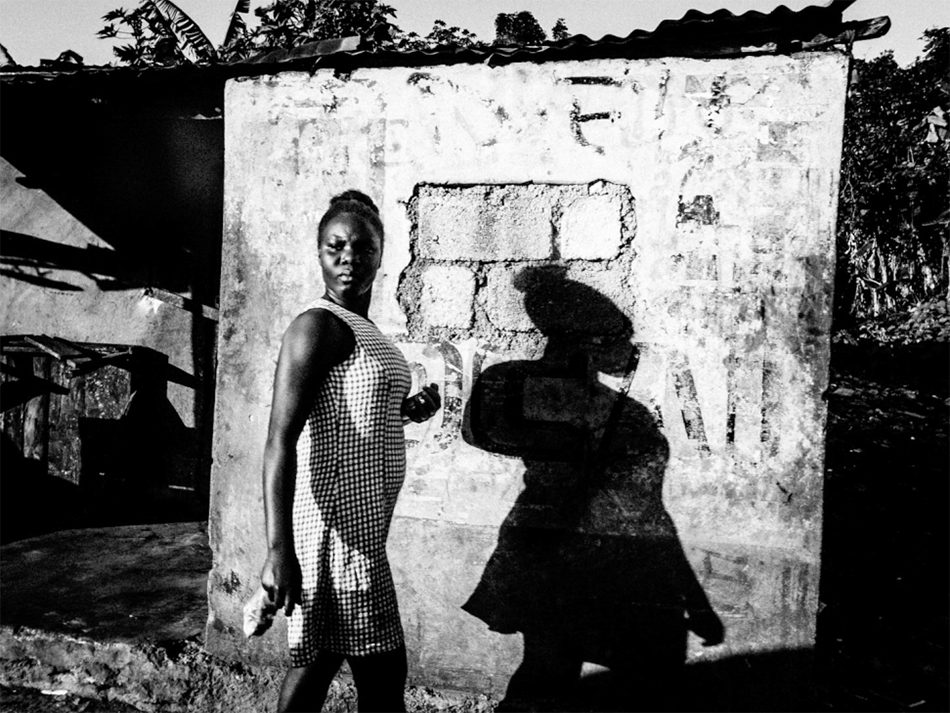
Fix 4: Composition starts with shapes, not people
Strong street photos are built on simple shapes, so train yourself to see the skeleton of a scene first. Everything visual can be reduced to a handful of basic elements such as line, shape, space, color and texture.
My friend Don Springer and I once worked with a group of street shooters, and one of them was a painter. Their photos were ahead of everyone else's. Painters already know that a complex street is made of simple parts.
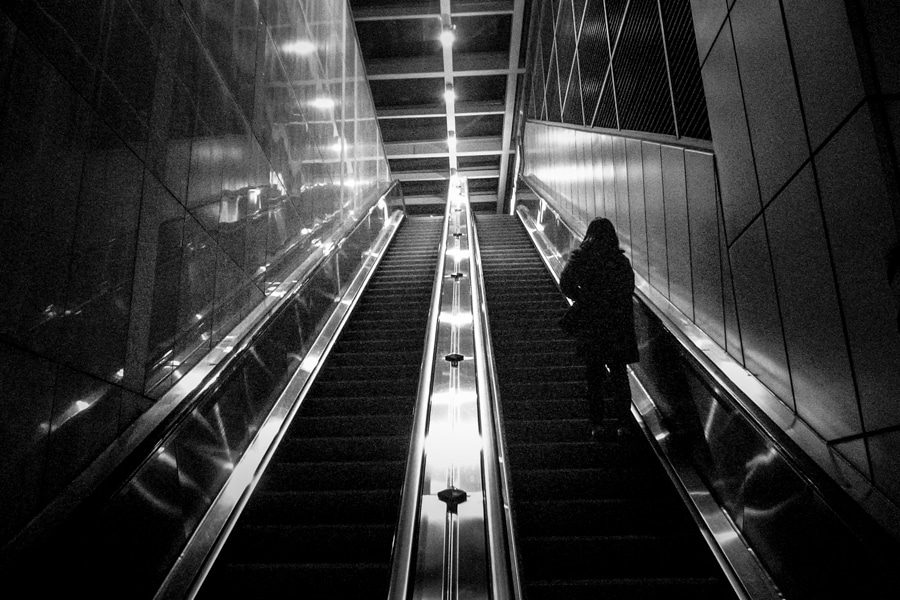
Look for a strong diagonal, a frame inside the frame, a big empty area, or a row of repeated shapes. Then wait for a person to complete it. If you want to go deeper, start with photography composition, then read about leading lines and negative space.
Fix 5: Use contrast and repetition
Contrast is the most powerful visual principle I know: the eye goes where two opposites meet. Light against dark is the easiest one to start with. Big next to small works too, and so does still next to moving.
The opposite trick works as well. The brain loves like with like. When a color or shape repeats, the photo looks composed on purpose. In design this is the law of similarity.
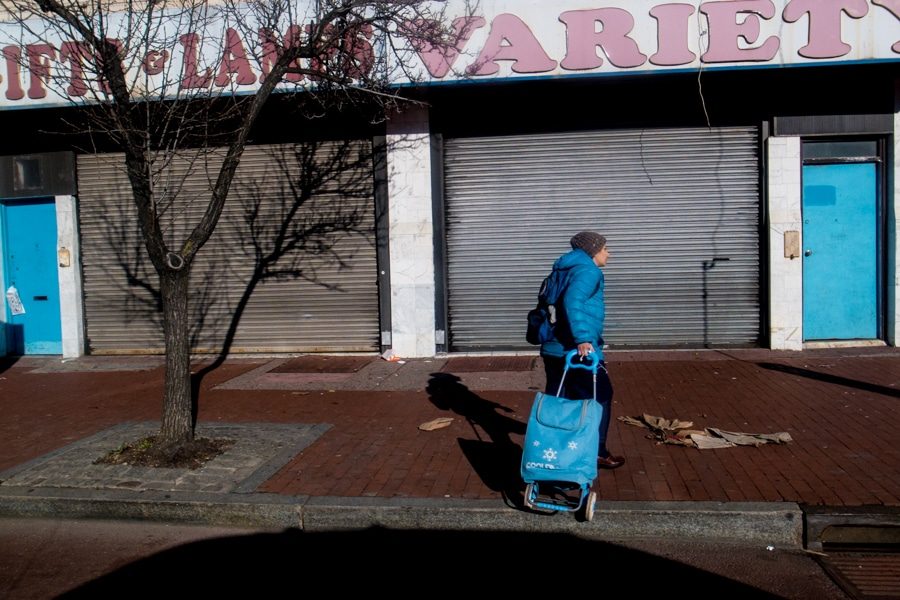
When two things in the frame comment on each other, you get juxtaposition, which is one of the quickest ways out of boring. See juxtaposition photography for examples.
Fix 6: Find the lighting first
Flat light makes flat photos. Look for side light, backlight, hard shadows and pools of light, and your street photography gets depth before you even find a subject.
Street photographers can't wait days for the perfect sunrise the way landscape photographers can. But you can learn to see light. Walk your usual route early and late, and note where the sun cuts between buildings. Lighting is a big part of emotion in a photo, so when you find good light, stay with it.
The word photography means drawing with light. A painter knows paint. A photographer needs to know light the same way. Notice how the light changes from golden hour to noon. Notice where the shadows and highlights fall.
Don't expect editing to rescue a flat frame. One Reddit user said it well: "editing all black and white doesn't make them any better." Lightroom presets and Photoshop can polish a strong photo. They can't add a subject or a moment that was never there. If your exposure settings keep failing you in hard light, my street photography settings guide covers aperture priority and shutter speed.
Fix 7: Set a trap and wait
When a place has good light and a good background but no subject, stay there and wait for the right person to walk in. Most great street photos are one frame from a series, not a lucky single shot.
I call this a trap shot. You can't direct people on the street like in fashion photography. You work with what walks past. So pick your spot, frame the scene, and shoot each person who enters it. Patience is a street photographer's best friend.
Traps also help you build layers, with one subject in the foreground and more people deeper in the frame. That's harder, and it's covered in layering photography.
Fix 8: Shoot what moves you
Photos that are technically perfect can still be boring if you felt nothing when you took them. Shoot the scenes that give you a gut feeling, not the scenes you think street photography is supposed to look like.
This was my biggest mistake. I came from graphic design, so my compositions were clean. In my only photo class, my classmates' pictures were loose and messy, yet they had something mine didn't. It took me years to see it was heart. My photos were cool for one second and then forgotten.
Robert Capa said "If your pictures aren't good enough, you're not close enough." I read it as close to your work, not just close in meters. W. Eugene Smith cared about the people he photographed, and you can see it. Ask yourself what pulls you toward pressing the shutter: the composition, or something you feel? Great photographs have both.
Ansel Adams is a good reminder. As a sick child he read a book about the Sierra Nevada that moved him so much he begged his parents for a trip to Yosemite. He got his first Kodak Brownie there in 1916. His heart was gripped before he knew anything about exposure or composition. The camera only let him show what was already inside.
Fix 9: Edit hard and let photos rest
Showing too many photos makes a good set look boring. Pick only your best, and wait before you judge them, because you are too close to fresh photos to see them clearly.
As a magazine editor I noticed that photographers overrate or underrate about 20% of their own images. They remember how it felt to be there, and the viewer doesn't. I often leave my memory card alone for months. When the high of shooting is gone, I judge much better.
The 80/20 rule applies too. A small share of your frames will carry most of the impact. Show those. If you want a checklist for judging a single frame, read what makes a good photograph.
Is it the camera, the tech side or the subject matter?
It's rarely the camera. A new Ricoh GR or Fujifilm won't fix a frame with no subject, and a boring place is only boring because you're used to it.
I spent about three years and thousands of dollars buying and selling cameras, sure that the next one would make me better. It didn't. Then I stumbled on the cheapest camera I owned, with a fixed lens and a small sensor. I got more creative with it than with all my other cameras combined. If you do want gear advice, the best camera for street photography and the best lens for street photography will help you pick one setup and stick with it.
Ordinary subject matter is not the problem either. William Eggleston made a tricycle and a red ceiling famous. Stephen Shore photographed parking lots and diner breakfasts on his American road trips. Their subjects were plain. Their seeing wasn't. Both helped make color photography accepted as art, with Eggleston's 1976 exhibition at MoMA. Look at their photo books and ask why their least interesting subjects still hold you.
Sometimes the tech side really is the issue. If a lot of your frames are blurry, raise your shutter speed. If faces are lost in shadow, check your exposure. Pick one focal length and learn it well. Once you can use your camera without thinking, you can put all your attention on the street. Learn the basics once, from a book, YouTube or a course, then stop tweaking and start looking.
How to stop taking boring photos for good
Pick one fix per outing instead of all nine. Try shooting for an hour with a single rule and you'll think more creatively, not less. One day look only for verbs. Another day look only for backgrounds. Your brain learns patterns by repetition, the same way you learned to read.
That's the idea behind my online street photography course. It trains picture patterns like intent and the 8 arrangement principles, in short videos with a cheat sheet you can carry on your phone. If you're just starting out, begin with street photography for beginners.
- Name the subject before you raise the camera.
- Wait for a gesture, not just a person.
- Check the background and edges.
- Look for light and shapes first.
- Show fewer, better photos.
Frequently Asked Questions
Why are my street photos boring?
Most boring street photos have no clear subject and no moment. The viewer sees a street with people walking but can't tell what the photo is about. Pick one subject and wait for a gesture or expression. Then move until the background is clean. Good light and simple shapes help too. A new camera rarely changes any of this.
How do I stop taking boring photos?
Decide what each photo is about before you shoot. Look for verbs instead of nouns, meaning actions like a jump or a glance. Check your background and find strong light. Set up a trap where the scene is good, and wait for the right person. Then cull hard and show only your best frames.
Why do my photos look flat?
Photos turn out flat when the light is flat and there is little contrast between light and dark. Shoot early or late in the day, when low side light gives you strong shadows. A small change of angle can separate your subject from the background. Editing can boost contrast, but it can't create depth that wasn't there.
Does black and white make street photos more interesting?
Not by itself. Black and white removes color distractions and can make light and shapes stronger, but it won't add a subject or a moment. Many beginners convert everything to black and white and the photos still lack a point. Decide on black and white when light and form carry the picture, and keep color when color is part of the story.
Will a better camera make my photos less boring?
Almost never. Dull street photos come from what you point the camera at and when you press the shutter. A small camera like a Ricoh GR can help you shoot more often and draw less attention, but it won't choose a subject for you. Learning composition and timing does far more than any upgrade.