
The Gestalt principles in photography are rules for how the brain groups what it sees, and photographers use them so a frame reads at a glance. Figure-ground, proximity, similarity, closure, continuation and common fate explain why some photos feel ordered and others feel like chaos.
I'm Olivier Duong. I came to photography from graphic design, where these laws are taught in the first semester. They're the reason I could compose from my first month with a camera. The street is chaos. The photographer's job is to turn it into order, and Gestalt is the most reliable tool I know for that. Painters used the same laws for centuries before psychologists named them, which is why composition lessons from painters pair well with this guide.
What is Gestalt theory?
Gestalt is German for "form" or "shape", in the sense of a whole configuration. Gestalt psychology started in Germany in the early twentieth century. Max Wertheimer's 1912 paper on apparent motion is usually taken as its starting point. He developed the ideas with his colleagues Wolfgang Köhler and Kurt Koffka.
Their key insight was that we don't perceive a scene as a list of separate parts. The brain organises what it sees into wholes, following predictable rules. Koffka's phrase for this is often quoted as "the whole is other than the sum of its parts."
For a photographer, that is a big deal. It means the viewer's brain will group and complete what's in your frame, planned or not. If you know the rules, you can make it group things the way you want.
Why Gestalt matters in street photography
Someone on Reddit wrote to another photographer: "In too many of your photographs, I struggle to understand what the photograph is about." That is a Gestalt problem. When a frame has no clear figure and no grouping, the viewer's brain can't settle on a reading, so it gives up.
The camera helps you here. It flattens three-dimensional space into two dimensions, so things that are metres apart in real life can touch or overlap in the photo. Gestalt tells you which of those flat relationships the brain will notice.
Research backs this up. A 2023 eye-tracking study by Hsien-Chih Chuang and colleagues in the Journal of Eye Movement Research found that photos built on different Gestalt principles changed how people looked at them. Images using closure produced fewer fixations and more concentrated gaze, and viewers rated them more attractive. Images built on similarity made the eye wander more and felt more complex.
The Gestalt principles photographers use
1. Figure-ground
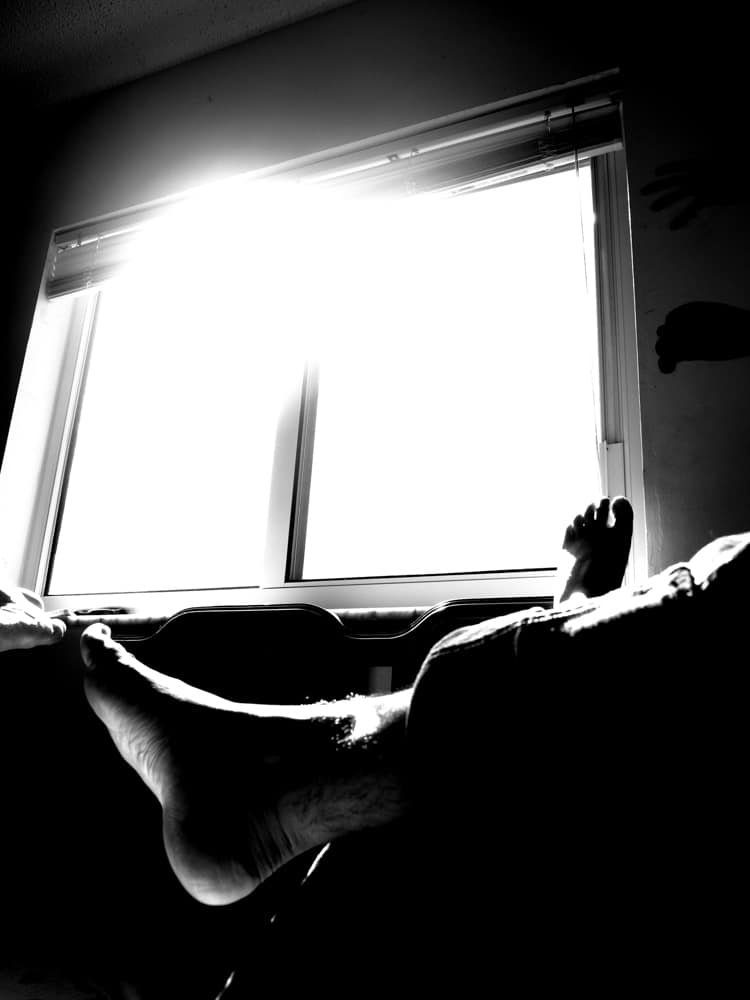
The brain splits every image into a figure (the thing we pay attention to) and a ground (everything behind it). The classic demonstration is Rubin's vase, the drawing that flips between a vase and two faces, associated with the Danish psychologist Edgar Rubin.
In a photo, a strong figure-ground relationship is the first thing that makes a frame readable. You get it through contrast: a dark figure on a light wall, a lit face in shadow, a red coat in a grey street, or a sharp subject against a blurred background with shallow depth of field. Isolation of the subject is the goal. Negative space is figure-ground pushed to its limit.
When figure and ground are ambiguous, the viewer's attention flips back and forth. That can be a playful effect or a confusing mess, depending on your intent.
2. Proximity
Things close together are seen as a group. Two strangers standing near each other look like they belong together. A person standing near a poster seems to relate to it.
This is the engine of juxtaposition. By changing your position so two elements touch or sit side by side in the frame, you create a relationship the viewer reads instantly. Move so they separate and the relationship disappears.
3. Similarity
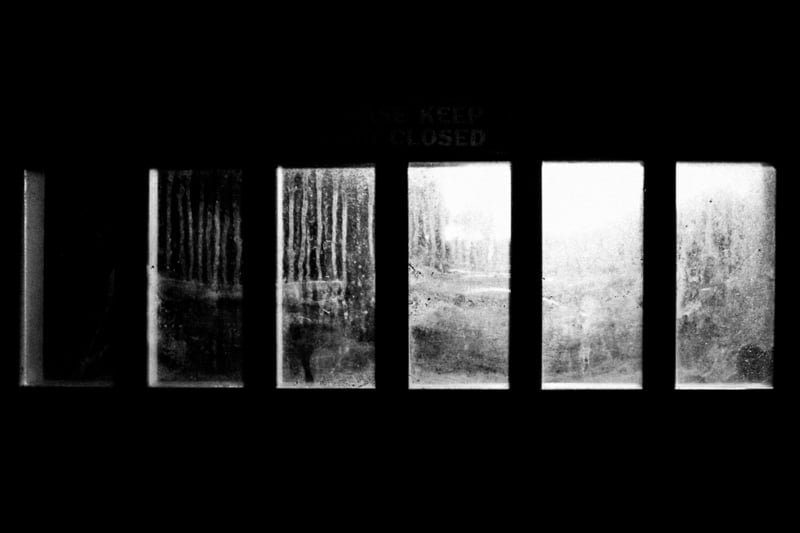
Things that look alike, in shape, colour, size or tone, are grouped together, even when they're far apart in the frame. This is the law of similarity, what I call "like with like." Rows of windows, matching coats, a hat that echoes a dome in the background.
Similarity also lets you break the pattern on purpose. One element that differs from a group of similar ones grabs the eye straight away. A single person in a red jacket among grey commuters is similarity used in reverse.
4. Closure
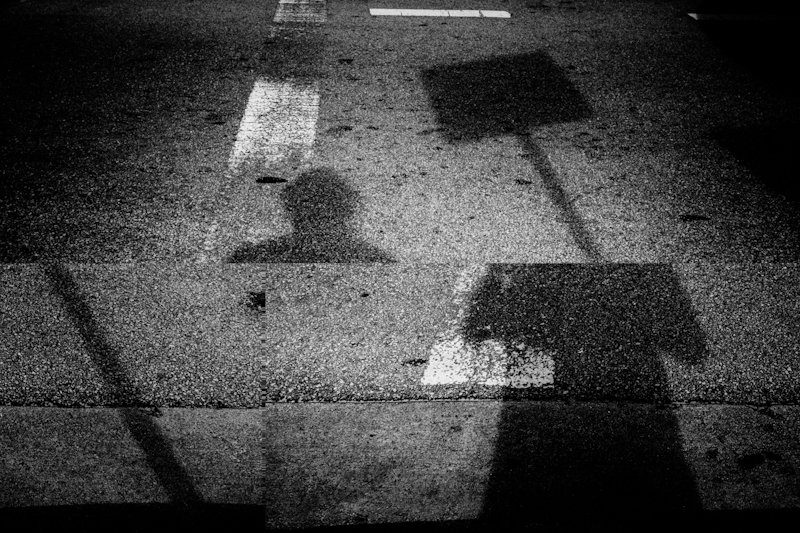
The brain fills in gaps to complete a familiar shape. A partly hidden circle still reads as a circle. Two shadows at the edge of the frame imply a person you don't see.
Closure is why you can crop a subject tightly without losing it, and why implied shapes feel satisfying. The eye-tracking study above found closure images were the easiest to look at. Shadows are a great way to practise it: the viewer completes the missing figure.
5. Continuation
Continuation, also called continuance, says the eye follows lines and curves, and prefers to keep going in the same direction. That's why leading lines work. It also means a line that is interrupted draws attention to whatever breaks it.
Lee Friedlander used this well. In some of his reflections, strong vertical lines run through the frame and he places himself exactly where the brain expects continuity, so his figure breaks the pattern and becomes the point of the picture.
6. Common fate
Elements moving in the same direction are grouped together. A crowd all walking left reads as one mass. One person walking against them stands out.
On the street, common fate is everywhere: commuters at a crossing, birds taking off, cars at a light. Look for the one element that doesn't share the fate.
7. Prägnanz (simplicity)
The law of Prägnanz says the brain interprets things in the simplest form it can. Given a complicated scene, it reduces it to basic shapes and lines. That's why simple compositions read fast and busy ones feel tiring.
Your job isn't to find simple scenes. It's to find the simple structure inside complicated ones, so the viewer's brain can do its simplifying quickly.
Other Gestalt ideas: symmetry, emergence, segregation and visual weight
Some guides add more principles. A few are worth knowing:
- Symmetry and order. Symmetrical elements are seen as belonging together and feel stable. A centred subject in a symmetrical doorway is symmetry at work.
- Emergence. Sometimes a shape only appears after you look for a while. Friedlander has a photo where a sign and a cloud form an ice cream cone. You don't see it at first, then you can't unsee it.
- Segregation. The subject has to be separated from its surroundings to be seen, which is figure-ground again, applied to small subjects in big scenes.
- Visual weight. Not a Gestalt law, but related. Some elements pull the eye harder than others: faces, bright areas, warm colours, text, high contrast. Balance a frame by weighing these against each other.
How to use Gestalt principles on the street
- Start with figure-ground. Before anything else, ask what your figure is and whether it separates from the ground. If it doesn't, change your angle, find a plain background, or wait for better light.
- Move to control proximity. One step left or right changes what touches what. Use it to create relationships or to separate things that shouldn't merge, like a pole behind a head.
- Hunt for similarity. Look for repeated shapes or poses. Then wait for someone who either fits the pattern perfectly or breaks it.
- Use lines for continuation. Place your subject where lines lead or where a line breaks. See also framing, which uses closure and continuation together.
- Simplify. Remove anything that doesn't belong to the main grouping. Step closer or use shadow to hide clutter.
- Stack principles. The strongest frames use several at once. Figure-ground separates the subject. Similarity builds a pattern around it and continuation leads the eye there.
Gestalt and the other rules of composition
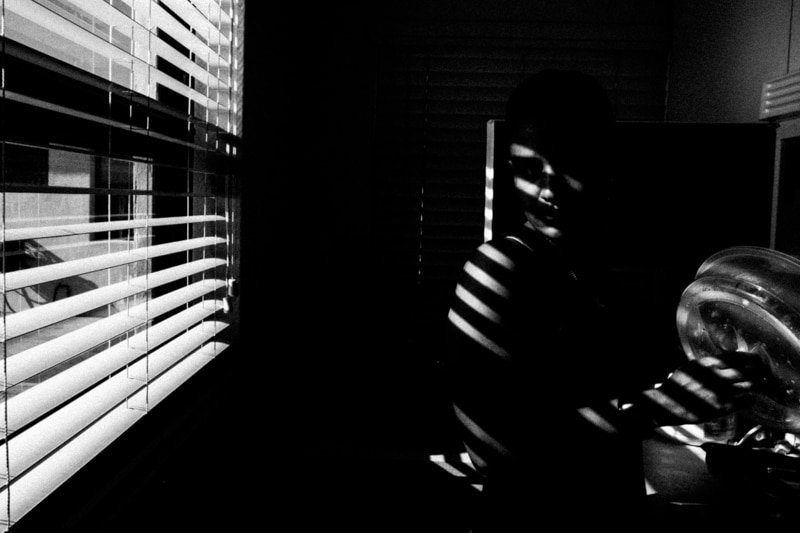
Gestalt isn't separate from the composition rules you already know. It explains why they work.
- Layering is figure-ground repeated at several depths.
- The rule of thirds works partly because it creates visual tension and stops the frame feeling static.
- Repetition, one of the principles in the free sample lesson, is similarity in action.
- The elements of photography (line, shape, colour, tone and so on) are what the brain groups. Gestalt describes how it groups them.
I sum up composition as visual elements multiplied by arrangement principles. Gestalt covers a big share of the arrangement side. The photography composition hub puts all of it together.
Learn the psychology behind your photos
Phototactic, my street photography course, teaches composition through the laws the brain actually uses: the law of proximity, the law of similarity, mid-point tension and frame dynamics, among others. One bonus covers 18 psychological principles every photographer should know, and another walks through critiques of 10 winning images so you can see these laws at work.
It's a video course you work through on your own. It doesn't include feedback on your own photos.
Frequently Asked Questions
What are the Gestalt principles in photography?
They're rules from Gestalt psychology about how the brain groups visual information. The main ones photographers use are figure-ground, proximity, similarity, closure, continuation, common fate and Prägnanz (simplicity). Knowing them helps you compose frames that viewers understand at a glance, because you're working with how perception already operates.
Who created Gestalt theory?
Gestalt psychology was developed in Germany in the early twentieth century by Max Wertheimer together with Wolfgang Köhler and Kurt Koffka. Wertheimer's 1912 paper on apparent motion is usually treated as the start of the movement. Later researchers such as Edgar Rubin added ideas like the figure-ground distinction.
What is figure-ground in photography?
Figure-ground is how the brain separates the subject you pay attention to (the figure) from everything behind it (the ground). Photographers strengthen it with contrast in tone or colour, shallow depth of field, clean backgrounds and good light. When figure and ground are unclear, the viewer struggles to know where to look.
What does 'the whole is other than the sum of its parts' mean?
It's a phrase attributed to Kurt Koffka. It means the brain perceives an arrangement as a whole with its own qualities, not as a collection of separate pieces. In a photo, the relationships between elements create meaning that no single element has on its own.
How is Gestalt different from the rule of thirds?
The rule of thirds is a placement guideline. Gestalt is a set of perception laws that explain how viewers group and read what's in the frame. You can follow the rule of thirds and still have a confusing photo if figure-ground or grouping is weak. Gestalt tells you why a frame reads or doesn't.