
To capture emotion in street photography, watch people's hands and faces mid-action and wait for the peak of the gesture before you press the shutter. Get close enough for that gesture to fill the frame. Emotion lives in gesture, and gesture lasts a fraction of a second.
I'm Olivier Duong. For years my photos were compositionally perfect and emotionally empty. My classmates' pictures were loose, yet they had something mine didn't. It took me years to understand what it was: the heart. This guide is what I wish I'd known then.
Why emotion matters more than composition
A reader on Reddit summed up the problem: "Taking photos of people walking to somewhere? and editing all black and white doesn't make them any better." They're right. A person walking is a noun. A person laughing, reaching, flinching or embracing is a verb, and verbs are what make a viewer feel something.
I think of every photograph in terms of the Eye, the Heart and the Mind. The Eye is composition. The Mind is the thought and the technical execution. The Heart is emotion. Great street photographs have all of them, but if I had to keep only one, I'd keep the heart. Some photos are technically perfect and do nothing for you. Emotion beats logic.
I keep coming back to one rule: what we feel while looking at a photograph is roughly proportional to what the photographer felt when making it. Photography is a transfer of feelings. If you felt nothing, the viewer won't either.
What is gesture in photography?
Gesture is any movement or position of the body that suggests something about what a person is feeling or doing. Hand signals count, but so does the way someone leans, turns their head, grips a bag, or holds a child.
In street photography, gesture does two jobs at once:
- It carries emotion. A clenched hand or a head thrown back in laughter tells the viewer how that person feels without a caption.
- It carries composition. An outstretched arm is a line. A bent body is a shape. A gesture can point the eye across the frame or echo something in the background.
The photographer James Maher, writing for Digital Photography School, describes gesture as any movement or position of a subject's body that is suggestive in some way. I like that word, suggestive. The best gestures don't spell out the story. They hint at it and let the viewer finish it.
Where emotion shows on the street
When you're on the street, train your eye to scan a handful of places.
Eyes and mouth
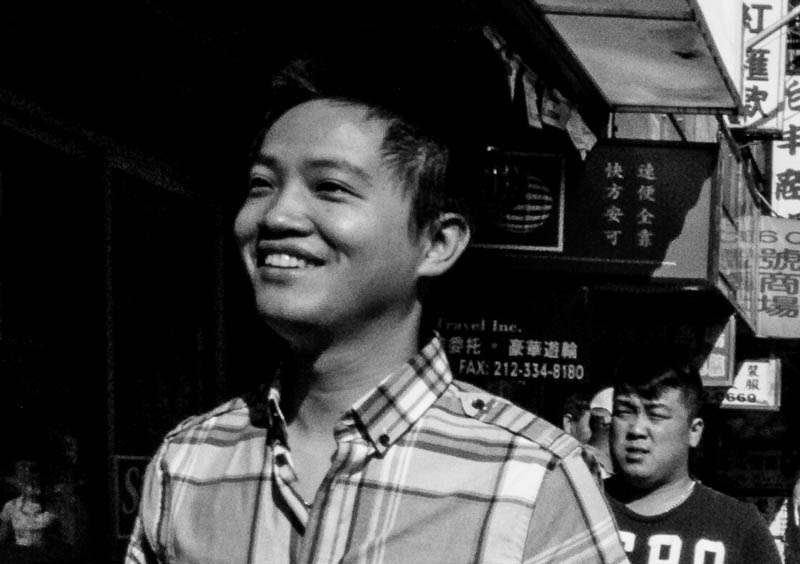
Facial expressions are the fastest read in any photograph. Psychologist Paul Ekman's research found that some basic expressions, like happiness, sadness, fear, anger, surprise and disgust, are recognised across very different cultures. That's useful for you: a clear expression reads for almost any viewer. Watch the eyes especially. A genuine smile creases the corners of the eyes, not just the mouth.
Hands
Hands are the most underrated source of emotion on the street. They grip, point, cover faces, hold other hands. I once looked at a photo of a couple and the whole story was in her grip on his arm: both hands, very tender. You didn't need to see her face.
The whole body
Posture tells you about mood from a distance. Hunched, stretched, leaning in, turning away. A body that's mid-stride or mid-jump shows energy even when the face is hidden.
Interaction between people
Two people reacting to each other is often stronger than one person alone, because the connection between them adds context. A glance between strangers. Friends sharing a joke. The emotion lives in the space between them.

How to capture emotion in street photography: practical steps
- Look for verbs, not nouns. Before you raise the camera, ask what the person is doing or feeling, not just what they look like. An interesting-looking person doing nothing is usually a weak photo.
- Go where emotion happens. Markets, festivals, fairs, playgrounds, sports events, protests, arrivals halls at airports and train stations. People show feelings openly in these places.
- Get close enough. A gesture that fills a quarter of the frame reads. One that fills a thumbnail doesn't. A 28mm or 35mm lens used at a few metres works well. My lens choices are in best lens for street photography.
- Pre-set everything. Emotion doesn't wait for autofocus. Use zone focus and a shutter speed of at least 1/250s so you can react instantly. See street photography settings.
- Anticipate the peak. Laughs build. Arguments escalate. Hugs close in. Watch the build-up and press just before the peak so the camera catches it.
- Stay after the first frame. Emotions come in waves. Keep shooting through the moment and after it. This is working the scene applied to people.
- Frame for the gesture. Once you see the main hand or face, compose around it. Give it clean space, keep it away from the frame edges, and avoid cutting through it.
The decisive moment is an emotional moment
Henri Cartier-Bresson described photography as recognising, in a fraction of a second, "the significance of an event as well as of a precise organization of forms." Most people remember the forms. The significance is the emotion.
My own version of the decisive moment is the point where the eye, heart and mind line up in one frame. Composition gives the photo order. Emotion gives it a reason to exist. When both peak together, the world seems to slow down and you press the shutter.
That's why timing in street photography is really about emotion. A few frames either side of the peak and the expression is neutral, the hand is down, the look has passed.
Photographers to study for emotion and gesture
- Henri Cartier-Bresson. Gesture inside tight geometry. Look at how a single raised arm or leaping body completes the composition.
- Helen Levitt. Her photographs of children playing on the streets of New York in the 1940s are full of theatrical gesture and play. Her book A Way of Seeing, with a text by James Agee, is full of lessons in body language.
- Josef Koudelka. His images of the 1968 Soviet invasion of Prague and his work on Roma communities are raw with feeling. I've written about his approach in my Josef Koudelka profile.
- W. Eugene Smith. He genuinely cared for the people he photographed, and it shows. The heart transcends the frame.
- Elliott Erwitt. Proof that emotion includes humour. His timing with people and dogs is a lesson in reading a scene for a laugh.
When you study their work, don't just look. Name the gesture in each frame and ask where it sits in the composition. That habit is how you start seeing gestures on the street.
Get emotionally closer, not just physically closer
Robert Capa said: "If your pictures aren't good enough, you're not close enough." Most people read that as physical distance. I read it differently. Get closer to your work. Feel it, question it, care about what you're shooting.
Getting physically close to a stranger doesn't make a picture meaningful on its own. A bad picture taken from 50 centimetres is still a bad picture. What changes your photos is being connected to the people and places you photograph. That's why photos of your own family and neighbourhood often carry more feeling than photos from a trip.
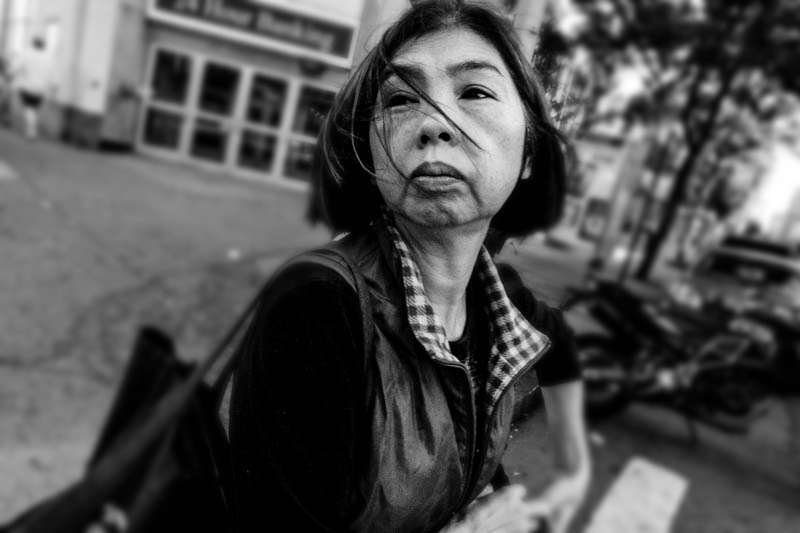
On the street, this means shooting because the scene gives you a gut feeling, not because it looks like what street photography is supposed to look like. Always check what's pulling you towards the shutter button. Is it a composition, or is it your heart? Great photographs have both.
Using light and colour to support emotion
Gesture is the main carrier of emotion, but light and tone set the mood around it.
- Hard light and deep shadows add drama and tension. See light and shadow photography.
- Low-key images (mostly dark tones) lean towards mystery or melancholy. High-key images (mostly light tones) feel softer and calmer.
- Black and white strips a scene back to gesture and tone, which can make emotion feel more universal. But converting a flat photo to monochrome won't add feeling that wasn't there. More in black and white photography.
- Colour brings its own emotional charge: warm light feels intimate, cold blue light feels distant.
Emotion and ethics
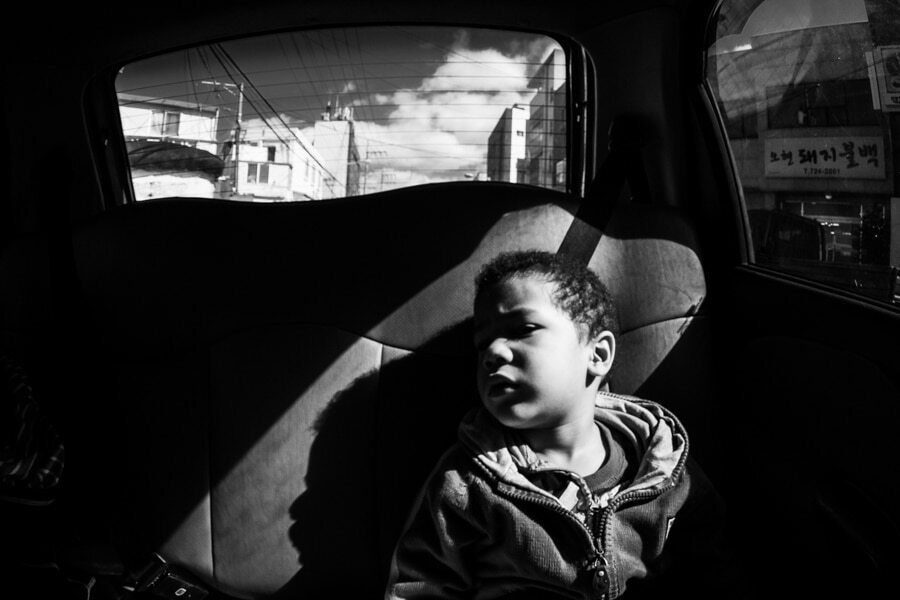
Strong emotion often means vulnerable moments. Grief or anger in public raises real questions. My rule is simple: if the photo would humiliate the person rather than show something human, I don't take it or I don't publish it. Joy, tenderness, concentration and wonder are just as emotional and far easier to share.
If someone reacts to your camera, be open and friendly. My guide to photographing strangers covers what to say. For the broader debate, read is street photography creepy?
How the course covers emotion
Emotion has its own module in Phototactic, my online street photography course. It shows how to put emotion in your images so they touch the viewer, alongside the composition modules that give those moments a strong frame. The bonus shooting demo lets you watch how I anticipate moments on the street.
It's a self-paced video course with no personal feedback on your photos. For the other side of the equation, read the photography composition guide and candid photography.
Frequently Asked Questions
How do you capture emotion in street photography?
Watch faces and hands mid-action. Get close enough that the gesture reads clearly and press the shutter just before the peak. Pre-set zone focus and a fast shutter speed so you can react instantly. Go where people show feelings openly, like markets or festivals, and keep shooting through the moment.
What is gesture in street photography?
Gesture is any movement or position of the body that suggests what a person feels or is doing, from a raised hand to a slumped posture. It carries emotion and it also acts as a compositional element, a line or shape that guides the eye through the frame.
Why do my street photos have no emotion?
Usually because the people in them are doing nothing in particular, or they're too small in the frame for their expression to read. Look for verbs instead of nouns. Get closer and wait for the peak of a gesture. Editing in black and white won't add emotion that wasn't captured in the moment.
Which photographers are known for emotion in street photography?
Helen Levitt for the play and gesture of children in 1940s New York, Josef Koudelka for his raw images of Prague in 1968 and of Roma communities, W. Eugene Smith for his empathy, and Elliott Erwitt for humour. Henri Cartier-Bresson shows how gesture works inside precise composition.
Is it ethical to photograph strangers showing strong emotion?
It depends on the moment and how you use the image. Joy and tenderness are rarely a problem. Grief or humiliation calls for more care. A good test is whether the photo shows something human or exploits someone at their worst. When in doubt, don't publish it.