
Josef Koudelka is known for dramatic black and white photographs of Roma communities and the 1968 Soviet invasion of Prague, shot close with wide lenses. The move you can use is to get close with a wide angle and build the frame around emotion, so the feeling hits before the viewer reads the details.
I'm Olivier Duong. I teach street photography, and Koudelka is who I point to when someone's photos are clean but leave people cold. His pictures are about feeling first. The composition serves the emotion, never the other way around.
What is Josef Koudelka known for?
Josef Koudelka is a Czech-French photographer and a member of Magnum Photos. His photographs of the 1968 Soviet invasion of Prague became international symbols. Gypsies (1975) documents Romani people in Czechoslovakia and across Europe in the 1960s. Exiles (1988) collects the years he spent wandering Europe after leaving his country. Since 1986 he has also worked with a panoramic camera, photographing landscapes marked by people: industrial ruins, ancient ruins, walls and wasted land. These later photographs usually have no people in them at all.
What ties it together is emotion. Desolation and alienation run through his work, yet you often feel a stubborn hope too. The Magnum biography calls him part of "the humanistic and poetic tradition of European photography".
Josef Koudelka's life: engineer, theatre, invasion, exile
Josef Koudelka was born on 10 January 1938 in Boskovice, a small town in Moravia, Czechoslovakia. He began photographing his family with a 6×6 Bakelite camera. He studied at the Czech Technical University in Prague from 1956, graduated in engineering in 1961 and worked as an aeronautical engineer in Prague and Bratislava.
Theatre photography
In the 1960s he took commissions from theatre magazines and regularly photographed productions at Prague's Theatre Behind the Gate (Divadlo za branou), the company led by director Otomar Krejča, using a Rolleiflex. Theatre taught him to see gesture and drama. You can feel that stage sense in his street work.
The Gypsies project
From 1962 to 1971 he travelled every summer to photograph Roma communities in Czechoslovakia, including Slovakia, and in Romania, Hungary, France and Spain. He carried a rucksack and slept in the open air, close to the nomadic life he photographed. In 1967 he gave up engineering to be a photographer full time.
Prague, August 1968
He came back from photographing in Romania just two days before the Soviet Union and other Warsaw Pact armies invaded Czechoslovakia in August 1968 to crush the Prague Spring. He photographed the invasion in the streets of Prague for a week. His negatives were smuggled out to Magnum and published anonymously in The Sunday Times Magazine, credited only to "P.P." (Prague Photographer), to protect him and his family. In 1969 the Overseas Press Club awarded the "unknown Czech photographer" the Robert Capa Gold Medal. His name was only attached to those pictures publicly years later; a 1984 exhibition at the Hayward Gallery in London credited him for the first time.
Exile
With Magnum's help he left for England in 1970, during the crackdown that followed the invasion, on a working visa and applied for political asylum. He joined Magnum as an associate in 1971 and became a full member in 1974. For years he wandered Europe with his camera and little else. Henri Cartier-Bresson was a friend and supporter. He became a French citizen in 1987 and could only return to Czechoslovakia in 1990.
Panoramas and later work
Back home he made Black Triangle, panoramic photographs of a wasted industrial landscape at the foot of the Ore Mountains. Chaos (1999) gathered his panoramic landscapes. Wall (2013, Aperture) shows Israel and the West Bank, made for the This Place project organized by photographer Frédéric Brenner. He divides his time between France and Prague.
Josef Koudelka's cameras and wide angle style
For the invasion he used an Exakta Varex with a 25mm Flektogon wide-angle lens, loaded with East German movie film, according to most accounts of those days. The same kind of wide setup shaped the intense, close pictures in Gypsies. Later he moved to a Leica with 35mm and 50mm lenses, and for his panoramic landscapes he used panoramic cameras, including a Fuji GX617.
What matters for you is how he used the wide lens. He didn't stand back and fit everything in. He got close, so a face or a hand fills the foreground while the scene around it adds meaning. Wide lenses tilt and stretch things near the edges. He used that tension on purpose to make frames feel unstable and charged.
If you want to try the same look, a 24mm or 28mm equivalent is a good start. My guide to the best lens for street photography compares focal lengths and how close each one forces you to get.
Three Josef Koudelka photographs and the move each one shows
I don't reproduce his photographs here. They're protected, and you can see them at Magnum Photos and the Josef Koudelka Foundation. Look each one up as you read.
Wenceslas Square, Prague, August 1968
An arm with a wristwatch reaches into the foreground. Behind it lies an almost empty square. People had chosen not to gather, so the occupiers would have no reason to shoot. You don't see a single soldier. The watch marks the moment. Koudelka later made it the first picture in Exiles and said it is symbolic of that book. The move: tell a big story with one small, close foreground detail and let the empty space carry the emotion.
The dog in the snow, the cover of Exiles
A black dog on a snowy field in France, alone in a white, desolate space. Many people read it as a portrait of Koudelka himself, rootless and drifting. The move: a single dark shape in a lot of white. It is negative space used for feeling, not decoration.
Gypsies, Jarabina and other villages
The Roma photographs from Slovakia and Romania are packed and close. Faces, hands and bodies crowd the frame, often at strong angles, with deep blacks. Look through the Magnum selection for the frames made in Jarabina, Slovakia. The move: get inside the scene instead of watching from the edge. Emotion comes from proximity.
Steal this move: close, wide and emotional
This exercise borrows Koudelka's approach. It's about feeling first and framing second.
- Use one wide lens for a month. A 24mm or 28mm equivalent, nothing else. I've written about limitation creativity before: fewer choices push your brain to solve problems with what you have.
- Pick a group, a place or a ritual you can return to. A market, a church, a fair, a neighborhood. Koudelka went back to the same communities summer after summer.
- Get close enough that a gesture fills the foreground. A hand or a face. Keep the context behind it.
- Look for the feeling before the frame. Ask what the scene feels like: grief, joy, tiredness, defiance. Then compose to push that feeling.
- Edit hard in black and white. Deep blacks and strong contrast suit this kind of picture. Keep only the frames with emotion.
Be respectful. Getting close is not the same as being pushy. My guide on how to photograph strangers covers how to do it calmly, and street photography law varies by country, so check whether street photography is legal where you shoot.
My take on the idea
My own street photography is not like Koudelka's. I don't have his decades with one community. But his work taught me that emotion is a separate part of a picture, and you can work on it on purpose.
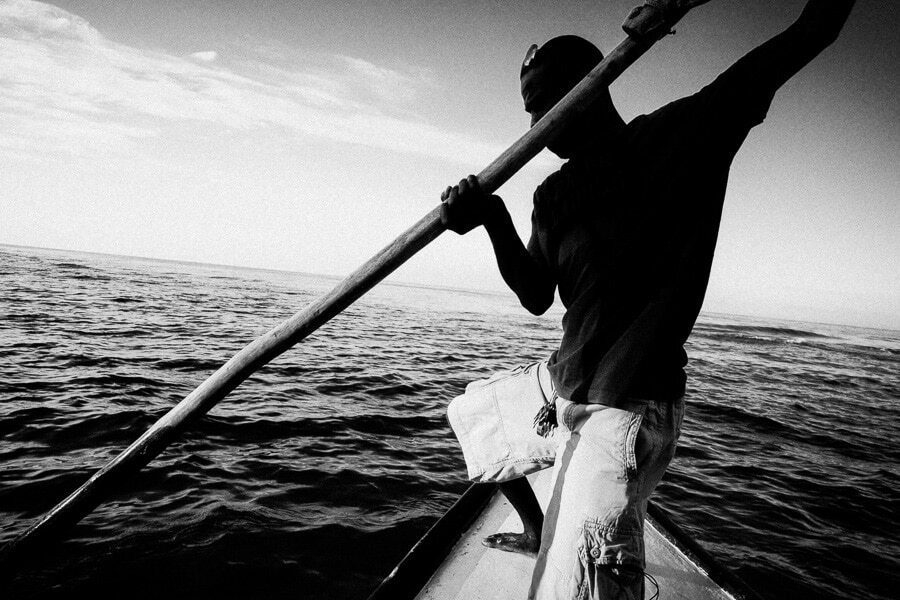
In the frame above the wide lens and the low angle make the man's effort feel bigger than life. The composition is simple. The emotion is the tension in his body against the sea.
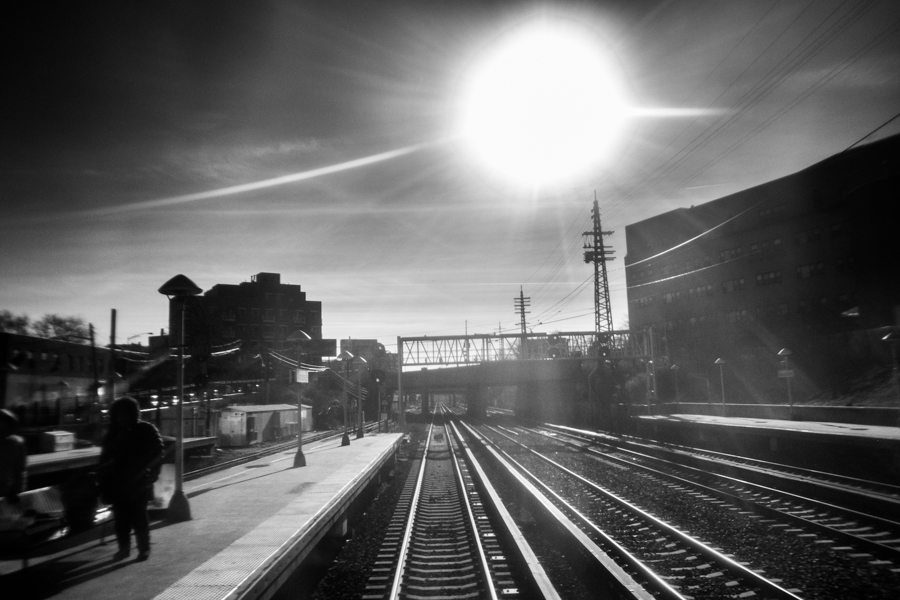
This one has nobody in it, like Koudelka's later landscapes. The tracks and the light carry the mood: departure, distance, going somewhere you can't see yet.
In my teaching I use a framework I call the Eye, Heart and Mind of a photograph. The Heart is the emotional part. For years my own pictures were clean and well composed but had no punch. It was my friend Don Springer who made me see that the Heart part was missing. Koudelka is pure Heart, backed by a strong Eye. For more on this, read what makes a good photograph.
Why Koudelka matters for street photographers today
Many street photographers feel their work looks like everyone else's. A lot of that comes from photographing surfaces: people walking in nice light. Koudelka shows another way. Commit to a subject for years and let what you feel about it shape the frame.
He also shows that a photographer can change form. He went from theatre and Roma villages to panoramic landscapes without people. The constant is the intensity. As he put it to Magnum: "The maximum, that is what has always interested me."
In my online street photography course, Phototactic, one module is about putting emotion in your images, alongside composition and the picture patterns that make a frame work. It's a video course. There is no feedback on your own photos, so the commitment part is yours. For more masters, see my list of famous street photographers, and for another take on timing, read about the decisive moment.
Josef Koudelka books, awards and exhibitions
| Book | Year | What it covers |
|---|---|---|
| Gypsies (Aperture) / Gitans: la fin du voyage (Delpire) | 1975 | Roma communities in the 1960s |
| Exiles | 1988 | His years wandering Europe after 1970 |
| Chaos | 1999 | Panoramic landscapes |
| Invasion 68: Prague (Aperture) | 2008 | The full record of the invasion |
| Wall (Aperture) | 2013 | Israeli and Palestinian landscapes |
| Ruines | 2020 | Ancient ruins around the Mediterranean |
His awards include the Prix Nadar (1978), the Grand Prix National de la Photographie, the Grand Prix Henri Cartier-Bresson (1991) and the Hasselblad Foundation International Award in Photography (1992). The Museum of Modern Art gave him a show in 1975. Later exhibitions ran at the Stedelijk Museum Amsterdam, the Palais de Tokyo in Paris, the International Center of Photography in New York and the Centre Pompidou, which has shown an exhibition on the making of Exiles. If you visit Prague, my Prague street photography guide covers the city where the invasion pictures were made.
His line "The maximum, that is what has always interested me" is in my collection of street photography quotes. More photobooks to study are in my list of the best street photography books.
Frequently Asked Questions
What camera did Josef Koudelka use?
For the 1968 invasion of Prague, Koudelka used an Exakta Varex with a 25mm Flektogon wide-angle lens, according to most accounts. He photographed theatre with a Rolleiflex, later used Leica cameras with 35mm and 50mm lenses, and has made his landscape work since 1986 with panoramic cameras such as the Fuji GX617. The wide, close framing matters more than the brand.
Who is Josef Koudelka?
Josef Koudelka is a Czech-French photographer, born in 1938 in Boskovice, Czechoslovakia, and a member of Magnum Photos. Trained as an aeronautical engineer, he became known for his photographs of the 1968 Soviet invasion of Prague and for the books Gypsies and Exiles. He left Czechoslovakia in 1970, received political asylum in England and became a French citizen in 1987.
What awards has Josef Koudelka received?
Koudelka received the Robert Capa Gold Medal in 1969, anonymously, for his Prague invasion photographs. He later won the Prix Nadar in 1978, the Grand Prix National de la Photographie, the Grand Prix Henri Cartier-Bresson in 1991 and the Hasselblad Foundation International Award in Photography in 1992. He was also made a Commandeur of the Ordre des Arts et des Lettres in 2012.
What are Josef Koudelka's most famous photographs?
The most famous include the arm with a wristwatch over an empty Wenceslas Square in Prague in August 1968 and the black dog in the snow on the cover of Exiles. The close, crowded pictures of Roma life from Gypsies are just as well known. His panoramic landscapes from Chaos and Wall are also widely shown. Magnum Photos has a good online selection.
What is Josef Koudelka's photographic style?
His style is high contrast black and white, often shot close with a wide-angle lens, with strong diagonals and figures crowding the frame. Emotion leads the composition. Themes of exile and endurance run through his work. Since 1986 he has also made panoramic landscapes, usually without people, that show land damaged or shaped by human activity.