
Working the scene means staying with a promising scene and shooting variations as people pass, instead of taking one frame and walking away. The first frame tells you there is a picture here. The frames after it are where you actually find it.
I'm Olivier Duong. When people send me street photos that feel flat, the problem is rarely the camera. Usually they saw something good and took one shot. On Reddit someone put it better than I can: "I usually just frame the shot and take the picture, so maybe that's why my photos lack a story." This guide shows what to do instead, from choosing the spot to knowing when to leave.
What does "work the scene" mean in photography?
To work a scene is to treat a good location as a problem you solve over several minutes, not a snapshot you grab in one second. You keep the camera up. You change where you stand and when you press. You let the street feed you new subjects until one frame has everything.
The phrase comes from photojournalism and documentary work, but it matters most in street photography because you can't direct anyone. In a studio you move the model. On the street the only things you control are where you stand and when you press the shutter. Working the scene is how you get the most out of both.
A good way to think about it: the first frame is a sketch. It records the idea. Every frame after it refines the composition and the timing until the idea is fully drawn.
Why your best photo is rarely your first frame
Look at the contact sheets of the great photographers and you see the same pattern. The famous frame sits in the middle of a run of near misses. The book Magnum Contact Sheets, edited by Kristen Lubben, shows exactly this for Henri Cartier-Bresson and many other Magnum photographers: the picture everyone knows was one of several attempts at the same scene.
There are a few reasons the first frame is weak:
- You haven't read the scene yet. You don't yet know where people will walk or what the background is doing.
- The subject isn't right. Often the location and the light are perfect for a shot. It's just that the person in it is not quite right.
- Your composition is loose. On the first frame you frame the obvious thing. After a few frames you start seeing the edges and the shapes.
- The moment hasn't happened. A gesture or a shadow lining up can take minutes to arrive.
This is also why a low street photography hit rate is normal. Working a scene means more frames per keeper, and that is fine. Storage is cheap. Missed moments are not.
Hunting vs fishing: two ways to work a scene
Street photographers talk about two approaches, and working the scene applies to both.
Hunting is walking and reacting. You see something, you follow it for a few seconds and shoot a burst of variations as it unfolds. You work the scene on the move: step closer, change angle, shoot again before it's gone.
Fishing is picking a spot and waiting for the subject to walk in. You find a strong background or a patch of light, then you stay. People come and go. You shoot the ones that fit. I call this setting up a trap shot, and it's one of the most practical things I teach. If you go somewhere and you can feel there's something there but not quite, set up camp for a few minutes.
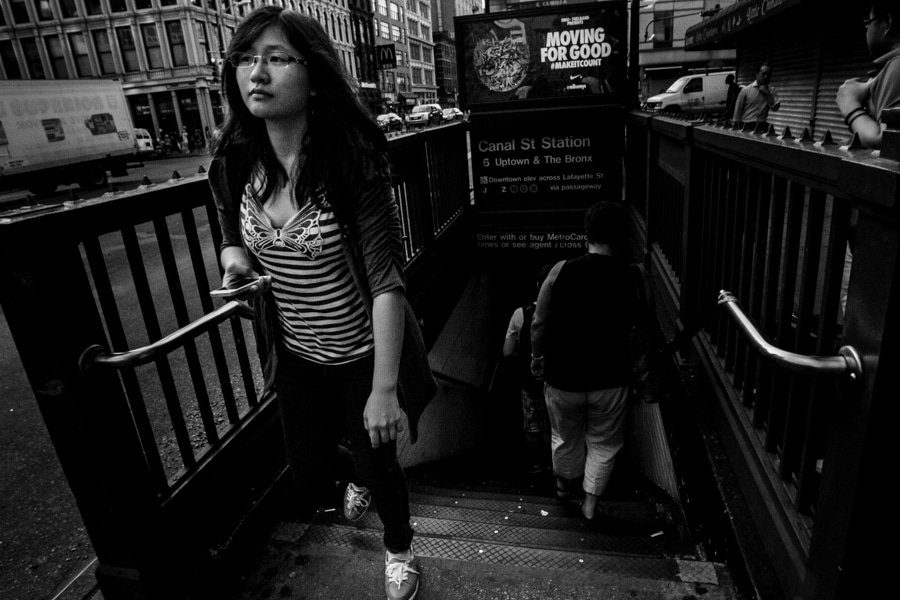
Eric Kim gives the same advice in his guide to working the scene: don't take one or two photos and run away. Keep lingering, because you won't know which frame is best until you see them at home.
Patience is a street photographer's best friend. A lot of the street shots you admire could look like one-off shots, but often enough each one is a single frame from a series with various subjects coming in and out of view.
How to work the scene, step by step
I go through the same steps whenever a scene grabs me, hunting or fishing.
- Take the first frame immediately. Don't think. Secure the sketch before the scene changes. Everything after it is a bonus.
- Ask what pulled you in. Was it the light, a shape, a person, a colour clash? Name it. That's the thing you're going to refine.
- Move your feet. Change your perspective: step forward, back, left, right. Crouch. Stand on a step. A small change in position changes how the elements overlap and can clear a messy background.
- Change the framing. Try vertical and horizontal. Put the subject on a different third. Use a doorway or a gap between people as a frame. See framing in photography for ideas.
- Add or remove layers. Include something in the foreground, then take it out. Look for a second subject in the background. This is where layering and juxtaposition happen, almost never on the first frame.
- Watch the light. If the light is the reason you stopped, wait for people to step into it. Shadows move, clouds pass. Five minutes can change everything, as I explain in light and shadow photography.
- Wait for the gesture. Once the frame is set, stop fiddling and watch for a hand or a stride. That's the decisive moment, and working the scene is how you put yourself in its path.
- Shoot through the peak. Press slightly before the action peaks and keep going through it. A short burst helps here, but single frames with good timing work too.
None of this has to take long. A small scene can be worked in a minute. A great one can deserve twenty.
What to look for in a scene worth working
Not every scene deserves ten minutes. The ones that do usually have something fixed that will stay put while you wait for something moving to arrive.
- Strong light. A patch of sun in a dark street, or a lit window at dusk.
- A clean background. A plain wall or a big shadow. Something that makes any passing person stand out.
- A natural frame or stage. A doorway, a subway exit, a bus stop, a crossing. Places where people keep arriving in the same spot.
- A graphic element. Leading lines, or a shape that a person could echo or complete.
- Constant foot traffic. The best place for this is where the most people are: the main street, the biggest crossroads, a market, a park.
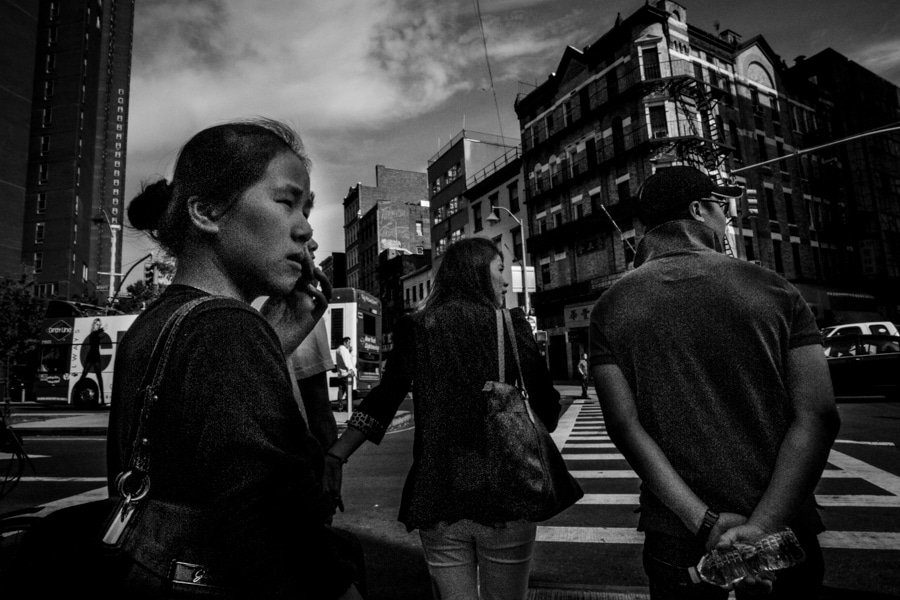
This is also why shooting where you live is an advantage. You know the streets, so you can make mental flags of places where a shot could happen and come back again and again until it does. I've stood in many foreign streets feeling there was a shot, then had to leave before the missing piece walked in. At home you don't have that problem.
Working the scene with people: staying without being creepy
The hardest part of working a scene is often not technical. It's standing in one spot with a camera for several minutes while people notice you. A few things help:
- Be part of the furniture. Stand still, relaxed, camera at chest or eye level. People stop noticing someone who isn't doing anything strange.
- Keep your settings ready. Zone focus and a fast shutter speed mean you're not fiddling with dials. My setup is in street photography settings.
- If someone notices, smile. A nod or a thank you usually ends it. If they ask, explain what you're doing. How to photograph strangers has scripts for this.
- Don't chase a single person. Working the scene means working a place and a moment, not following one person down the street.
If the waiting makes you anxious, that's normal. The fear doesn't vanish, but it gets smaller the more often you stand your ground. More on that in how to overcome the fear of street photography.
Reviewing the sequence: how to pick the one
Working the scene gives you a run of similar frames. The edit is where the work pays off. Look at the frames side by side in Lightroom or any viewer, like a contact sheet, and ask:
- Which frame has the clearest subject?
- Where does the gesture peak?
- Which one has the cleanest edges and no distracting overlaps?
- Does one frame have a second layer or a juxtaposition the others lack?
Don't decide on the spot. The high of shooting clouds your judgement. I let my cards sit for a while before I look, so I'm judging the image, not the memory of taking it. Often the frame you thought was the one isn't, and the one you barely remember is.
Keep the near misses too. Studying your own sequences shows you how you work. Maybe you leave too early. Maybe you never move your feet.
Common mistakes when working a scene
- Machine-gunning without looking. Holding down the shutter isn't working the scene. Each change should be made with intention.
- Leaving too early. Most people quit just before the good frame. Give a strong scene at least a few more minutes than feels comfortable.
- Staying too long on a dead scene. If nothing about it excites you after a while, go. There's a scene around the next corner.
- Only changing one variable. Moving closer but never lower, or waiting for people but never changing the framing. Mix it up.
- Forgetting the background. The foreground subject gets all your attention and a pole grows out of someone's head. Check the corners on every frame.
How the course teaches working the scene
In my street photography course, Phototactic, the live shooting bonus lets you watch me work scenes on the street. You see about 300 images in the making, how I set up traps to secure a shot, and the thinking behind each frame. The composition modules give you the picture patterns to look for while you wait, so you know which variation to try next.
It's a video course. There's no personal feedback on your own photos, so it suits people who like to practise on their own and study how the frames were made. If you want the bigger picture on composition first, start with the photography composition guide.
Frequently Asked Questions
What does work the scene mean in photography?
It means staying with a promising scene and taking several variations instead of one frame. You change your position and your framing, and you wait for people or light to move into place. The first frame records the idea. The later frames are where the strongest composition and moment usually appear.
How long should you work a scene in street photography?
There's no fixed rule. Some scenes take thirty seconds, others twenty minutes. Stay as long as the scene still has something fixed worth waiting for, like strong light or a clean background, and people keep passing through. If nothing excites you after a few minutes, move on.
What is fishing in street photography?
Fishing means choosing a strong background or patch of light and waiting for the right person to walk into it. It's the opposite of hunting, where you walk and react. Many well-known street photographs come from fishing, with the photographer taking frames of several passers-by and keeping the best one.
How many photos should I take of one scene?
As many as it takes to try real variations of position and timing. That might be five frames or fifty. The number matters less than whether each frame changes something. Shooting a long burst from one spot without adjusting anything isn't working the scene.
Is working the scene the same as spraying and praying?
No. Spraying is shooting lots of frames without thinking. Working the scene is shooting lots of frames where each one is a deliberate change of angle or timing. Both produce many images, but only one teaches you to see and improves your composition over time.