
Helen Levitt (1913 to 2009) was an American street photographer known for her pictures of children playing on the sidewalks of New York in the late 1930s and 1940s, and later for pioneering color street photography. The lesson you can take from her is simple: watch people who are not performing for anyone, because their gestures are honest and they make the picture.
I'm Olivier Duong. I teach street photography, and I send people to Levitt when their pictures show people walking from A to B and nothing else. Her frames are full of small dramas: a kid mid jump, or a game you don't understand but can feel. She found all of it within a few neighborhoods of her own city.
What is Helen Levitt known for?
Helen Levitt is known for lyrical, often funny photographs of street life in New York's working class neighborhoods, especially Spanish Harlem and the Lower East Side. Children are her great subject. They fight, dance, wear masks, climb and draw on the pavement with chalk. Critic David Levi Strauss called her "the most celebrated and least known photographer of her time."
Her photographs of children's chalk drawings came first. Later, her color work of the 1970s made her one of the early serious color street photographers, years before color was accepted in museums. In 1974 the Museum of Modern Art showed her color work as a continuous projection of 40 slides, curated by John Szarkowski.
She is also known for staying out of the spotlight. She rarely gave interviews, photographed for herself, and belonged to no movement. That quiet life is one reason her name is less famous than her pictures.
Helen Levitt's life: from Brooklyn to Spanish Harlem
Levitt was born in Bensonhurst, Brooklyn, on 31 August 1913, to a family of Russian Jewish immigrants. She left high school in 1931 and went to work for J. Florian Mitchell, a commercial portrait photographer in the Bronx, where she learned to develop and print in the darkroom. She was essentially self-taught.
Two meetings shaped her. Through the Film and Photo League she met Henri Cartier-Bresson, whose work she had seen at the Julien Levy Gallery. She later said she learned from him that "a picture didn't have to have social meaning," that it could stand on its own, as quoted by Rangefinder. In 1936 she bought a 35mm Leica, the same kind of small camera he used. The second meeting was with Walker Evans, who became a close friend. According to MoMA curator Eva Respini, Evans introduced her to the right angle viewfinder she would use on the street.
In 1937, while teaching art to children for the Federal Art Project, she became fascinated by the chalk drawings kids made on the sidewalks. She photographed the drawings and the children who made them. Those pictures were collected much later in In the Street: Chalk Drawings and Messages, New York City 1938 to 1948 (1987).
Her work was in MoMA's first photography exhibition in 1939. In 1943 Nancy Newhall curated her first solo show there, Helen Levitt: Photographs of Children, with pictures from Harlem and from Mexico City, where she had photographed in 1941. She also worked in film for about 25 years. With Janice Loeb and James Agee she made the short documentary In the Street, and she shared an Academy Award nomination for The Quiet One.
In 1959 and 1960 she received two Guggenheim fellowships to photograph the streets in color. In 1970 a burglar broke into her East 12th Street apartment and stole most of those color transparencies. She went back out in the 1970s and started again. Her first major book, A Way of Seeing, with an essay by James Agee, was put together in the 1940s but only published in 1965.
In the 1990s sciatica made carrying her Leica hard, and she switched to a small automatic Contax. She lived alone in Greenwich Village and died in her sleep on 29 March 2009, aged 95.
Helen Levitt's style: gesture and the theater of the street
James Agee called her photographs, taken as a whole, "a major poetic work." That poetry comes from a few habits you can learn.
- Children as subjects. Kids don't pose on the street. They are absorbed in their games, so their bodies move freely. Levitt used that. Her best frames look like choreography.
- Gesture over face. A raised arm, a head turned away, two hands touching. The body tells the story. My guide to emotion in street photography shows how to read these small movements.
- Close and unnoticed. The right angle viewfinder (a winkelsucher) let her look one way while the camera pointed another. She could stand very close without breaking the moment. You feel physically inside her scenes.
- Her own neighborhoods. She came back to the same streets for decades. In an interview quoted by Rangefinder she explained why Spanish Harlem worked: "It was a very good neighborhood for taking pictures in those days, because that was before television."
- Internal frames. Doorways, stoops, windows and fences hold her figures. Photography historian Keith F. Davis points to her "internal framing devices" in New York, ca. 1942. See my guide to framing in photography.
- Color that feels alive. In her 1970s and 1980s color work, a pink shirt or a green car jumps out of the street. Color is part of the gesture, not decoration.
What she avoided matters too. Many photographers of the 1930s showed poverty as suffering. Levitt photographed the same poor neighborhoods, but she showed play and dignity. That choice is a big part of why the pictures still feel warm.
Four Helen Levitt photographs to study
I don't reproduce her photographs here. They are protected, and you can see them properly in museum collections such as the Museum of Modern Art. Look each one up while you read.
Chalk drawings, New York (around 1940)
Her early series of children's chalk drawings on walls and sidewalks. The Metropolitan Museum of Art holds one titled Graffiti: Chalk Drawing of Figure with Double Pupils, New York City. The move: photograph the traces people leave, not only the people. A wall can be a portrait of a street.
New York, ca. 1942
A small group of figures connected by touch and looks, held inside the frames of the street. Keith F. Davis describes it as "a gentle mystery" built from "touch, expression, and glance." The move: wait until the hands and eyes in your frame point at each other.
New York, 1972
A color photograph of a boy and a girl leaning against a gumball machine outside a market. The fruit in the window echoes the print on the girl's dress. The move: look for a color or a pattern that repeats between a person and the background.
New York, 1980
A girl crouches at the curb and looks under a green car, with a pale blue Volkswagen behind. Her small body curls against the hard curves of the cars. The move: get down to a child's height and let their posture be the subject.
Steal this move: photograph play
Here is a Levitt exercise you can do this weekend. It works anywhere people spend time outside: a park, a public square, a street festival, a beach.
- Find a place where people play. Kids at a fountain, teenagers with a ball, older men at a chess table, a family on a picnic blanket. Play means people forget about you.
- Stay a while. Twenty minutes in one spot is better than two hours of walking. People stop noticing you after a few minutes.
- Watch the hands. Pointing, grabbing, touching, throwing. Press the shutter at the peak of the gesture, not after.
- Use a clean background. A plain wall or a patch of shade makes a gesture read instantly.
- Keep it respectful. With children, parents are close by. Stay visible and smile. Show the picture, or delete it if anyone asks.
For settings, use zone focus at around 2 to 3 meters and a shutter speed of 1/500 or faster, because children move quickly. My street photography settings guide has the details, and my page on candid photography covers how to stay unnoticed without hiding.
My take: lessons I use from Levitt
I photograph a lot of children, partly because I travel with my own kids. These are my photos, not copies of her style, but each one uses something I learned from her.
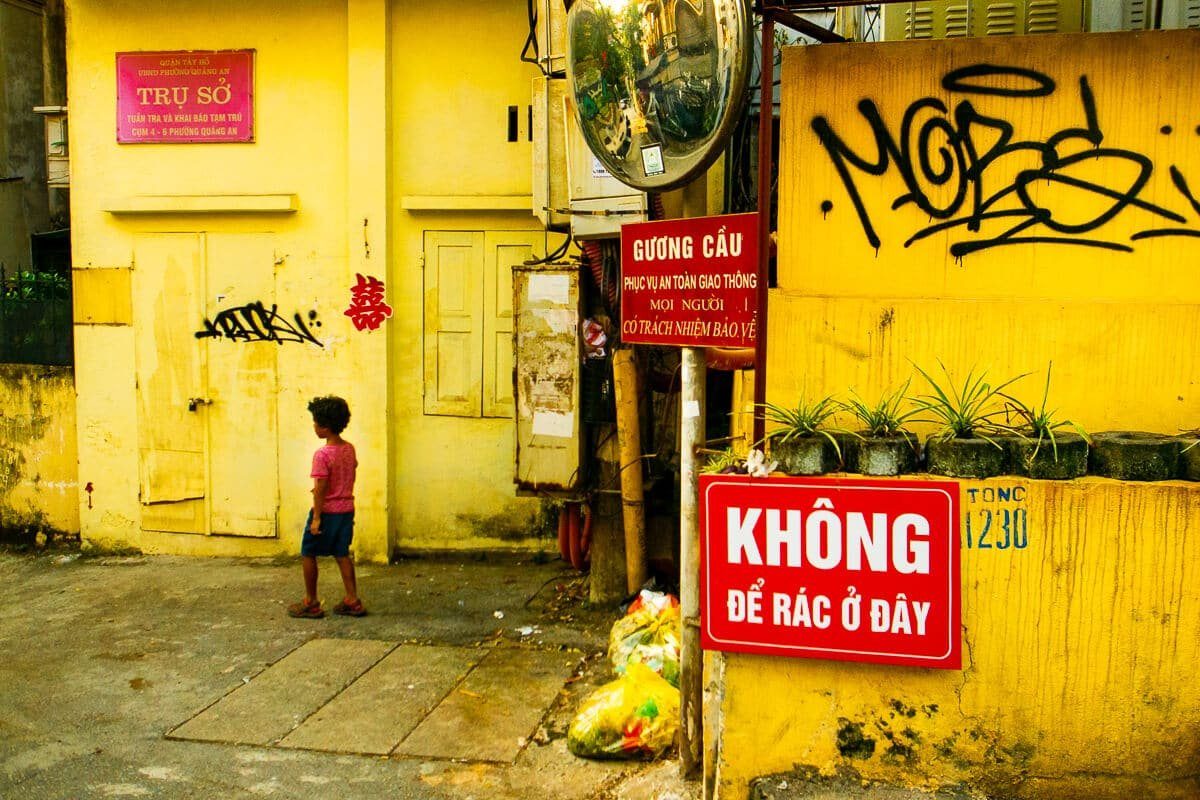
In Hanoi the walls are often yellow, and I noticed early that a small person in front of one reads right away. The child is tiny in the frame, but the color and the empty wall point straight at them. Levitt's color work taught me that a street can be a stage, and the person does not need to be big to be the star.
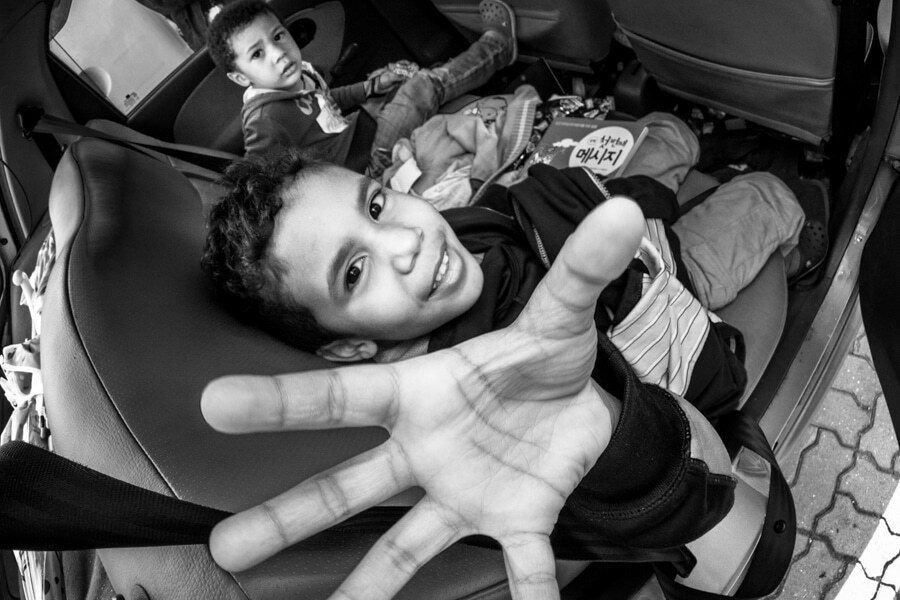
Children do things adults would never do in front of a camera. This boy threw his hand at the lens. The gesture is the whole photo, and a wide lens made it even bigger. Levitt's pictures are full of these moments where a body does something unexpected.

This one is of my own child, shot with a 28mm very close. I keep it because of the hands. Without them it's a nice smile. With them it's a feeling. When I edit, I now look at hands first.
Why Helen Levitt matters to your street photography
A common complaint I hear is that street photos feel random: people walking, nothing happening. Levitt's answer was to go where something is always happening. She didn't chase famous places. She went to the stoops and sidewalks of her own city and waited for life to show up.
She also proves you don't need to be loud to get close. She was shy and private, and she used a small camera and a right angle finder to stay out of the way. If fear of strangers is holding you back, that is encouraging. My guide to overcoming the fear of street photography goes further.
In my street photography course, Phototactic, a whole module is about emotion, and gesture is at the center of it. We call repeatable structures like "one small figure against a big color field" picture patterns. Once you learn a few, you start seeing them in the street without trying. The course has no feedback on your own photos, so the practice is yours to do.
If you want to walk the same streets, my guide to street photography in New York lists places to start, and my Mexico City guide covers the city where she photographed in 1941. For more masters and the lesson each one teaches, see my list of famous street photographers, including Saul Leiter and Garry Winogrand, who worked the same city.
Helen Levitt books and exhibitions
| Book | Year | Why get it |
|---|---|---|
| A Way of Seeing (with James Agee) | 1965 | Her classic black and white work. Start here. |
| In the Street: Chalk Drawings and Messages | 1987 | The chalk drawing series |
| Mexico City | 1997 | Her 1941 pictures from Mexico |
| Crosstown | 2001 | A broad selection across her career |
| Slide Show: The Color Photographs of Helen Levitt | 2005 | Her color street photography |
| Manhattan Transit (David Campany) | 2017 | Her subway photographs |
Her first major retrospective in the United States opened at the San Francisco Museum of Modern Art and the Metropolitan Museum of Art in 1991. More recent shows include In the Street at The Photographers' Gallery in London (2021) and a survey of her complete work at Fundación MAPFRE in Barcelona and Madrid (2025 to 2026). A Way of Seeing is also on my list of the best photography books.
Frequently Asked Questions
What camera did Helen Levitt use?
Helen Levitt bought a 35mm Leica in 1936, the same type of small camera Henri Cartier-Bresson used. She often fitted it with a right angle viewfinder, which let her point the camera sideways while looking ahead, so people did not know they were being photographed. In the 1990s back pain made the Leica hard to carry, and she switched to a small automatic Contax.
Why is Helen Levitt important?
Helen Levitt is important because she showed that street photography could be personal and poetic instead of purely documentary. Her pictures of children playing in New York in the 1930s and 1940s are some of the most loved in the genre. She was also an early serious color street photographer, with a MoMA show of her color slides in 1974.
What did Helen Levitt photograph?
She photographed everyday life on the streets of New York, mostly in Spanish Harlem and the Lower East Side. Children at play were her main subject, along with their chalk drawings on walls and sidewalks. She also photographed in Mexico City in 1941 and on the New York subway, and she made color street photographs from 1959 into the 1990s.
What happened to Helen Levitt's color photographs?
Levitt made hundreds of color photographs with two Guggenheim grants in 1959 and 1960. In 1970 a burglar broke into her East 12th Street apartment and stole most of those transparencies. She started again in the 1970s. The surviving images and her later color work are collected in the 2005 book Slide Show: The Color Photographs of Helen Levitt.
Did Helen Levitt make films?
Yes. Levitt worked in film for about 25 years. With Janice Loeb and James Agee she made the short documentary In the Street, filmed in East Harlem, and she shared an Academy Award nomination for The Quiet One. She also worked as a cinematographer and editor on other documentaries. Her film work influenced the way she saw movement in her photographs.