
Saul Leiter is known for soft, painterly color photographs of New York made through fogged windows, rain, snow and reflections, mostly in the late 1940s and 1950s. The move you can use is to shoot through something, a window or a gap, so color and blur become part of the picture instead of a problem.
I'm Olivier Duong. I teach street photography, and I send people to Leiter when their color street photos feel like plain records of a street. His pictures show that you don't need a sharp subject in the middle of the frame. You need a color idea and the nerve to hide most of the scene.
What is Saul Leiter known for?
Saul Leiter is known as a pioneer of color photography on the streets of New York. He started shooting color in 1948, long before the art world took color seriously. His photographs look more like paintings than documents: a red umbrella in grey snow, or a figure smeared behind wet glass.
His use of color is quiet, closer to Abstract Expressionism than to the sharp black and white of his peers. There is usually one color note, often red or yellow, set against a lot of grey and black. Much of the frame is blocked by a window or an awning. You see the city in pieces.
He is also known for being discovered late. His early color work was barely seen for decades. When the book Early Color came out from Steidl in 2006, he was in his eighties, and he became famous almost overnight.
Saul Leiter's life: rabbi, painter, photographer
The American photographer and painter Saul Leiter was born in Pittsburgh on 3 December 1923. His father was a well known Talmudic scholar, and Saul studied to become a rabbi. His mother gave him his first camera when he was 12; several sources say it was a Detrola.
At 23 he left theology school and moved to New York to become an artist. He wanted to be a painter. There he met the Abstract Expressionist painter Richard Pousette-Dart. Pousette-Dart and W. Eugene Smith encouraged him to pursue photography, and he was soon shooting black and white with a 35mm Leica he got in exchange for a few Eugene Smith prints.
In 1948 Leiter began taking color photographs. Photographers such as Helen Levitt and William Klein were working the same streets. He knew Robert Frank and Diane Arbus, and his work is now grouped with what Jane Livingston called the New York School of photography. Edward Steichen included his black and white photographs in the 1953 exhibition Always the Young Stranger at the Museum of Modern Art.
From the late 1950s he also worked as a fashion photographer. Art director Henry Wolf published his color fashion work in Esquire and later in Harper's Bazaar. Over about 20 years his fashion photography also ran in Elle, British Vogue, Show, Queen and Nova. His partner and muse from the early 1960s was the painter and model Soames Bantry, until her death in 2002. They lived in the same building on East Tenth Street.
He kept painting his whole life and saw himself as both photographer and painter. His personal work stayed mostly private until Howard Greenberg Gallery began showing it in the 1990s. Early Color, his first monograph of that color work, with an introduction by art historian Martin Harrison, changed everything. The Henri Cartier-Bresson Foundation in Paris gave him his first European museum show in 2008. Tomas Leach's documentary film In No Great Hurry: 13 Lessons in Life with Saul Leiter followed. Leiter died in New York on 26 November 2013, aged 89. The Saul Leiter Foundation now looks after his archive.
Saul Leiter's style: color, glass and hidden subjects
Martin Harrison put his difference well. Unlike Robert Frank and William Klein, with their "visceral encounters" with street life, Leiter "operated on a more reflective, less overtly confrontational mode, seeking out tranquility in the Manhattan maelstrom."
That calm comes from a few habits you can see across his color photographs.
- Shooting through things. Steamed up windows, glass covered in rain or snow, reflections in shop windows, the gap between two parked trucks. The glass softens everything and turns color into patches, like paint.
- Blocking most of the frame. A dark awning, a truck, a wall or a pole takes up half the image. The real subject lives in a small gap. That is negative space used with confidence.
- One color note. A red umbrella or a yellow taxi. He let one color do the work and kept the rest muted.
- Layers of blur. Out of focus shapes in front of the subject, reflections on top of the street. See my guide to layering in photography for how to build these planes.
- Slide film. He shot color slides, including Kodachrome, when most serious street photographers still worked in black and white. Accounts of his working life say he sometimes used outdated film, which may explain some of the odd tones.
He was also not in a hurry. Leiter walked his own neighborhood around East Tenth Street for years instead of chasing new places. His search for beauty was local and patient.
His own words sum it up: "I like it when one is not certain of what one sees. We don't know why the photographer has taken such a picture. If we look and look, we begin to see and are still left with the pleasure of uncertainty."
Four Saul Leiter photographs to study
I don't reproduce his photographs here. They are protected, and the Saul Leiter Foundation is the place to see them properly. Look each one up while you read.
Through Boards (1957)
Shot from behind planks. Dark red and black slabs fill most of the frame, and a thin slice of street with a white car and people at a shop window sits in the middle. Critics often compare it to Rothko's color field paintings. The move: frame the street through a narrow gap and let the blockers become color shapes. My guide to framing in photography covers this.
Red Umbrella (around 1958)
A grey winter street with a red umbrella that seems to arrive by accident. Umbrellas turn up again and again in his pictures of the streets of New York. The move: in a muted scene, wait for the one bright color to enter the frame.
Canopy (1958)
A black awning takes up most of the photograph. Below it, small figures move across a snowy street. The move: let a dark shape dominate so the tiny bit of life below feels bigger.
Snow (1960)
A window covered with snow and moisture, with a blurred red shape of a person on the other side. The glass does the painting. The move: on a cold or rainy day, photograph through the window of a café or bus and focus on the glass, not the street.
Steal this move: shoot color through glass
Here is a Leiter exercise for your next rainy or cold day. It works best in the late afternoon when shop lights come on.
- Find a window. A café, a bus, a train or a shop front. Wet or fogged glass is best.
- Choose your color. Look for one strong color outside: a sign, an umbrella, a traffic light, a coat. Everything else should be dull.
- Block part of the frame. Let the window frame or a dark shape cover a third to a half of the picture.
- Focus on the glass or let it go soft. Manual focus helps. Try both and compare.
- Wait for a person. A figure passing the color, blurred by the glass, finishes the image.
Expose a little under, about -0.7 to -1 stop, so the colors stay rich. Shoot RAW so you can shape the color later. If you want settings for different light, my street photography settings guide has a cheat sheet.
My take on color: lessons I use from Leiter
I shoot a lot of color street photography, and Leiter's work changed what I look for. These are my own photos, not his style copied, but they use ideas I learned from studying him.
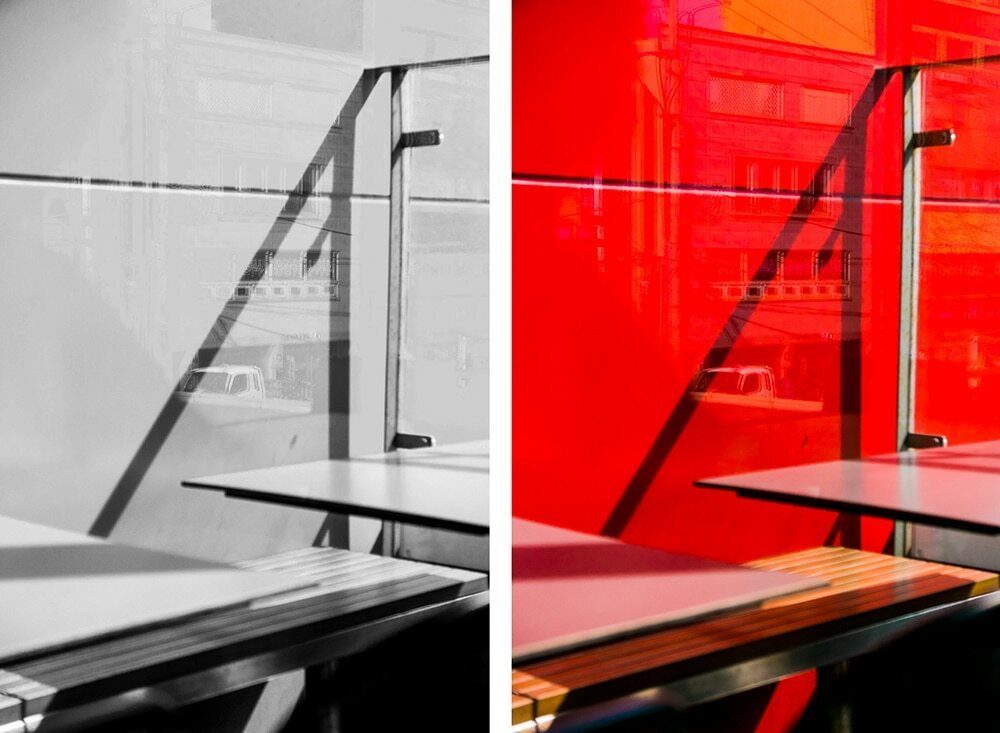
My test for a color photograph: if it works just as well in black and white, the color isn't doing anything. In the frame above, taken in Korea, the red is the whole reason I pressed the shutter. Leiter's best pictures pass this test easily.
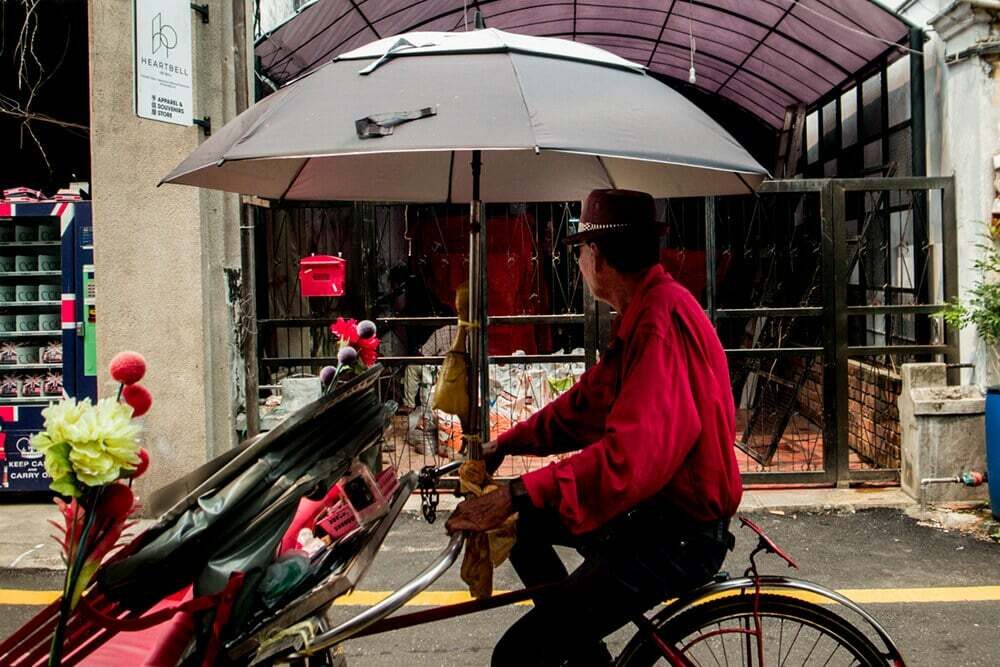
I call this one "like with like". The same color appears in different parts of the frame, so your eye jumps from one to the next. It's the opposite of Leiter's single red note, and both work. Pick one on purpose.
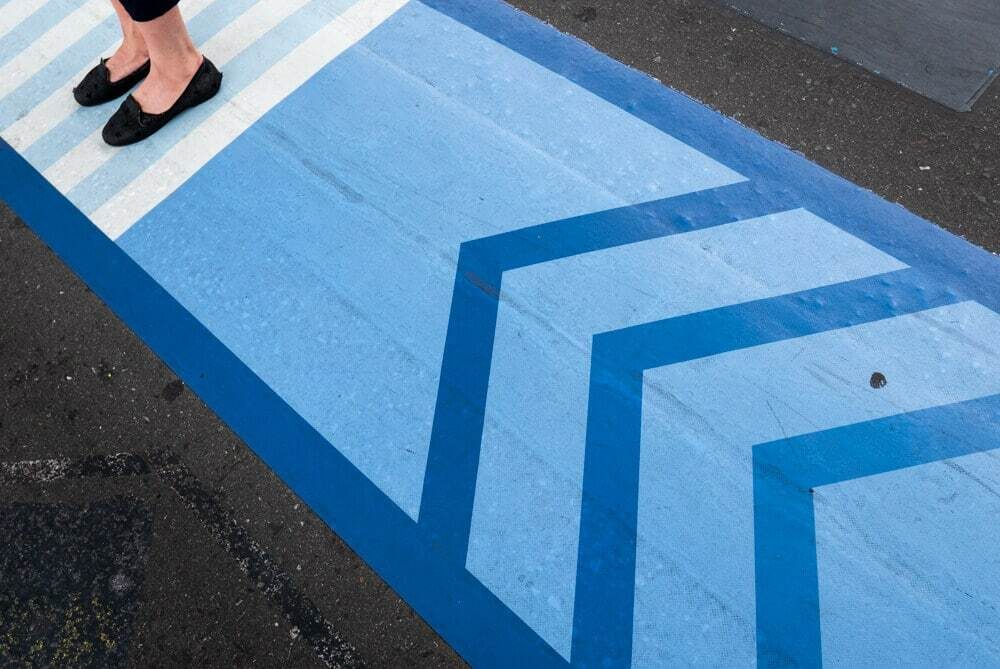
Leiter often pushed people to the edge of the frame or hid them. Here the blue crosswalk carries the picture and the feet at the top are just enough human presence. You can find these moments in any city, including New York, where my street photography in New York guide lists places to start.
Why Saul Leiter matters to your street photography
A common complaint I see from photographers is that everyone's street photos look the same. Leiter's answer was to slow down and look at the ordinary: his own street and whatever the weather did to it. He didn't need dramatic events. He needed color and patience.
His place in the history of photography also frees you from one rule, that a street photo must be sharp and clear. His pictures are soft and often abstract, and they hang in the Museum of Modern Art and the Victoria and Albert Museum.
In my street photography course, Phototactic, color gets its own lessons on color coordination and color psychology. We call repeatable structures like "one color note in a muted frame" picture patterns. Learn a few and you start seeing them without trying. The course has no feedback on your own photos, so the practice is yours to do.
For more masters and the lesson each one teaches, see my list of famous street photographers.
Saul Leiter books and exhibitions
| Book | Year | Why get it |
|---|---|---|
| Early Color (Steidl) | 2006 | The book that made him famous. Start here. |
| Early Black and White (Steidl) | 2014 | Two volumes of his black and white street work |
| In My Room (Steidl) | 2018 | His more private photographs |
| Forever Saul Leiter (Thames & Hudson) | 2022 | A broad selection with his own words |
| The Unseen Saul Leiter (Thames & Hudson) | 2022 | Previously unseen slides from the archive |
Retrospective exhibitions have run at Deichtorhallen Hamburg (2012) and MK Gallery in Milton Keynes (2024), and Howard Greenberg Gallery marked his centennial in 2024. For the full list of shows and collections, check the Saul Leiter Foundation. Early Color is also on my list of the best street photography books, and three of his lines are in my street photography quotes.
Frequently Asked Questions
What camera and film did Saul Leiter use?
Saul Leiter shot black and white with a 35mm Leica he got in exchange for some W. Eugene Smith prints. For his color work he used color slide film, including Kodachrome, starting in 1948. Several accounts say his first camera, a gift from his mother when he was 12, was a Detrola. His gear was simple. The seeing is what made the pictures.
Why is Saul Leiter famous?
Saul Leiter is famous for his early color street photography of New York, made from the late 1940s, when color was not yet accepted as art. His soft, painterly images shot through wet or frosted glass were barely known until the book Early Color came out in 2006. He is now seen as one of the great color photographers of the twentieth century.
What was Saul Leiter's style?
His style is quiet, painterly color. He often shot through windows or gaps, let dark shapes fill most of the frame, and used one strong color note against muted tones. Blur and reflections are part of the picture, not mistakes. He preferred tranquility to confrontation, and he found his photographs close to home in his own New York neighborhood.
Where did Saul Leiter live and work?
Saul Leiter was born in Pittsburgh and moved to New York City at 23 to become a painter. He lived and worked for decades in the East Village, on East Tenth Street, and photographed the streets of New York close to home. He also worked as a fashion photographer for magazines such as Harper's Bazaar and Esquire.
What is Saul Leiter's most famous photo?
There is no single answer, but the pictures most often named are Snow (1960), Red Umbrella (around 1958), Canopy (1958) and Through Boards (1957). All show his signature approach: a muted scene, one bright color and a subject partly hidden behind glass, snow or a dark shape. You can see them through the Saul Leiter Foundation.