
Robert Frank (1924 to 2019) was a Swiss American photographer and filmmaker best known for The Americans, a book of 83 black and white photographs made on road trips across the United States in 1955 and 1956. The lesson you can use from him is that mood and sequence matter more than technical perfection: a grainy, tilted frame that carries a feeling beats a sharp one that says nothing.
I'm Olivier Duong. I teach street photography, and I send people to Frank when their pictures are clean and correct but feel empty. Critics in 1959 attacked his photos as sloppy. Today the same book is on almost every list of the most important photobooks ever made.
What is Robert Frank known for?
Robert Frank is known for The Americans, published in France in 1958 and in the United States in 1959 with an introduction by Jack Kerouac. The book shows 1950s America as lonely and divided, at a time when magazines showed it as cheerful and prosperous. Critic Sean O'Hagan wrote in The Guardian in 2014 that it "changed the nature of photography, what it could say and how it could say it."
MoMA calls his vision "gritty" and "melancholic." His pictures are full of jukeboxes, cars, flags, diners, funerals and highways. Race and class run through the whole book, often in the same frame.
He is also known for leaving photography at the height of his fame. By 1959 he was making films, starting with Pull My Daisy, narrated by Kerouac and featuring Allen Ginsberg. Photographers who followed, including Garry Winogrand and Lee Friedlander, learned from his example. Joel Meyerowitz quit his advertising job after watching Frank work on a 1962 shoot.
Robert Frank's life: from Zurich to the American road
Robert Frank was born in Zurich on 9 November 1924 into a Jewish family. He grew up safe in Switzerland during the Second World War, but the threat of Nazism shaped how he saw power and oppression. He trained with commercial photographers and graphic designers in Zurich and made his first handmade book, 40 Fotos, in 1946.
In 1947 he emigrated to New York and found work as a fashion photographer at Harper's Bazaar under the art director Alexey Brodovitch. He soon left for a freer life, traveling and photographing in Peru and Europe. Back in New York he took part in the 51 American Photographers show at MoMA in 1950 and married the artist Mary Frank. Through the early 1950s he worked freelance for magazines. He became part of what Jane Livingston called the New York School of photographers, with Saul Leiter and Diane Arbus.
Frank admired Walker Evans's book American Photographs (1938), and Evans supported his application for a Guggenheim Fellowship. He got it in 1955. Over the next two years he drove across the country, through places like Detroit, Savannah, Miami Beach, New Orleans, Houston, Los Angeles, Reno, Butte and Chicago. He shot about 28,000 frames and chose 83 for the book.
The trip wasn't easy. In a small town in Arkansas the police arrested him and held him in jail. Frank later recalled: "They put me in jail. It was scary. Nobody knew where I was."
Back in New York in 1957 he met Jack Kerouac, who agreed on the spot to write about the pictures. No American publisher wanted the book at first. Robert Delpire published Les Américains in Paris in 1958, and Grove Press published The Americans in New York in 1959. The reviews were brutal. Popular Photography ran comments about "meaningless blur, grain, muddy exposures, drunken horizons and general sloppiness." Sales were slow. Over the next decade the book became a model for a new generation.
Frank then turned to film, including a notorious documentary of the Rolling Stones' 1972 tour. In 1972 he published The Lines of My Hand, a visual autobiography. With the sculptor June Leaf he moved to Mabou in Nova Scotia, and his later photographs became collages of Polaroids and scratched negatives, often with handwritten words. His daughter Andrea died in a plane crash in 1974, and his son Pablo died in 1994. Frank died at his home in Nova Scotia on 9 September 2019, aged 94.
Robert Frank's style: imperfect frames that carry a feeling
Frank explained what he was after in a statement for U.S. Camera Annual 1958: "When people look at my pictures I want them to feel the way they do when they want to read a line of a poem twice." Everything in his style serves that feeling.
- A small camera and available light. He worked with a 35mm Leica, fast and quiet, in bars and at night. The grain and deep shadows come from shooting fast in low light.
- Imperfect frames. Tilted horizons, blur, cropped heads, subjects out of focus. He kept what the moment gave him when it carried the mood.
- Symbols in the ordinary. The flag, the jukebox, the car and the road repeat through the book like words in a poem. Each picture is a scene and a sign at once.
- Distance and loneliness. People stand apart or look away. Even in crowds, his subjects often seem alone.
- Sequence. The Americans is built in four sections, each opening with a picture of the flag. The order of the photos creates the meaning, the way shots do in a film. My guide to the photo essay shows how to do this with your own work.
Kerouac summed up the result in his introduction, saying Frank "sucked a sad poem right out of America onto film." He ended with a line photographers still quote: "To Robert Frank I now give this message: You got eyes."
Four Robert Frank photographs to study
I don't reproduce his photographs here. They are protected, and you can see them in museum collections such as the Museum of Modern Art and the National Gallery of Art in Washington, which holds the Robert Frank Collection. Look each one up while you read.
Parade, Hoboken, New Jersey (1955)
The opening picture of the book. Two people watch a parade from separate windows of a brick building; one face is hidden by an American flag. The move: let an object cover a face and it becomes a symbol. Use the building's windows as a frame within a frame.
Trolley, New Orleans (1955)
Passengers look out from the windows of a streetcar, white passengers in front and Black passengers at the back, in the segregated South. Each window holds a different face. The move: a row of windows can tell a story about a whole society. My New Orleans street photography guide covers the city today.
Elevator, Miami Beach (1955)
A young elevator operator stands still, lost in thought, while blurred guests move past her. The move: use a slow shutter so the crowd blurs and the one still person carries the emotion. See my guide to motion blur photography.
U.S. 285, New Mexico (1955)
An empty highway at dusk, a line running into the dark. No people at all. The move: a place can carry a mood by itself. Put one landscape among your people pictures to give a sequence room to breathe.
Steal this move: shoot a mood, then sequence it
Here is a Frank exercise. It takes a few weeks, and it will change how you think about single pictures.
- Pick one feeling. Loneliness, waiting, pride, boredom. Write it down.
- Pick a territory. Your city, a bus route, a highway, a string of towns on a weekend drive.
- Shoot the feeling, not the place. Look for people alone in crowds and objects that stand for something. Accept blur and grain when they help.
- Print small. Make cheap 4x6 prints of your best 40 frames and lay them on a table.
- Sequence 12 to 20. Put pictures next to each other that talk: a flag and a face, an empty chair and a crowd. Move them around until the order says something none of them says alone.
Shoot in black and white if it helps you see mood. My guide to black and white photography has settings and editing tips, and my page on the photo zine shows how to turn a sequence into something you can hold.
My take: lessons I use from Frank
Frank taught me that a picture can be about a feeling and not about an event. These are my photos, not his style copied, but each one tries to carry a mood more than a story.
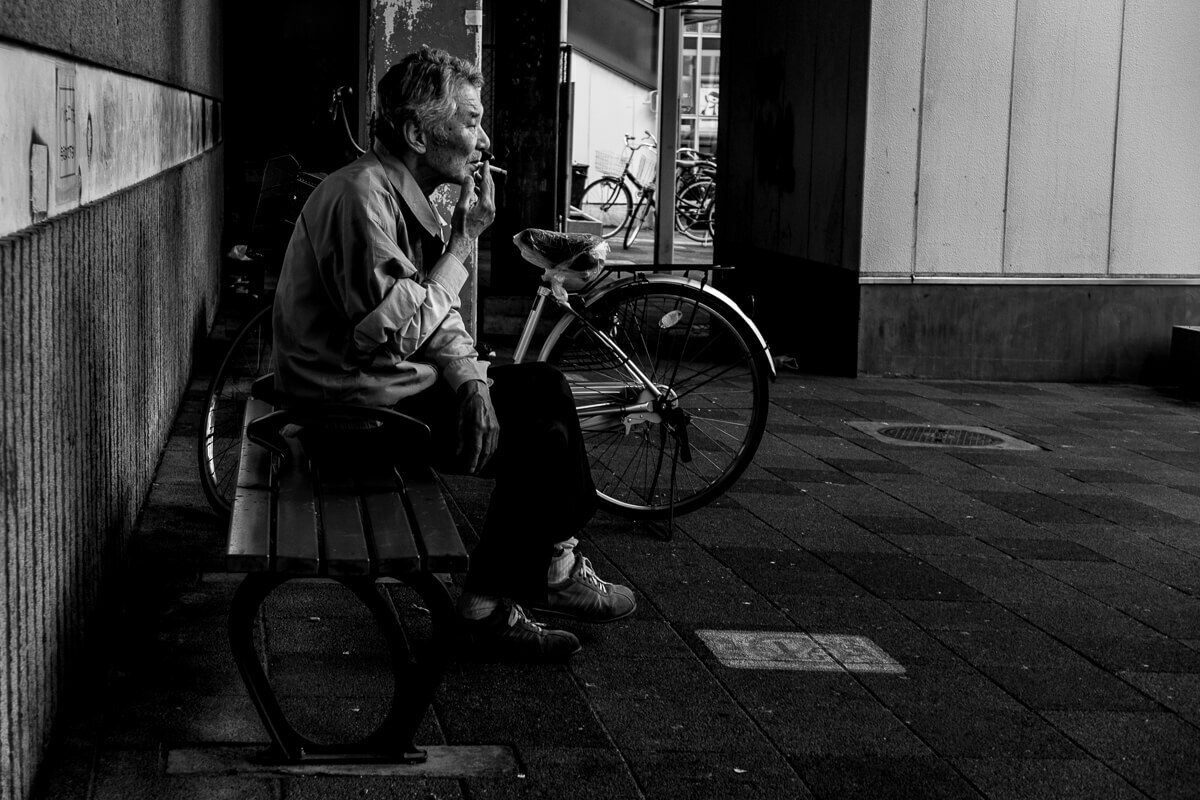
A man smoking on a bench. Nothing dramatic. But the dark wall and the way he sits make it feel like the end of a long day. That kind of quiet weight is what I look for after studying The Americans.
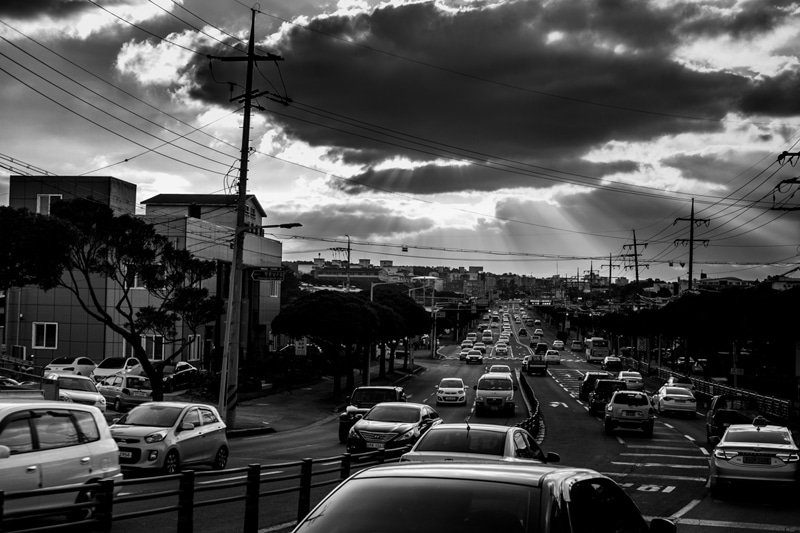
Frank's book is full of roads and cars. They stand for movement and escape. Here the traffic and the heavy sky do the talking. There isn't a single face, and the picture still has a mood.
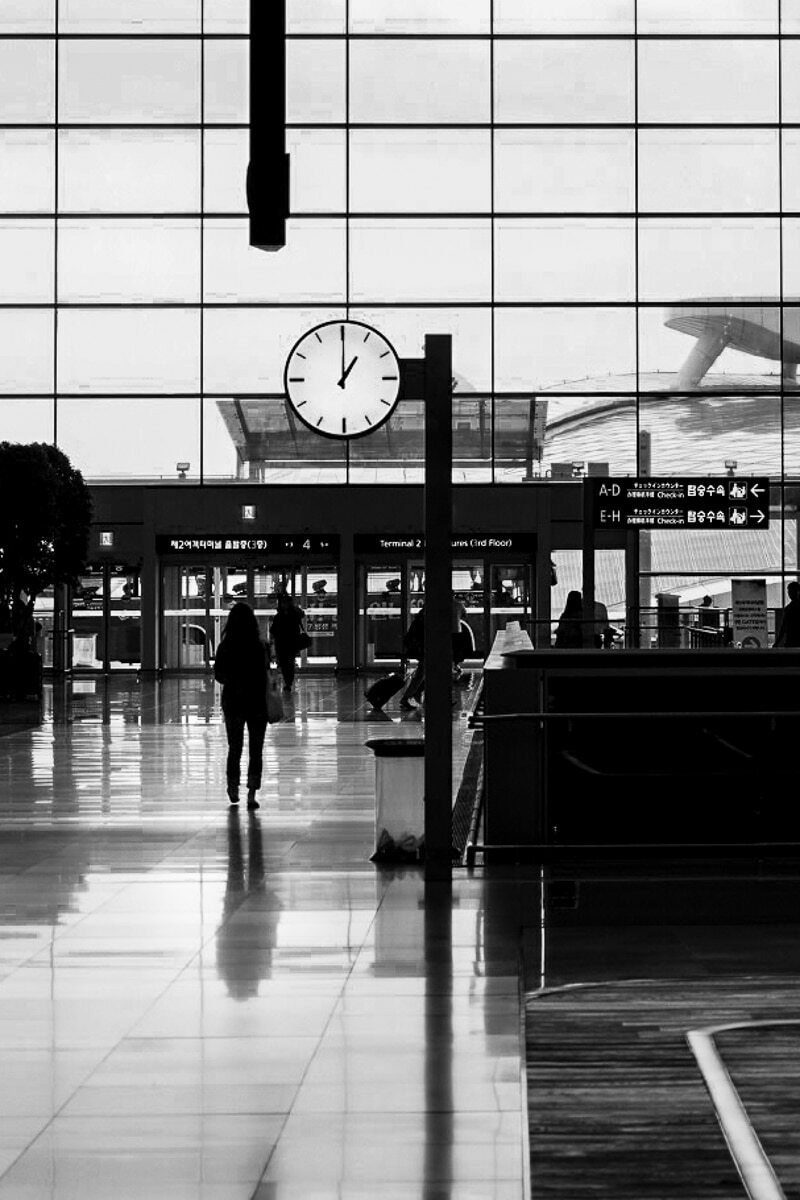
I travel a lot with my family, and airports are some of the loneliest places I know. The clock and the one small figure say "waiting" better than any close portrait could. Put a frame like this between two busy street scenes and the sequence suddenly breathes.
Why Robert Frank matters to your street photography
Most photographers I talk to are stuck on single images. They want each photo to be a hit. Frank shows that a body of work is more than the sum of its best frames. Some of his pictures would look weak alone. In sequence, they are powerful. If you've hit a wall, my guide to the street photography plateau explains why projects help.
He also frees you from the fear of imperfection. If your picture is a little soft or tilted, ask one question: does it carry the feeling? If yes, keep it. He also saw America clearly because he was an outsider. You can use that too, by traveling, or by looking at your own city as if you'd just arrived.
In my street photography course, Phototactic, we work on what we call the Eye, Heart and Mind of a photograph. Frank is a master of the Heart and the Mind: his pictures carry emotion and make you think about a whole country. The course has no feedback on your own photos, but it gives you the frameworks to judge your own work.
For more masters and the lesson each one teaches, see my list of famous street photographers, and read about Vivian Maier, who critics have compared to Frank. You can also find his book on my list of the best photography books and more lines from the masters on my page of photography quotes.
Robert Frank books and films
| Book or film | Year | Why get it |
|---|---|---|
| The Americans (Steidl edition) | 1958 (Steidl 2008) | The essential book. The 2008 edition uses mostly uncropped images. |
| Pull My Daisy (film) | 1959 | His Beat film with Kerouac and Ginsberg |
| The Lines of My Hand | 1972 | His visual autobiography |
| Looking In: Robert Frank's The Americans (Sarah Greenough) | 2009 | Contact sheets and the full story of the book |
| Peru (Steidl) | 2006 | Early work from before America |
| Don't Blink: Robert Frank (film, Laura Israel) | 2015 | A documentary about his life and work |
The National Gallery of Art in Washington marked the 50th anniversary of The Americans in 2009 with Looking In, which also traveled to the San Francisco Museum of Modern Art and the Metropolitan Museum of Art. In 1996 he received the Hasselblad Award.
Frequently Asked Questions
What camera did Robert Frank use for The Americans?
Robert Frank shot The Americans with a 35mm Leica rangefinder and black and white film. The small camera let him work quickly and quietly in bars and on the street, often in poor light. The grain and tilted horizons that critics attacked in 1959 came partly from working fast with a handheld camera and available light.
Why is The Americans so important?
The Americans showed a lonely, divided United States at a time when magazines showed a happy one. Its loose, personal style broke the rules of 1950s photojournalism, and its sequence of 83 photos works like a poem. It shaped photographers such as Garry Winogrand and Lee Friedlander, and it is still one of the most influential photobooks ever made.
Who wrote the introduction to The Americans?
Jack Kerouac wrote the introduction to the American edition, published by Grove Press in 1959. The first edition, Les Americains, came out in Paris in 1958 from Robert Delpire, with texts by other writers instead. Kerouac's introduction ends with the famous line: To Robert Frank I now give this message: You got eyes.
How many photos did Robert Frank take for The Americans?
Frank shot about 28,000 frames on his road trips across the United States in 1955 and 1956, funded by a Guggenheim Fellowship. He selected 83 photographs for the book. His contact sheets and early work prints were shown in the 2009 exhibition Looking In at the National Gallery of Art, which explored how he built the sequence.
What did Robert Frank do after The Americans?
He turned mostly to filmmaking, starting with Pull My Daisy in 1959 and later a documentary of the Rolling Stones' 1972 tour. In 1972 he published The Lines of My Hand. After moving to Nova Scotia, he made personal work that combined Polaroids with scratched negatives, much of it about the loss of his daughter and son.