
Vivian Maier (1926 to 2009) was an American street photographer who worked as a nanny in Chicago and made well over 100,000 photographs of city life, mostly with a Rolleiflex, that nobody saw until after her death. The lesson you can use from her is to photograph constantly for yourself, and to put yourself in the picture: her self-portraits in mirrors and shadows are some of the most copied in street photography.
I'm Olivier Duong. I teach street photography, and Maier is the photographer I point to when someone tells me they need followers or a gallery to keep going. She had none of those. She had a camera around her neck and a day off each week.
What is Vivian Maier known for?
Vivian Maier is known for two things at once: her photographs and her story. The photographs are sharp and often funny portraits of people on the streets of Chicago and New York in the 1950s and 1960s, plus a huge body of self-portraits. The story is that she kept almost all of it to herself. Many rolls were never even developed.
Her work only became public after a storage auction in Chicago in 2007. When collector John Maloof posted a selection on Flickr in October 2009, it went viral. The documentary Finding Vivian Maier (2013), directed by Maloof and Charlie Siskel, was nominated for the Academy Award for Best Documentary Feature.
Photographers who know the genre rate her highly. Joel Meyerowitz said her work was "suffused with the kind of human understanding, warmth and playfulness" that proves she was "a real shooter." Mary Ellen Mark compared her to Helen Levitt, Robert Frank, Lisette Model and Diane Arbus.
Vivian Maier's life: from New York to Chicago
Vivian Dorothy Maier was born in New York City on 1 February 1926, to a French mother and an Austrian father. As a child she moved several times between the United States and France, living for years with her mother in the Champsaur valley in the French Alps, where her mother's family came from. For a time they lived with Jeanne Bertrand, a successful portrait photographer.
She bought her first Rolleiflex in 1952. By then she was back in New York, and she photographed its streets intensely. In 1956 she moved to Chicago's North Shore and spent about 40 years working as a nanny and carer. She worked for the Gensburg family from 1956 to 1972. Lane Gensburg, one of the boys she looked after, later said: "She was like a real, live Mary Poppins."
On her days off she walked the city with her camera, often taking the children with her. In 1959 and 1960 she traveled alone around the world, photographing across Asia and on the way back through the Middle East and Europe. Her employers described her as fiercely private. She kept boxes of negatives and newspapers wherever she lived; at one home there were about 200 boxes.
In her last years she was poor, and the Gensburg brothers helped her find an apartment. She fell on ice in late 2008 and never fully recovered. She died in a nursing home near Chicago on 21 April 2009.
Two years before her death she stopped paying for a storage unit, and its contents were auctioned. John Maloof bought about 30,000 negatives while researching a book on a Chicago neighborhood. Ron Slattery and Randy Prow bought parts too, and Jeffrey Goldstein later bought part of Prow's share. Maloof's collection now holds most of her known work. Because she left no will, the rights to her photographs went through years of legal dispute, and Cook County set up an estate in 2014.
Vivian Maier's style: square frames and self-portraits
Roberta Smith of The New York Times wrote that her photographs seem to touch on nearly every famous street photographer, yet keep "a distinctive element of calm, a clarity of composition and a gentleness." That calm comes from her tools and her habits.
- A Rolleiflex held at the waist. A twin lens reflex is looked into from above, so she didn't raise a camera to her eye. People looked at her, not at a lens. Her close portraits often have that direct, slightly curious gaze.
- Square medium format. The 6x6 negative gave her more detail than most 35mm street photographers, as critic William Meyers noted. The square frame also pushes you to center the subject and fill the frame.
- Close portraits of strangers. Wealthy shoppers, workers, children, people sleeping in doorways. She got close and let faces carry the picture. My guide to how to photograph strangers covers how to do this with respect.
- Herself, again and again. Reflections in shop windows and mirrors, and her long shadow falling on the street or on the people she photographed.
- Later, color and 35mm. From the late 1970s she stopped using the Rolleiflex. Most of her later photographs are color slides on Ektachrome, shot with 35mm cameras such as a Leica IIIc.
The self-portraits are what most people copy. Meyers wrote that she "often photographed her own shadow, possibly as a way of being there and simultaneously not quite there." I think that's exactly it. She is present in the scene and hidden at the same time.
Four kinds of Vivian Maier photographs to study
I don't reproduce her photographs here. They are protected, and the official Vivian Maier website has large galleries. Look at each group while you read.
Self-portraits in mirrors and windows
Maier with her Rolleiflex at chest height, seen in a shop window, a round mirror or a reflective surface, often mixed with what's behind the glass. The move: use reflections to put yourself in the city, and let the layers of glass add depth. My guide to layering in photography explains the idea.
Shadow self-portraits
Her shadow on a sidewalk, on grass, or falling across a stranger. It's a signature and a joke at once. The move: with low sun behind you, make your shadow part of the composition. See my page on light and shadow photography.
Close portraits on the street
Faces filling the square frame, often looking straight at her, from women in furs to workers on a break. The move: get close enough that the face and the expression are the whole picture.
Children and small moments
Kids crying or staring back at the lens. She spent her working life with children, and it shows in how natural they look. The move: photograph from their height, like Helen Levitt did in New York.
Steal this move: the self-portrait walk
Here is a Maier exercise that also cures fear of the street, because the first subject is you.
- Pick a route with glass and sun. Shop windows, car doors, round traffic mirrors and puddles all work. Low morning or late afternoon sun gives you long shadows.
- Make ten self-portraits. Five reflections, five shadows. Don't pose. Hold the camera where you normally do.
- Add the city. In each frame, include something else, like a passerby or a sign. The self-portrait should also be a street photograph.
- Then turn outward. Once you're warmed up, photograph strangers on the same route. You'll already be relaxed with the camera in public.
- Don't share for a month. Maier never showed her work. Try shooting for a few weeks without posting anything, and notice what you photograph when no one is watching.
If you have a camera with a tilting screen, shoot from the waist like a Rolleiflex. People react differently when you aren't holding a camera to your face. My guide to shooting from the hip has more on this, and overcoming the fear of street photography covers the mental side.
My take: lessons I use from Maier
I've made self-portraits for years, and I once wrote on Inspired Eye that every image we make is a kind of self-portrait: we choose what to shoot and which frames to keep. Maier made that literal. These are my photos, not copies of her style, but her work gave me permission to keep making them.
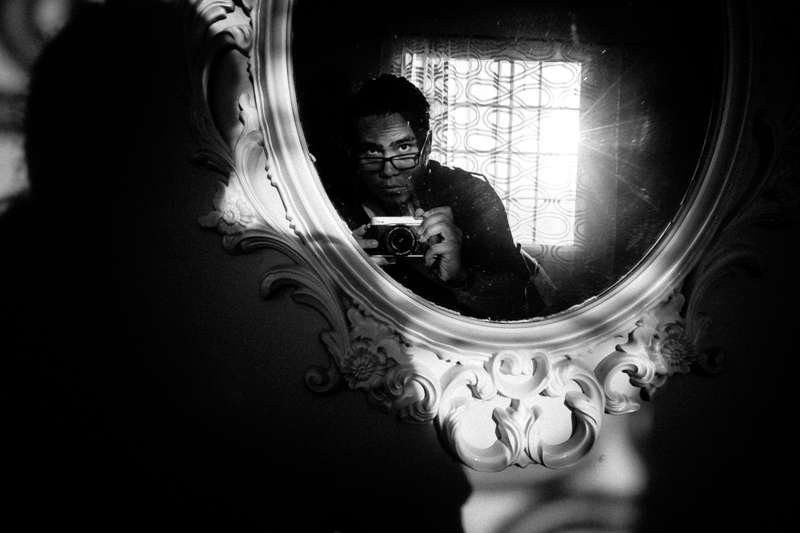
The ornate frame and the dark room around it turn a simple mirror selfie into a frame within a frame. Maier's mirror pictures often work the same way: the mirror is a small window of light in a busy or dark scene.
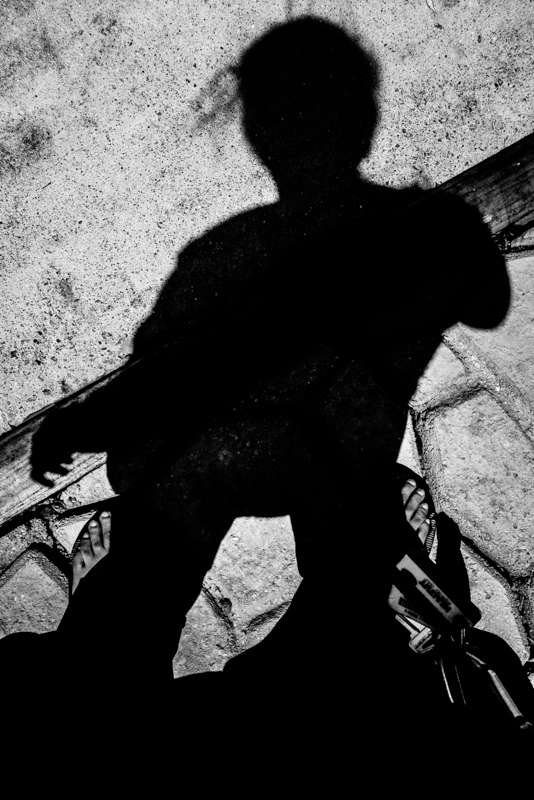
Shadow self-portraits are the easiest place to start. You only need low sun and a textured surface. The texture of the ground does half the work here.
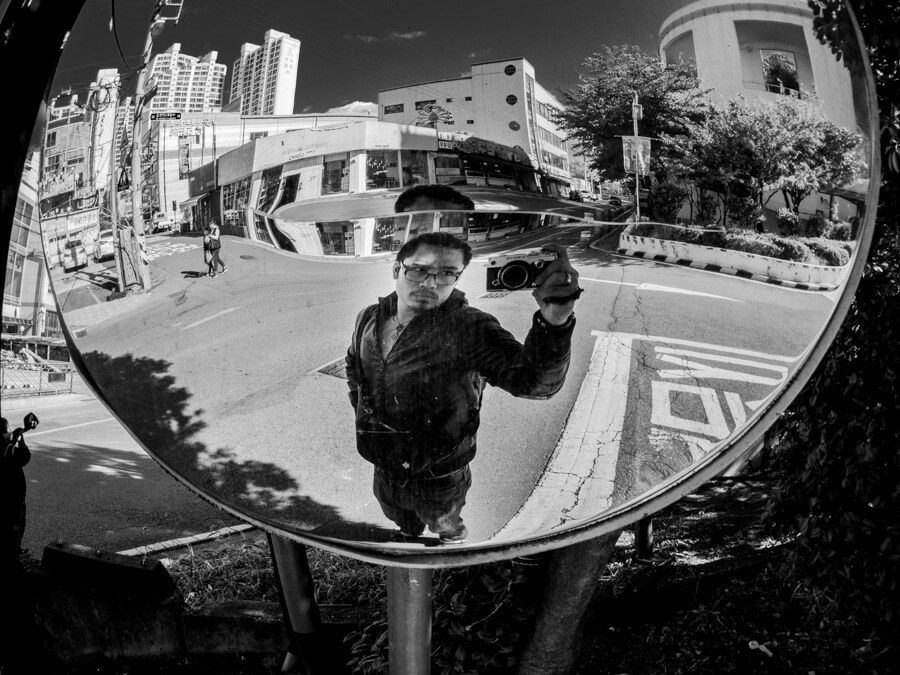
Round traffic mirrors are everywhere in Korea and Japan. They put you and the whole street in one frame. I shot this with a fisheye lens, one handed. It's a playful picture, and I think Maier would have liked the joke.
Why Vivian Maier matters to your street photography
In a guest essay for Inspired Eye, the photographer J. H. Dricker drew a lesson from Maier that I still repeat: "Practice is more important than product." She had no audience and no market. She just kept shooting for decades. Dricker also warned that quantity alone doesn't make you good; what makes her special is how many of her frames are strong.
That matters now, when most photographers judge their work by likes. If you shoot only for an audience, you start copying what gets likes. Maier shows another path: photograph what fascinates you, and keep doing it. My guide to photography as a hobby makes the case for shooting for yourself.
In my online street photography course, Phototactic, we train the eye with picture patterns, repeatable structures like "reflection plus passerby" or "shadow across a stranger." Learn a few and you see them everywhere, which is how you keep a habit going for years. The course has no feedback on your own photos, so, like Maier, the practice is yours.
If you want to walk her streets, see my guides to street photography in Chicago and New York. For more masters, see my list of famous street photographers, including Robert Frank, another outsider who photographed America.
Vivian Maier books and films
| Book or film | Year | Why get it |
|---|---|---|
| Vivian Maier: Street Photographer (powerHouse) | 2011 | The first book, edited by John Maloof. Start here. |
| Vivian Maier: Self-Portraits (powerHouse) | 2013 | Her mirror and shadow pictures |
| Finding Vivian Maier (film) | 2013 | The Oscar-nominated documentary |
| Vivian Maier: A Photographer Found (Harper Design) | 2014 | A large selection with more of her life |
| Vivian Maier: The Color Work (Harper Design) | 2018 | Her color photographs, foreword by Joel Meyerowitz |
| Vivian Maier Developed (Ann Marks, Atria) | 2021 | The most detailed biography |
Her work has been shown around the world, from the Chicago Cultural Center (2011) to the Musée du Luxembourg in Paris (2021 to 2022) and Fotografiska New York (2024). A Maier book is also on my list of the best photography books.
Frequently Asked Questions
What camera did Vivian Maier use?
Vivian Maier bought her first Rolleiflex in 1952 and used several twin lens reflex models over the years, including the Rolleiflex 3.5T, 3.5F, 2.8C and Automat. They shoot square 6x6 negatives and are held at the waist. From the late 1970s she switched mostly to 35mm cameras, including a Leica IIIc, and shot color slides on Ektachrome.
How many photos did Vivian Maier take?
Estimates run from more than 100,000 to about 150,000 negatives, plus thousands of prints and home movies. Many rolls were never developed during her lifetime. John Maloof's collection holds the large majority of her known work, and other collectors bought smaller parts at the 2007 storage auction.
Why did Vivian Maier never show her photos?
Nobody knows for sure. She was very private, and the families she worked for describe her as independent and hard to know. She shot for herself and did not look for publishers or galleries. Some of her photos were printed, but most of her work stayed in boxes until the 2007 auction brought it to light after her death.
How was Vivian Maier discovered?
In 2007 Maier stopped paying for a storage unit in Chicago, and its contents were auctioned. John Maloof bought about 30,000 negatives while researching a local history book. After finding her name and learning she had died in April 2009, he posted her photos on Flickr in October 2009. They went viral, and exhibitions and films followed.
Is Finding Vivian Maier worth watching?
Yes, if you want the story of how her work was found and how the families she worked for remember her. Directed by John Maloof and Charlie Siskel, it was nominated for the Academy Award for Best Documentary Feature. Keep in mind that Maloof owns most of her work, so for a fuller biography also read Ann Marks's Vivian Maier Developed.