
Shooting from the hip means taking a photo without raising the camera to your eye, holding it at waist or chest level and firing blind. It helps in tight crowds and for candid moments, but you lose control of framing, so zone focusing at eye level usually works better.
I'm Olivier Duong. I get the camera low when the action is low, like in Hanoi, where half the street sits on plastic stools. My Vietnam street photography guide covers where to find those scenes. But I don't recommend blind hip shooting as your main way of shooting street photography. It's a tool with a real cost, and the settings decide whether it works at all.
What does shooting from the hip mean in photography?
In photography, "shooting from the hip" means pressing the shutter button without looking through the viewfinder or at the screen. The camera hangs at waist or chest height, pointed roughly at your subject. The phrase comes from gunslingers firing without aiming, and it fits: you aim with your body, not your eye.
It's a style of photography that street photographers use for two reasons:
- To stay unnoticed and capture candid moments. A camera in front of your face tells everyone they're being photographed. A camera at your hip doesn't, so expressions and emotion stay natural. You can even keep eye contact with your subjects, unencumbered by the camera.
- To shoot where you can't lift the camera. Packed markets, subway cars, narrow alleys and crowds where there's no room to raise your arms.
It's different from waist level shooting. Vivian Maier shot with a Rolleiflex, looking down into a waist-level finder. She saw the frame; she just didn't look at the person. Tilting LCD screens on mirrorless cameras give you the same option today. True hip shooting is fully blind, taking photographs without using the viewfinder at all.
Should you shoot from the hip in street photography?
Sometimes. When you shoot from the hip in candid street photography, you trade control for invisibility. It has real benefits and real costs.
| Pros | Cons |
|---|---|
| People don't react to the camera, so the photo stays candid | You can't compose. Heads get cut, horizons tilt |
| Works in crowds where you can't raise the camera | Your hit rate drops a lot |
| A lower angle, closer to how kids and seated people see the street | If someone spots you, it looks sneaky, which invites confrontation |
| Lets you keep eye contact with the scene instead of the viewfinder | You're counting on luck instead of learning to see |
The last con matters most to me. Composition is where your pictures get better, and it's how your photography skills grow. Hip shooting hands framing to chance, and you learn less from each frame. A beginner who shoots only from the hip because they're scared ends up with a hard drive of crooked street photos of the backs of heads. The image may be candid, but it's rarely good.
Some famous photographers did shoot quickly without always framing through the viewfinder. Daido Moriyama is often described that way, working fast with small compacts. Garry Winogrand's tilted frames look spontaneous too. But both had years of seeing behind every frame. Henri Cartier-Bresson, by contrast, composed carefully through his Leica's viewfinder.
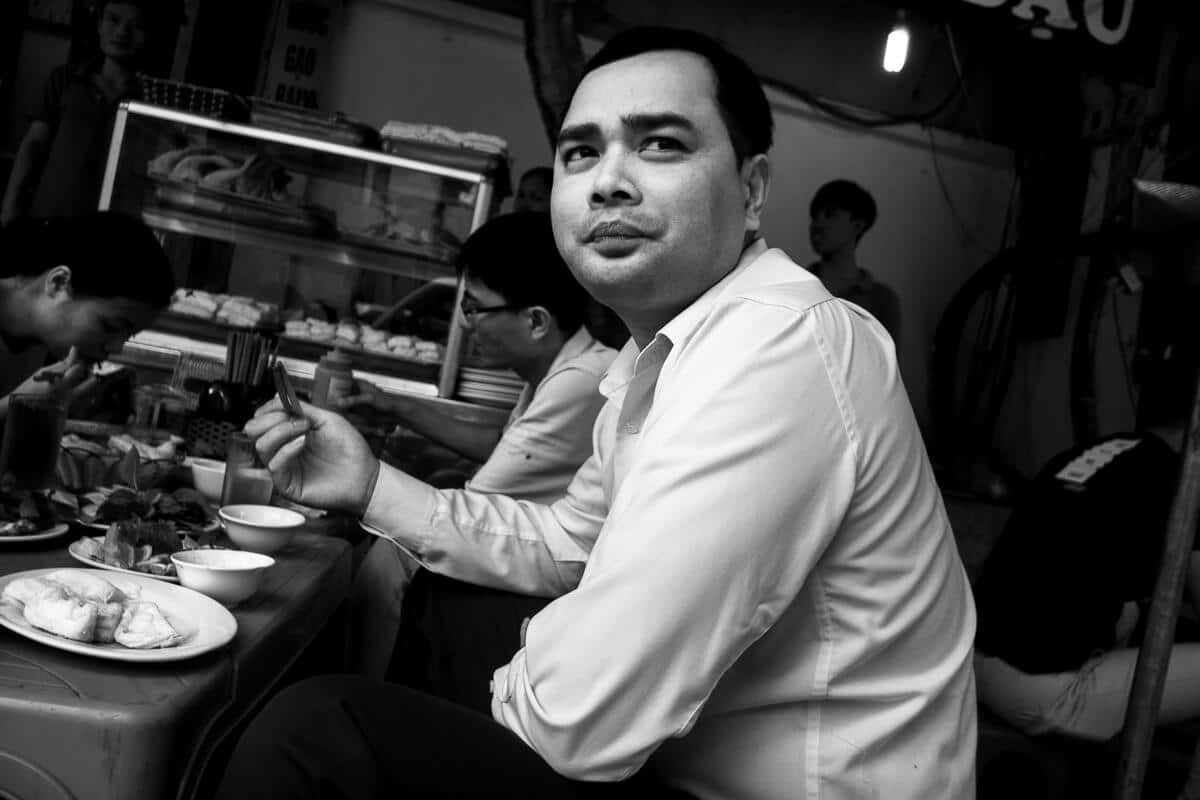
Camera settings for shooting from the hip
When you shoot from the hip you won't be looking, so you don't want to be fiddling with dials from the hip or waiting for autofocus to find a focus point. Set your exposure ahead of time and let depth of field do the focusing. Color or black and white doesn't matter here; the settings do.
- Lens: a wide angle lens, 24mm to 28mm full-frame equivalent. Using a wide angle lens with street photography helps because the wider field of view also increases the likelihood of getting your desired subject in the frame when your aim is off. A 35mm works once you're used to it.
- Aperture: a small aperture (a high f-number), f/8 to f/11, for deep depth of field. Forget bokeh here.
- Focus: manual focus or zone focus, set to a fixed focus distance of 2 to 3 meters. With a 28mm at f/8 focused at 2 m, roughly 1.2 m to 5 m is acceptably sharp. On a Ricoh GR, Snap Focus does this in one press. On older lenses, use the distance scale.
- Shutter speed: a fast shutter speed, 1/500s or faster. A faster than normal shutter speed also hides small camera shake from shooting one-handed.
- ISO: auto ISO, so the camera raises it when light drops. Use aperture priority or full manual mode with auto ISO.
- Metering: your camera's through-the-lens meter in matrix or evaluative metering rather than spot metering. A spot meter will read wherever the center lands, which is random when you're not looking.
- Burst mode: fire a short burst of 3 to 5 frames raises your chances of one good gesture.
For the settings I use when I am looking through the viewfinder, see street photography settings. For lens choice, see the best lens for street photography.
How to shoot from the hip: tips that help
These photography tips come from trial and error. Try shooting a few hundred frames this way before you judge it.
- Know your camera's field of view. Practice at home. Point the camera at a doorway from your hip, take a shot and check it. Repeat until you can predict the frame.
- Aim with your chest. Point your body at the subject. The camera follows. Keep your elbow tucked in so the camera stays steady.
- Hold the camera level. Most hip shots tilt. Some cameras show a level on the screen; glance at it before the moment, not during.
- Tilt the lens up slightly. From waist height, a camera pointed straight ahead cuts off heads. Angle it up a little.
- Consider putting your camera on a short strap or wrist strap so it rests naturally in your hand instead of swinging.
- Don't look at your subject either. Staring at someone while your camera clicks at your hip is more suspicious than just raising the camera.
- Crop later if you must. Shooting a bit wider and cropping in post is fine. A straight, clean crop beats a crooked full frame.
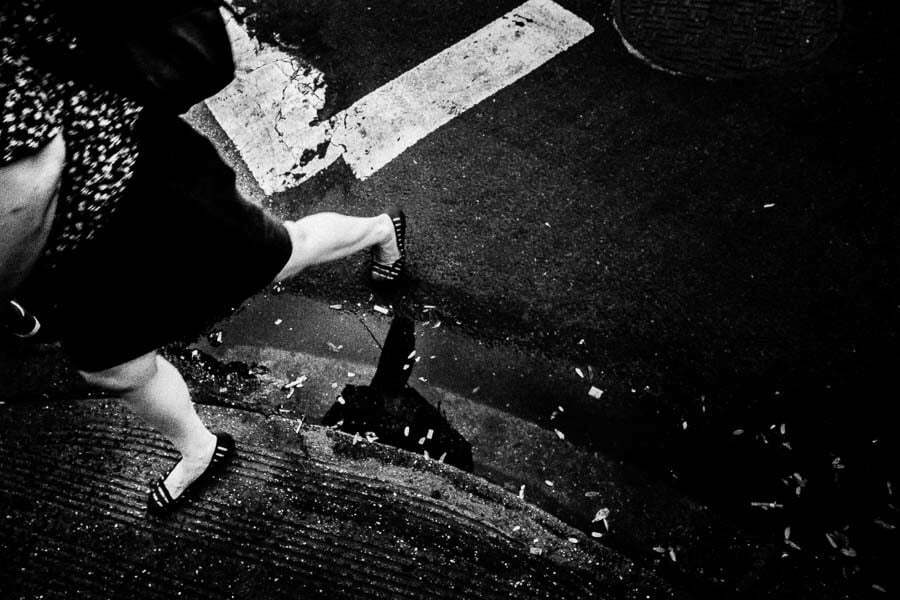
When not to shoot from the hip
Hip shooting has an ethical side, and it's where I draw lines.
- In Japan and Korea, be very careful. Both have a real problem with men secretly photographing women, especially on trains. A camera held low can look like an attempt to shoot up a skirt. Phones sold in Japan and Korea generally make a shutter sound you can't turn off, for exactly this reason. Don't hip shoot near women there. Just don't.
- Around children. A hidden camera near kids looks terrible, whatever your intent.
- When you're using it to hide fear. If you only hip shoot because you're scared, it keeps you scared. Work on the fear itself instead.
- When a silent shutter plus a hidden camera turns candid into covert. A silent shutter is useful, but combined with blind shooting it's surveillance, not street photography.
There's a difference between not drawing attention and hiding, and it matters for people's privacy. The first is fine. The second is what makes people feel street photography is creepy. More on that in is street photography creepy?
Better ways to do street photography without being noticed
Most people shoot from the hip because they want candid shots without anyone reacting. There are better tools for that:
- Zone focus at eye level. Pre-focus, bring the camera up, shoot, lower it. The camera up to your face for a second is barely noticed. You get composition and speed.
- Set a trap. Find a strong background and wait for people to walk into it. You're shooting a scene, not a person, and nobody feels targeted.
- Stay put after the shot. Keep looking through the camera or at the scene past your subject. People assume they weren't the point.
- Use a small camera. A compact draws far less attention than a big digital SLR. See the best camera for street photography.
- Look relaxed. The streets mirror you. Nervous, shifty body language draws eyes. Calm and open gets ignored.
- Get the camera low when the action is low. Squat or sit, and you can use the LCD screen instead of guessing. You still see the frame without looking through your viewfinder.
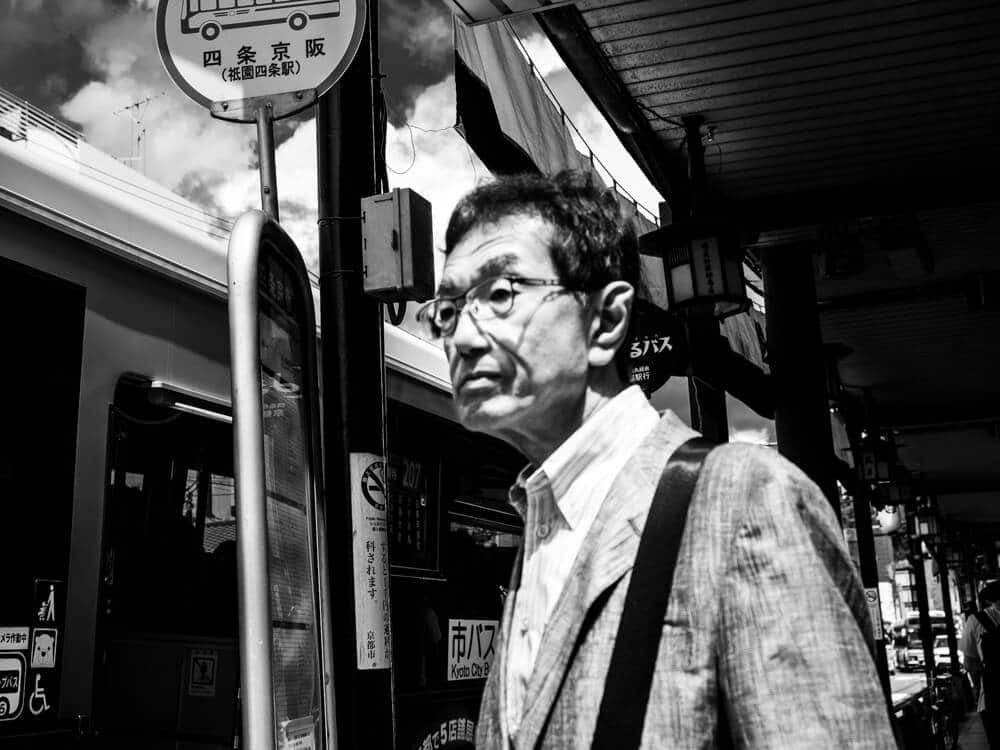
For the full picture on candid work, read candid photography and how to photograph strangers. If nerves are the reason you hip shoot, my guide on how to overcome the fear of street photography is a better fix.
Get closer without hiding
Hip shooting is a crutch that feels like a technique. The photographers I admire get close and stay visible, and they know why they raise the camera.
In Phototactic, our street photography course, Don Springer and I cover how to do street photography without being noticed. A bonus recorded shooting demonstration shows a sneaky trick to get super close shots, even if you fear shooting strangers. The core of the course teaches the picture patterns and composition keys that make each frame count, so you rely less on luck. It's $297 as one payment with a 60 day money back guarantee.
Frequently Asked Questions
What is shooting from the hip in photography?
Shooting from the hip means taking a photo without looking through the viewfinder or at the screen. You hold the camera at waist or chest level, point it with your body, and press the shutter. Street photographers use it to stay unnoticed or to shoot in crowds where raising the camera isn't possible.
What settings should I use to shoot from the hip?
Use a wide angle lens around 28mm at f/8 to f/11, zone focused at 2 to 3 meters. Set a shutter speed of 1/500s or faster with auto ISO. Matrix metering works better than spot metering, and a short burst helps you catch the gesture.
Is shooting from the hip good for street photography?
It helps in tight crowds and keeps people from reacting, but you lose control of composition and your hit rate drops. For most photographers, zone focusing and raising the camera briefly to eye level works better. Use hip shooting as an occasional tool, not your main method.
How do you do street photography without being noticed?
Use a small camera and zone focus, so you can raise it for just a second. Set up in front of a good background and let people walk into your frame. Stay put after the shot and keep a relaxed look. Being unobtrusive is different from hiding.
Is shooting from the hip creepy?
It can be. A hidden camera looks sneaky if someone notices, and in places like Japan a low camera can be mistaken for secret photography of women. Avoid hip shooting near women in those settings and near children. Shooting openly at eye level is often less suspicious.