
Daido Moriyama (born 1938) is a Japanese photographer known for grainy, blurred black and white street photographs of Tokyo, especially Shinjuku, made with small compact cameras. The lesson you can use from him: walk a lot and shoot fast. Grain and blur are part of the picture, not mistakes.
I'm Olivier Duong. I teach street photography, and I point people to Moriyama when they are stuck chasing clean, sharp files. His pictures feel like memory. They are rough on purpose, and they prove that a pocket camera is enough.
What is Daido Moriyama known for?
Moriyama is known for the style often summed up in Japanese as are, bure, boke: grainy or rough, blurred, and out of focus. That look came out of Provoke, a short lived photography magazine he joined with its second issue in 1969. It pushed against the clean, realist photojournalism that dominated Japan at the time.
His pictures show postwar Japan from the street: neon signs, tights and legs, shop windows, crowds, traffic and stray animals. Tilted angles and harsh contrast are everywhere. His most famous single image is Stray Dog, Misawa (1971), a scruffy dog turning back toward the camera.
He is also known for the photobook. Moriyama has produced more than 150 of them since 1968. For him, the book and its sequence are the work, not the single print.
Daido Moriyama's life: from Osaka to Shinjuku
Daido Moriyama was born Hiromichi Moriyama on 10 October 1938 in Ikeda, Osaka. His family moved often because of his father's job. As a teenager he worked in graphic design, then turned to photography in his early twenties after a friend sold him a cheap Canon IV Sb.
In Osaka he worked in the studio of photographer Takeji Iwamiya. In 1961 he moved to Tokyo to join the photographers' group Vivo, which was about to break up, and became an assistant to Eikoh Hosoe. He helped Hosoe on Ordeal by Roses, the series with writer Yukio Mishima. He went freelance in 1964 and often photographed around the American naval base at Yokosuka.
His first photobook, Japan: A Photo Theater, came out in 1968 with text by the poet and playwright Shuji Terayama. After Provoke he published Farewell Photography (1972), a book so rough it almost takes photography apart, and A Hunter (1972), made on a road trip across Japan inspired by Jack Kerouac's On the Road. The Hasselblad Foundation also names William Klein and James Baldwin among his influences.
From the 1970s he kept shooting the streets, above all in Shinjuku in Tokyo. He shared a two person exhibition with William Klein at Tate Modern in 2012 and 2013. In 2019 he won the Hasselblad Award, often called the most important prize in photography. On receiving it he said the award recognized "my lifelong commitment to photographing the streets."
Daido Moriyama's style: grain and blur in the snapshot
Moriyama calls what he does snapshot photography. His advice to beginners, in the book Daido Moriyama: How I Take Photographs, is blunt: "Get outside. It's all about getting out and walking." Then: "forget everything you've learned on the subject of photography for the moment, and just shoot."
A few habits show across his work.
- A compact camera. He has worked for decades with small cameras, famously the Ricoh GR, small enough to fit in the back pocket of his jeans. In a 2019 Ricoh interview he said "the camera must be compact and light-weighted" for his street work, and that "the GR has been my favorite since it was a film camera."
- A fixed 28mm view. The same wide angle for years. He never has to think about focal length, so he only thinks about what's in front of him. My guide to the best lens for street photography explains why 28mm suits this kind of shooting.
- Shooting while moving. Many pictures are taken walking or from a car, often without raising the camera to his eye. Frames tilt and subjects blur. See my guide on how to shoot from the hip for when this works.
- Hard contrast in the print. Deep blacks and heavy grain from pushed film and rough printing. My guide to black and white photography covers how to push contrast in the edit.
- No waiting. "I go ahead and take photos one after another. If I fail, I take another one again. I do not look back on life. Photograph is the same for me," he told Ricoh's GR blog.
He isn't hunting for a decisive moment in the Cartier-Bresson sense. He is collecting fragments of the city and building meaning in the sequence of a book. That's a different model, and a freeing one if the decisive moment feels out of reach.
Four Daido Moriyama works to study
I don't reproduce his photographs here. The Daido Moriyama Photo Foundation site and museum collections such as SFMOMA are the places to see them. Look each one up while you read.
Stray Dog, Misawa (1971)
A ragged dog near the U.S. Air Force base in Misawa looks back over its shoulder. It appeared in A Hunter, and many people read it as a self portrait of the photographer as a wandering animal. The move: one strong subject, close, with rough grain. Simple and hard to forget.
Japan: A Photo Theater (1968)
His first book mixes street scenes, blurred faces, signs, nightlife and traveling performers in a fast sequence. The move: don't judge single frames only. Lay out a set of prints and see which ones talk to each other.
Farewell Photography (1972)
Scratches, dust, light leaks and film edges become the pictures. It's his most extreme book. The move: ask what a photograph is when it barely shows anything. You don't have to agree to learn from the question.
Shinjuku (2002)
Years of work in one Tokyo district: crowds, alleys, bars and signs. It shows what happens when you return to the same place again and again. The move: pick one neighborhood and photograph it for a year.
Steal this move: a Moriyama walk
This is an exercise for one evening walk in a dense part of any city.
- Take the smallest camera you own. A compact or your phone. A Ricoh GR is close to his setup. Set it to black and white with high contrast. My Ricoh GR recipes include a high contrast monochrome look.
- Zone focus and forget it. Set about 2 meters, f/8 in daylight, and a high ISO at night. Accept the grain. My night street photography guide has settings.
- Walk and don't stop. Photograph whatever catches your eye: a sign, a leg, a reflection, a dog. Don't pause to judge it.
- Tilt and blur on purpose. Shoot some frames at waist height while walking. Some will fail. That is part of the method.
- Sequence, don't select. Print 20 small proofs and lay them out. Build a run of ten where each picture leads to the next. A photo zine is the perfect format for this.
Keep in mind that shooting at waist height in crowds still means photographing people who haven't agreed. Read is street photography legal for the rules where you live.
My take: lessons I use from Moriyama
I shot most of my own work on small sensor cameras for years, and Moriyama is one reason I never felt I needed anything bigger. These are my photos, not his, but they use ideas I learned from him.
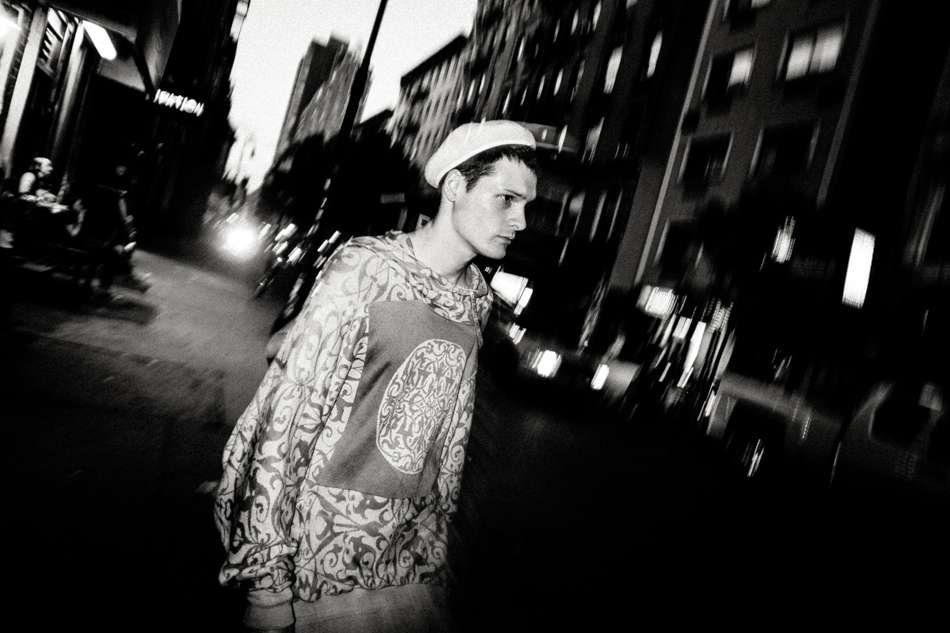
At night I stop trying to get a clean file. A slow shutter and a tilted frame say more about the street than sharp detail would. Look for patches of light and let the rest fall to black.
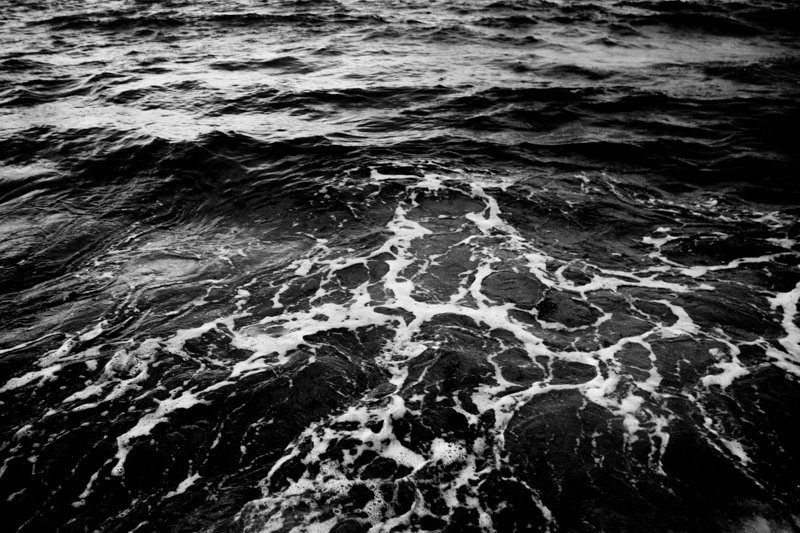
I took this on a beach walk with the kids with a small sensor camera. I would never have carried my big camera there. That's the Moriyama point about compacts: the camera you have in your pocket gets the picture. Push the contrast and the grain becomes texture.
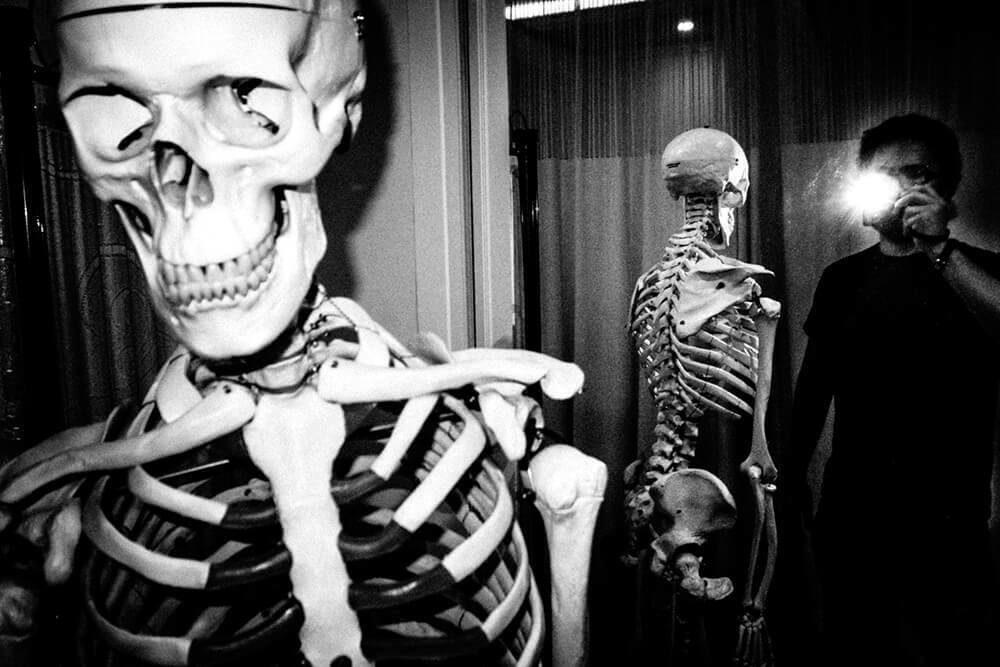
I made this in Hanoi while my wife was at physiotherapy. A small camera and a flash turned a waiting room into something strange. Moriyama often found his pictures in odd corners like this, not at famous sights. For more on this, read my guide to flash street photography.
Why Daido Moriyama matters to your street photography
Many photographers I hear from are stuck on gear and on sharpness. Moriyama answers both. He shot one of the most admired bodies of street work in the world on a pocket camera, and he made the flaws part of the language.
He also shows that street photography can be personal and emotional instead of neat. His Tokyo is anxious and restless. That's a mood, and mood is something you can learn to put in a frame on purpose.
In my street photography course, Phototactic, a whole module is about emotion and how picture elements carry it, and another covers editing for a "wow" factor. The course has no feedback on your own photos, so the walking and shooting are up to you. Moriyama would say that's the only part that matters anyway.
If you want to shoot where he did, my guides to street photography in Tokyo and Osaka cover the areas. For more masters, see my list of famous street photographers and the best street photography books, where Moriyama's books have a place. Two of his lines are in my collection of street photography quotes.
Daido Moriyama books and exhibitions
| Book | Year | Why get it |
|---|---|---|
| Japan: A Photo Theater | 1968 | His first book. The raw start. |
| Farewell Photography | 1972 | His most radical book, with film debris as image |
| A Hunter | 1972 | Road trip pictures, including Stray Dog, Misawa |
| Shinjuku | 2002 | Tokyo's busiest district over years of walking |
| Daido Moriyama: How I Take Photographs (with Takeshi Nakamoto) | 2019 (English edition) | His method and his cameras. The most practical one for beginners. |
His long running Record series of small magazine style books is a good way into his later work. The Photographers' Gallery in London has shown a major retrospective, and SFMOMA holds his work in its collection. The official foundation site keeps a full bibliography.
Frequently Asked Questions
What camera does Daido Moriyama use?
Moriyama is best known for using small compact cameras, especially the Ricoh GR series with its fixed 28mm lens. He used the GR when it was a film camera and later the digital models, and in a 2019 Ricoh interview he said his street camera must be compact and light. His first camera, bought cheap from a friend in his twenties, was a Canon IV Sb.
What does are, bure, boke mean?
Are, bure, boke is a Japanese phrase usually translated as grainy or rough, blurry, and out of focus. It describes the look associated with Provoke magazine in 1968 to 1970, which Moriyama joined from its second issue. The style rejected clean, realist photojournalism and tried to show how fragmented and uncertain everyday life felt.
What is Daido Moriyama's most famous photo?
His most famous photograph is Stray Dog, Misawa, taken in 1971 near a U.S. Air Force base in northern Japan and published in his 1972 book A Hunter. It shows a ragged dog looking back at the camera. Many people read it as a symbol of the photographer himself, a wanderer prowling the streets.
What was Provoke magazine?
Provoke was an avant-garde Japanese photography magazine founded in 1968 by Takuma Nakahira, Yutaka Takanashi, critic Koji Taki and writer Takahiko Okada. Only three issues came out, in 1968 and 1969, plus a book in 1970. Moriyama joined from the second issue. Its rough, blurred style had a huge influence on Japanese and world photography.
What advice does Daido Moriyama give beginners?
In Daido Moriyama: How I Take Photographs he says the first thing he tells anyone is to get outside and walk. The second is to forget everything you've learned about photography for the moment and just shoot, photographing anything that catches your eye without pausing to think. Walking and volume come first.