
Flash street photography means lighting people on the street with a camera flash, day or night, for a raw, hard look you can't get from natural light. It is the most confrontational way to shoot, so use the flash openly and be ready to talk.
Traditional street photography is quiet and works with available light. Shooting with a flash is the opposite: you control the light and everyone knows you took the picture.
I'm Olivier Duong. I shot flash on the streets of New York and Miami with a tiny Ricoh GRD IV, and I used flash when I shot weddings. Flash is technical, and a lot of people bury it in math. You only need a few rules, and I'll keep it simple.
Why use a flash in street photography?
Street photographers use flash for two reasons: they need light, or they want the look. Often it is both.
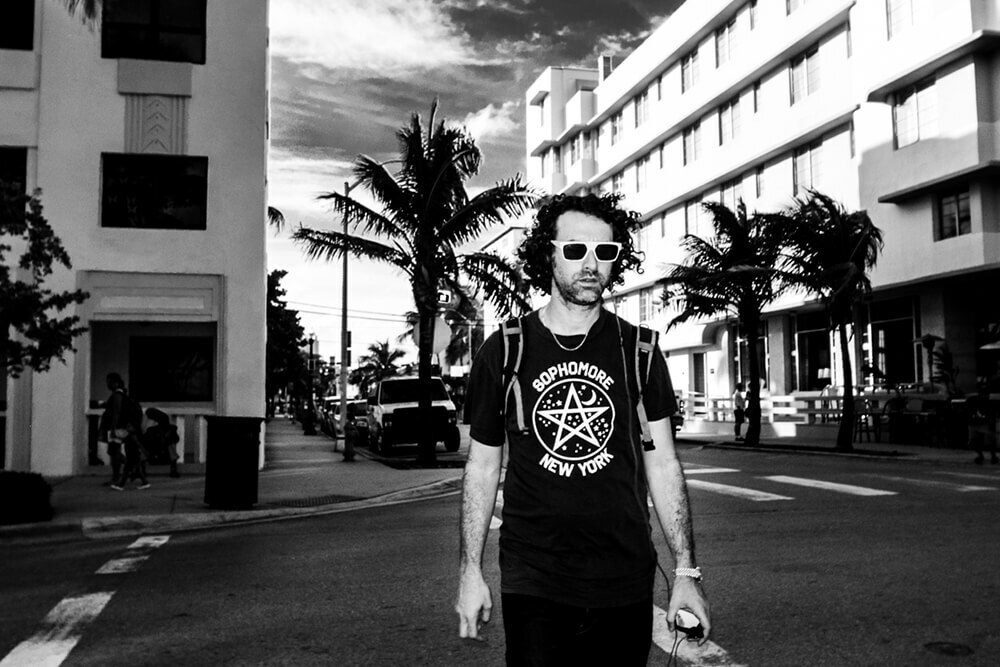
- Need. At night, or when your camera struggles in low light, a flash creates the light that isn't there. See night street photography for the no-flash approach.
- Aesthetics. Direct flash gives harsh shadows and a gritty, in-your-face look. Many street photographers love it so much they shoot nothing else.
- Eye travel. Light the subject and let the background go darker, and the eye goes straight to your subject. It is one of the easiest ways to add contrast.
- Freezing motion. A flash burst is very short, so it freezes a moving subject even at a slow shutter speed.
Is flash street photography rude?
It can be. Walking past someone and taking a picture is almost invisible. Firing a flash in someone's face is not. They see a pop of light and may be blinded for a second or two.
My rule is respect-based shooting. Subjects are people. I shoot at a normal distance and I don't shove the camera into anyone's face. How close you get is your call, but if you use flash, own it. Don't pretend you didn't take the picture. Smile and talk if they want to talk.
On Reddit, the fear sounds like this: "I'd like to try to get close, but I'm afraid someone will flip on me." With flash that fear is realistic, so prepare a few calm answers first. I wrote them out in what to say when someone confronts you. For the ethics side, read is street photography creepy?
How Bruce Gilden uses flash
Bruce Gilden is the best known flash street photographer alive. Born in Brooklyn and a member of Magnum Photos since 1998, he built his reputation on candid close-ups of people on the streets of New York City lit with a flashgun.
His method is simple and hard. He holds the camera in one hand and an off-camera flash on a cord in the other, then steps into the subject's path at the last moment. He has described it as "flash in one hand and jumping at people." Accounts of his kit usually mention a Leica with a wide angle lens and a small handheld flash.
He also divides photographers. Joel Meyerowitz has publicly called him a bully, and reviewers have said his style works against humanizing his subjects. That is worth knowing before you copy it.
What to take from Gilden: commit. Half-hearted flash looks timid and still annoys people. The off-camera flash angle also gives you shape and hard side shadows that an on-camera flash can't. You don't need his aggression to use that.
Gilden's official site is brucegilden.com, and his portfolio is on Magnum Photos.
How Mark Cohen uses flash
Mark Cohen, born in 1943 in Wilkes-Barre, Pennsylvania, photographs people very close with a wide-angle lens and a flash, often cropping out their heads to focus on a small detail. He had a solo show at the Museum of Modern Art in 1973, and his books include Grim Street (2005) and True Color (2007).
Martin Parr used flash in daylight too, but in saturated color, to make British seaside crowds look loud and a little absurd.
Cohen called many of these pictures "grab shots". He often shot from the hip with the camera pre-focused and fired the flash at close range. The frame cut people into fragments, like a forearm or a homemade tattoo. He has called his method intrusive. He worked the same neighborhoods between Wilkes-Barre and Scranton for about thirty years.
What to take from Cohen: flash can make a small detail the whole picture. And a familiar place is enough. He didn't need Paris or Tokyo. He needed his own town and a flash. If you shoot from the waist, read how to shoot from the hip first.
What gear do you need for street photography with a flash?
You need a camera and a small flash with manual power control. The built-in flash on your camera is fine for a first try, but it is weak and drains the battery. You have to be very close for it to register.
Built-in vs external flash. Experiment with the built-in one first. If you like the look, buy a small external flash. Don't buy gear before you know you'll use it.
Small flashes I like for street photography:
- Fujifilm EF-X20. Pocketable, with a satisfying power dial on top. Fixed head, runs on two AAA batteries, so carry spares.
- Fujifilm EF-20. More powerful but more plastic. The head tilts up and down.
- Nissin i40. A mini full-size speedlight with a tilting, swiveling head and simple manual dials. Made in versions for several brands with TTL (through-the-lens metering), where the camera sets the flash power for you.
- Your brand's small flash. For example, the Canon 270EX II or the Nikon SB-300. They talk to your camera, while a flash from another brand often becomes "dumb" and only fires at full power.
Godox and other makers sell small, cheap manual flashes for most mounts too. Look at recycle times and whether it takes AA batteries or a rechargeable battery pack. On a long day, slow recycling costs you shots.
On-camera vs off-camera flash. A flash cable (or a wireless flash trigger, which I find overkill) lets you hold the flash in your hand like Gilden. It gives you control over where the light falls. Unless you want to be a full-time flash user, keep the flash on the hot shoe. You'll still get great shots. For the camera itself, a small one balances best with a small flash. My picks are in the best camera for street photography.
Using your flash: settings for street photography
Flash photography changes how exposure works. With flash you control two exposures at once. The shutter speed controls the ambient light (the background the flash doesn't reach). The aperture and flash power control the subject the flash hits.
That is why automatic flash gives average, cookie-cutter results. Once you know which dial controls which part, you decide how dark the background goes. The bigger the gap between flash and ambient light, the more your subject pops.
Get your settings before you shoot:
- Set ISO low. With a flash you rarely need high ISO settings.
- In manual mode, set aperture and shutter speed for a normal looking background exposure.
- Put the flash in manual at full power (1/1).
- Wait for someone to pass at the distance you plan to shoot, and take a test frame.
- They will probably be too bright. Lower the flash power until the subject looks right.
- Want a darker background? Use a faster shutter speed, up to your camera's sync speed.
Sync speed is the fastest shutter speed that works with a normal flash, often around 1/180s to 1/250s on cameras with a focal plane shutter. Leaf shutter compacts like the Ricoh GR and Fujifilm X100 series can sync much faster. Most cameras don't warn you when you go past it, and you get a dark band across the frame, so learn your number.
| Look | Shutter speed | Aperture | ISO | Flash power |
|---|---|---|---|---|
| Daylight fill flash, subject in shade | 1/250s (up to sync) | f/8 to f/11 | 100 to 200 | 1/8 to 1/4 |
| Dark background, subject pops | At sync speed | f/8 | 100 to 400 | 1/4 to 1/1 |
| Night, keep some city light | 1/30s to 1/60s | f/5.6 | 400 to 800 | 1/16 to 1/8 |
| Drag the shutter (sharp subject plus blur) | 1/8s to 1/15s | f/5.6 to f/8 | 200 to 400 | 1/8 to 1/4 |
These are starting points at 1.5 to 2 meters. Change the flash power for distance and keep the rest locked.
The inverse square law, made simple
Double the distance between your flash and your subject and they get a quarter of the light. That's all you need from the inverse square law as a street photographer.
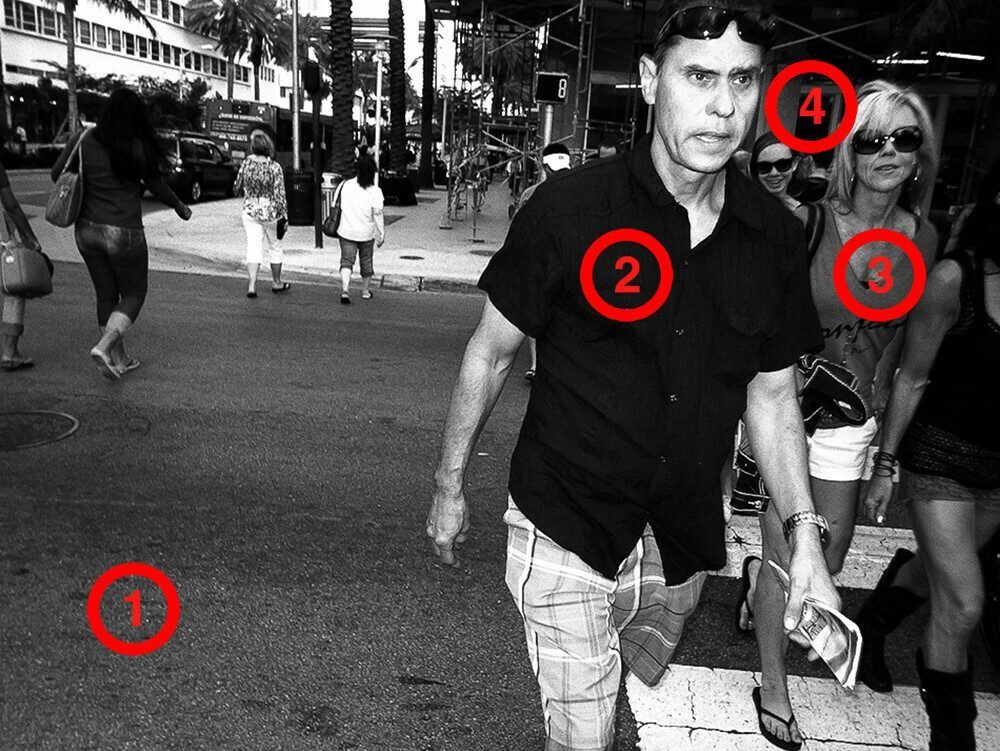
In this frame I fired the flash to the right. The left side is pure ambient exposure, set by the shutter speed. The man one step from me gets the full power of the flash. The woman one step behind him is already much darker, because she is twice as far away and gets a quarter of the light. People further back barely register. Light falls off fast.
Studio shooters calculate this. You don't need to. Keep the distance to your subjects consistent and your exposures will be consistent too.
Flash street photography tips
Mind your distance. A step too close and the subject is overexposed. A step too far and they are dark. I decide the kind of shot I want in advance and keep the same distance, instead of fiddling with settings every frame.
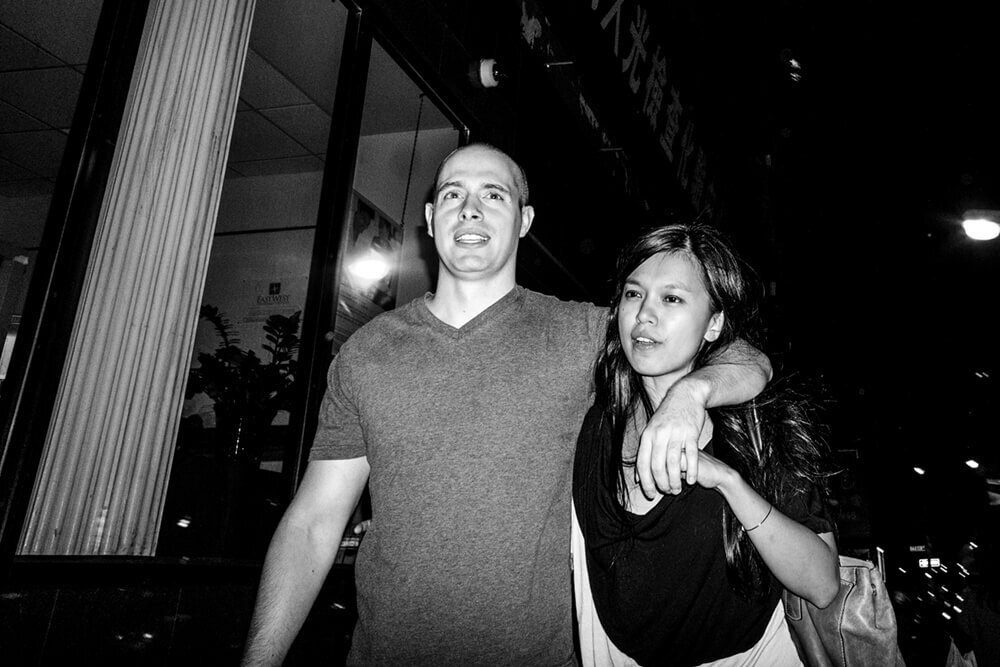
Shoot RAW and underexpose. When in doubt, use less flash. You can lift an underexposed RAW file in Lightroom. You can't bring back highlights the flash burned out.
Beware of white. White shirts and menus blow out first. Look at the side of the waitress's shirt below: nothing could recover it.
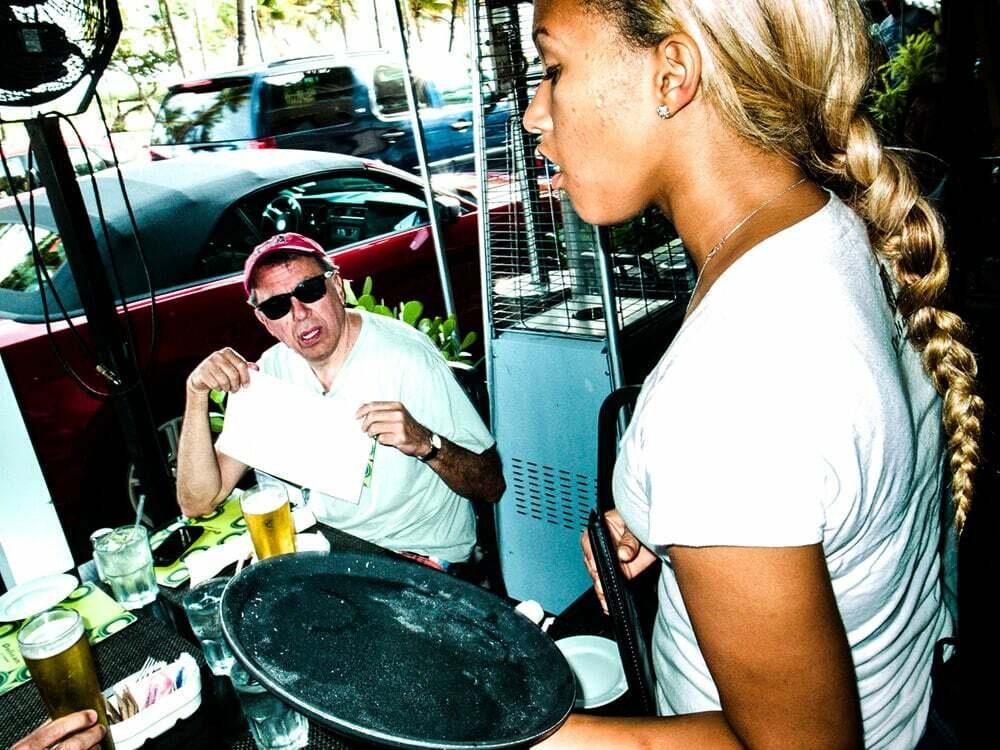
Muted flash. Flash doesn't have to be obvious. In hard sun, fill flash lifts a face that sits in shadow and nobody looking at the photo notices. It is the quietest way to use a flash on the street.
Drag the shutter. Use a slow shutter speed with the flash, from 1/15s and slower. The flash freezes your subject while the background and light trails streak. Rear curtain sync fires the flash at the end of the exposure, so the trails fall behind the moving subject. I cover it in motion blur photography.
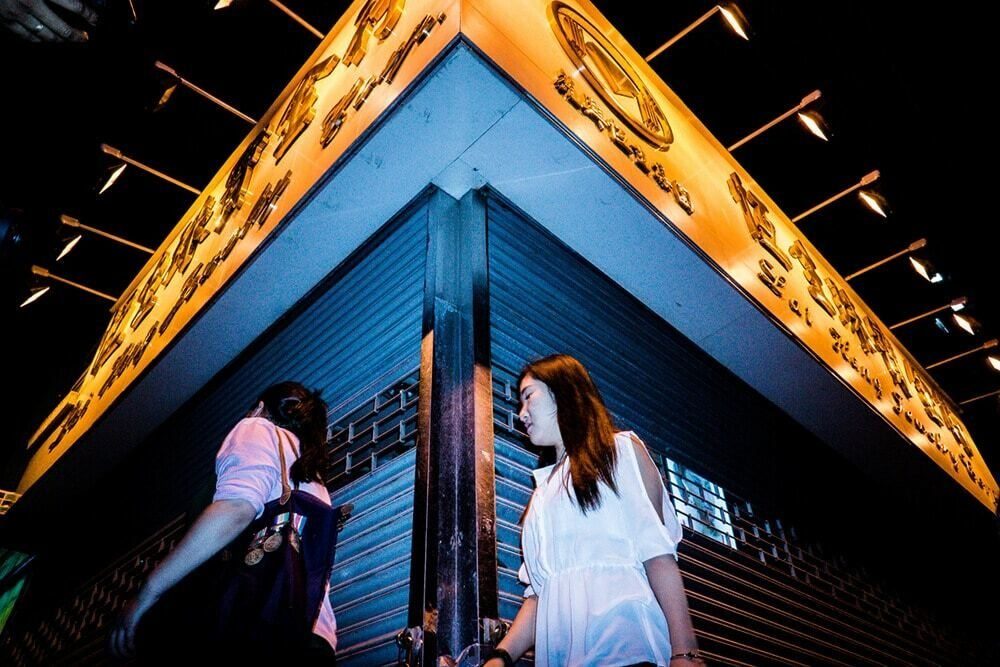
Blend colors or make them fight. Flash has a different color temperature from street lamps and neon. Mix the ambient color of the signs with your flash, and you get color you can't get any other way.
Flash is a tool. Seeing is the skill.
A flash makes any subject pop, which is exactly why flash photos can look alike. What makes one great is the same thing that makes any street photograph great: what's in the frame and how it's arranged.
That is what my street photography course teaches: composition and picture patterns, for any camera. It also includes a Photography Basics bonus on how to control light and how settings change the image. It does not include feedback on your photos. If you want to understand exposure without a meter first, start with the sunny 16 rule, and use the street photography settings cheat sheet for everything that isn't flash.
Frequently Asked Questions
What are the best flash settings for street photography?
Start in manual: ISO 100 to 400, f/8, shutter at your sync speed (often 1/180s to 1/250s) and the flash in manual at 1/4 power, with the subject 1.5 to 2 meters away. Take a test shot, then adjust flash power for the subject and shutter speed for the background. Keep your distance consistent so the settings keep working.
What is the best flash for street photography?
A small flash with manual power control. The Fujifilm EF-X20 fits in a pocket, and the Nissin i40 is a mini full-size speedlight with tilt and swivel. Small brand flashes like the Canon 270EX II or Nikon SB-300 also work well because they talk to your camera. Pick small and light: a big speedlight on a small camera tires your hand.
Can you use flash for street photography during the day?
Yes. In daylight, flash fills shadows on faces under hard sun, or makes the subject pop against a darker background if you use a fast shutter speed. You are limited by the flash sync speed, so a leaf shutter camera like the Ricoh GR or Fujifilm X100 series gives you more room in bright sun.
Is flash street photography legal?
In most countries where street photography is legal, using a flash in a public place is legal too, but local rules differ and some places ban flash, such as certain museums and transport systems. This is general information, not legal advice. Check our guide to whether street photography is legal where you live.
How do you avoid confrontations when shooting street photography with a flash?
Be open about it. Don't hide after the flash fires. Smile and be ready to explain what you are doing. Keep a respectful distance instead of firing inches from someone's face, and if someone asks you to delete a photo, consider doing it. Calm beats clever.