
Bruce Gilden (born 1946) is an American Magnum photographer known for close-up, flash-lit photographs of strangers on the streets of New York and around the world, often taken from less than a meter away without asking. The lesson worth taking from him is commitment to one clear way of seeing, and to getting close. His method of firing a flash in people's faces is also one of the most debated consent questions in street photography.
I'm Olivier Duong. I teach street photography, and I don't teach Gilden's method. But you can't understand the genre today without him, and he has real lessons for photographers who hang back. I'll cover both sides here, fairly.
What is Bruce Gilden known for?
Bruce Gilden is known for photographing people at very close range with a flash, usually on busy sidewalks, at the moment they walk into him. The results are hard, dramatic black and white frames: faces lit harshly against a darker street, with surprise or tension in their expressions. His own line sums it up: "I'm known for taking pictures very close, and the older I get, the closer I get."
He is also known for strong characters. Over more than 50 years he has photographed Coney Island, Mardi Gras in New Orleans, Haiti, Japan's yakuza, rural Ireland and the English Black Country. His later color portraits, gathered in the book Face (2015), show faces in extreme detail.
And he is known for dividing people. Some photographers see honest, energetic work that shows people society ignores. Others see a method that treats strangers as targets. Both views deserve a hearing, and I cover them below.
Bruce Gilden's life: from Brooklyn to Magnum
Bruce Gilden was born in Brooklyn in 1946. He went to Penn State to study sociology, found it too boring for his temperament and left. He briefly thought about acting. Seeing Michelangelo Antonioni's film Blow-Up is often cited as what pushed him toward photography. In 1967 he bought a camera and decided to become a photographer. Apart from a few evening classes at the School of Visual Arts in New York, he is self-taught.
Street life fascinated him from childhood, and his first long projects were at Coney Island and at Mardi Gras in New Orleans. His book Facing New York (1992) collected his sidewalk work in Manhattan. Haiti (1996) won the European Publishers Award for Photography, and Go (2000) covered his years photographing in Japan.
He joined Magnum Photos in 1998 and became a full member in 2002. He became a Guggenheim Fellow in 2013. Magnum counts 23 monographs of his work, including Black Country and The Circuit, both from 2022. The documentary Misery Loves Company: The Life and Death of Bruce Gilden (2007) is about him.
He is still active. In 2026 a major monographic exhibition of his work opened at the Museo di Santa Giulia in Brescia, Italy, and Fotografiska Berlin showed a selection of 41 photographs he picked himself. He still posts new work on his official Instagram and on his Magnum profile.
Bruce Gilden's style: close and lit by flash
Magnum describes his style as "up-close, flash-lit, emotionally engaged, and real photographs of real people." Here is how he works, as he and others have described it.
- A wide lens, very close. Accounts of his kit usually mention a Leica with a 28mm lens. At that focal length you have to be within a meter or two to fill the frame with a face.
- Handheld flash. He holds the camera in one hand and a flash on a cord in the other, and fires both as the person reaches him. He has described it as "flash in one hand and jumping at people." My guide to flash street photography explains the technique and its risks.
- Timing on the move. He positions himself in the flow of a crowd and steps in at the last moment, so the subject has no time to react before the shutter fires.
- Characters. He picks people with strong faces or a strong presence. He has said he is drawn to the double lives of the people he photographs.
- Robert Capa's rule. Magnum says he applies the mantra often attributed to Capa: "If your pictures aren't good enough, you aren't close enough."
His color portrait work for Face is different. Those are posed close-ups, and reports at the time said he got permission from the people in them. That detail matters in the debate below.
The flash-in-the-face debate: consent and ethics
Gilden's street method raises a real question: is it okay to startle a stranger with a flash from a few centimeters away and publish the result without asking? Here are the main arguments on each side.
The case against
- No consent, and no chance to refuse. The method is designed so the person can't react until it's over.
- It can feel like an ambush. A flash at arm's length is physically startling, and some people read it as aggression.
- It can exploit vulnerable people. Critics say the pictures often make ordinary people look grotesque. Reviewing Face in The Guardian, Sean O'Hagan wrote that "his style seems to work against any intention to humanise his subjects."
- Peers object too. Joel Meyerowitz, in a widely quoted interview, called him "an aggressive bully."
The case for
- Honesty. Supporters say he shows people as they are, including people who rarely appear in glossy pictures, and that he photographs them as equals rather than as victims.
- Energy. His frames have a force that polite, distant street photography rarely has.
- Commitment. He spends years on a subject, in Haiti or Japan, rather than grabbing a few frames and leaving.
- Legality in many places. On a public sidewalk in the United States, photographing people without consent is generally legal. But the law differs a lot by country. France, for example, gives people strong rights over their image. My guide to whether street photography is legal covers the differences. This is general information, not legal advice.
My own view: legal is not the same as right. I don't use a flash in strangers' faces, and I don't recommend it. If someone notices you and objects, the respectful thing is to talk, show the picture and delete it if they ask. My pages on whether street photography is creepy and on handling confrontation go further. You can still learn from Gilden's commitment and closeness without copying the ambush.
Four Bruce Gilden books to study
I don't reproduce his photographs here. They are protected, and his Magnum Photos profile and his official website are the places to see them.
Coney Island (2002)
His first big subject, photographed from the late 1960s onward. Beach crowds and summer chaos. The move: start with a place full of people who are relaxed and outgoing.
Facing New York (1992)
The classic sidewalk work: businesspeople and characters caught in the flash on Fifth Avenue and around Manhattan. The move: study how close he is and how the flash separates the face from the street. My guide to street photography in New York covers the city.
Go (2000)
Japan, from yakuza to street racers. The move: long commitment to a subject gets you access that a quick visit never will. If you go, my Tokyo guide has spots and etiquette, which matters a lot in Japan.
Face (2015)
Large color portraits, made close with the subjects' permission. The move: you can get Gilden's intensity by asking. A close portrait made with consent can be just as strong.
Steal this move, the ethical way: get close with permission
Here is an exercise that keeps what's valuable in Gilden (closeness and commitment) and drops the ambush.
- Pick one street and one hour. A market or a busy corner where people stop, not rush.
- Look for characters. People with a strong face or presence.
- Ask. Say something simple: "You have a great face. Can I take a close portrait?" Most people say yes more often than you expect.
- Go really close. With a 28mm or 35mm lens, get within a meter. Fill the frame with the face.
- Use light, not surprise. Find open shade or side light. If you use a flash, tell them first and keep it off to the side.
- Show them the picture. Offer to send it. It builds trust and often leads to a better second frame.
My guide to how to photograph strangers has scripts for asking, and my page on overcoming the fear of street photography helps with the nerves.
My take: lessons I use from Gilden
Years ago on Inspired Eye I wrote that Gilden is the name most people think of for flash street photography, but that Weegee did it first. Every style has a source. What Gilden added was commitment. These are my photos, not his method, but each one comes from being close.
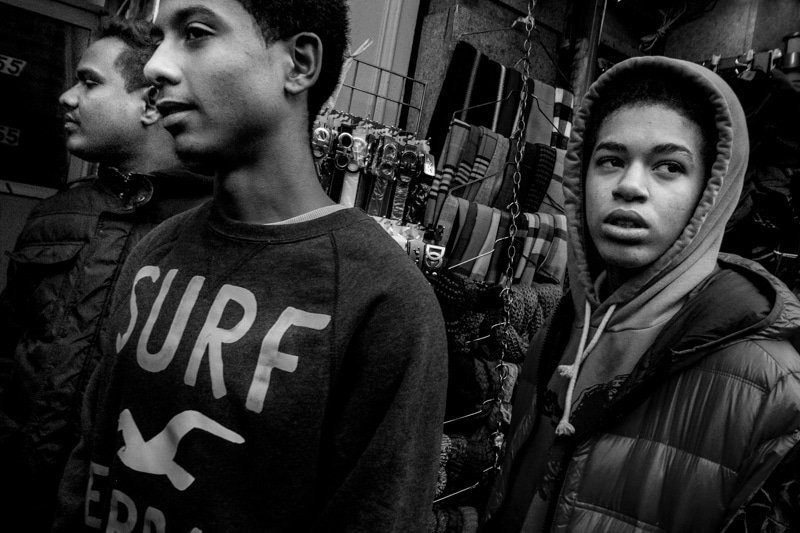
This was taken in a crowd, very close, with a wide lens. No flash, no surprise. The two faces fill the frame, and the closeness gives it energy. That's the part of Gilden worth keeping.
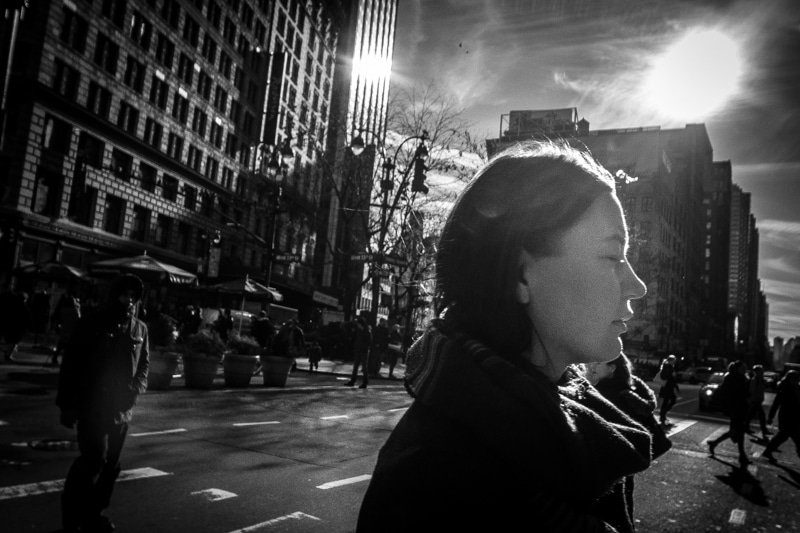
Hard sunlight gives you the same contrast Gilden gets from a flash: a bright face against a darker city. You don't need to light people up if you learn to read the light that's already there. See my page on light and shadow photography.
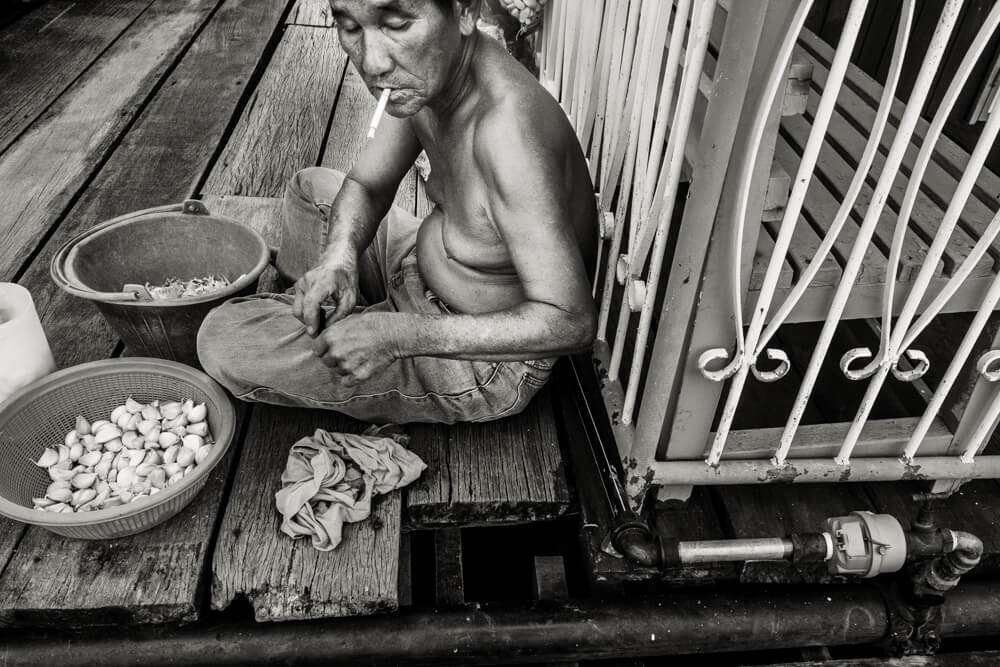
Gilden looks for characters, and so do I. This woman was peeling garlic with a cigarette in her mouth, completely at ease. I stood close and took my time. She knew I was there, and the picture is better for it.
Why Bruce Gilden matters to your street photography
Many beginners stay far away and shoot with a long lens, and their photos feel distant. Gilden is the extreme opposite, and he shows how much energy closeness adds. You don't have to go as far as he does. Moving even two steps closer changes your pictures.
He also forces you to decide where your own line is. Every street photographer should think about consent, and his work is the clearest test case there is. Decide your rules before you're in the moment.
In my street photography course, Phototactic, one module is about fearless street photography, and it's about confidence without aggression. We also teach picture patterns, repeatable structures like "strong face against a dark background," so you know what you're looking for before you get close. The course has no feedback on your own photos, so the practice is yours to do.
For more masters and the lesson each one teaches, see my list of famous street photographers. Compare Gilden with the gritty Tokyo of Daido Moriyama, or with the gentle approach of Helen Levitt. For more lines from the masters, see my photography quotes, and for more books, my list of the best photography books.
Frequently Asked Questions
Is Bruce Gilden still alive?
Yes. Bruce Gilden was born in Brooklyn in 1946 and is still working. In 2026 his work was shown in a major exhibition at the Museo di Santa Giulia in Brescia, Italy, and at Fotografiska Berlin. He has been a member of Magnum Photos since 1998 and a full member since 2002.
What camera and flash does Bruce Gilden use?
Accounts of his street work usually mention a Leica rangefinder with a 28mm lens and a small flash held in his other hand on a cord. For much of his career he shot black and white film. He began working in color and digital when Magnum introduced him to the Leica S medium format camera for a group project.
Is Bruce Gilden's style of street photography legal?
In the United States, photographing people in public without consent is generally legal, and so is publishing the images in a book or exhibition. Other countries, such as France, give people stronger rights over their image. Legal and ethical are not the same, though. This is general information, not legal advice.
Why is Bruce Gilden controversial?
He photographs strangers from very close range with a flash, without asking, so they are startled and have no chance to refuse. Critics, including Joel Meyerowitz and Guardian critic Sean O'Hagan, say the method is aggressive and fails to humanize people. Supporters say his work is honest and shows people who are usually ignored.
Should I copy Bruce Gilden's method?
I don't recommend it. Firing a flash in a stranger's face causes confrontations and many people find it disrespectful. You can take the useful parts: commitment to a clear style, and getting physically close to strong characters. Ask for close portraits, or work close without flash in good light.