
The sunny 16 rule says that in bright sun, you set the aperture (the f-number) to f/16 and the shutter speed to 1 over your ISO, and you get a correct exposure without a light meter. Open up one stop for each step of cloud: f/11 for slight overcast, f/8 for overcast, f/5.6 for heavy overcast and f/4 for open shade.
At ISO 400 in full sun, that is f/16 at 1/500s (the closest real setting to 1/400s). I'm Olivier Duong, and I teach street photography. The sunny 16 rule makes you read the light instead of reading a screen. Once you know it, you can set a manual exposure for a whole afternoon and put your attention back on the street.
The sunny 16 chart
Set the shutter speed to 1/ISO (or the nearest setting), then pick the aperture from the light conditions. Look at the shadows to decide which row you are in:
| Light conditions | Aperture at 1/ISO | What the shadows look like |
|---|---|---|
| Snow or sand in bright sun | f/22 | Dark with sharp edges |
| Bright sunny day, direct sunlight | f/16 | Distinct, sharp edges |
| Slight overcast | f/11 | Soft around the edges |
| Overcast | f/8 | Barely visible |
| Heavy overcast | f/5.6 | No shadows |
| Open shade, or sunrise and before sunset | f/4 | No shadows |
Backlit subject? Add one stop (open the aperture one step, or halve the shutter speed). The chart follows the standard version on Wikipedia's sunny 16 rule page, which cites classic references like the Ilford Manual of Photography.
How to use sunny 16 at other apertures
You don't have to shoot at f/16. Keep the same exposure and trade stops: every time you open the aperture one stop, double the shutter speed.
At ISO 100 on a sunny day, these settings all give the same exposure:
| Aperture | f/16 | f/11 | f/8 | f/5.6 | f/4 | f/2.8 |
|---|---|---|---|---|---|---|
| Shutter speed at ISO 100 | 1/125s | 1/250s | 1/500s | 1/1000s | 1/2000s | 1/4000s |
| Shutter speed at ISO 400 | 1/500s | 1/1000s | 1/2000s | 1/4000s | 1/8000s | Too bright |
In exposure value terms, sunny 16 at ISO 100 is about EV 15. Every pair in the table is the same EV, so these are equivalent settings: same amount of light, different depth of field and motion. This reciprocal relationship between aperture and shutter speed is the basic rule of all exposure settings, not just sunny 16. It is also why ISO 400 film in bright sun can be a problem on older film cameras: many top out at 1/1000s, so you end up at f/11 or f/16 whether you like it or not.
Sunny 16 street photography cheat sheet
For street photography, fix the aperture at f/8 for depth of field and zone focusing, and let the light decide the shutter speed. Here is sunny 16 worked out for you:
| Light at f/8 | ISO 200 | ISO 400 | ISO 800 |
|---|---|---|---|
| Snow or sand, bright sun | 1/2000s | 1/4000s | Too bright, use f/11 |
| Bright sun | 1/1000s | 1/2000s | 1/4000s |
| Slight overcast | 1/500s | 1/1000s | 1/2000s |
| Overcast | 1/250s | 1/500s | 1/1000s |
| Heavy overcast | 1/125s | 1/250s | 1/500s |
| Open shade or sunset | 1/60s (too slow for walkers) | 1/125s | 1/250s |
ISO 400 is the sweet spot. It keeps the shutter at 1/125s or faster in every row, even open shade, and 1/125s is what you need to freeze people walking. If you shoot at f/5.6 instead, go one stop faster on every row (1/2000s instead of 1/1000s). For focus distances and the rest of the setup, see my street photography settings guide.
Why street photographers still use the sunny 16 rule
The sunny 16 rule lets you set exposure once and stop checking. On the street, speed matters more than precision. Know your gear and use it quickly, and you get the moment instead of a perfect histogram of the moment after.
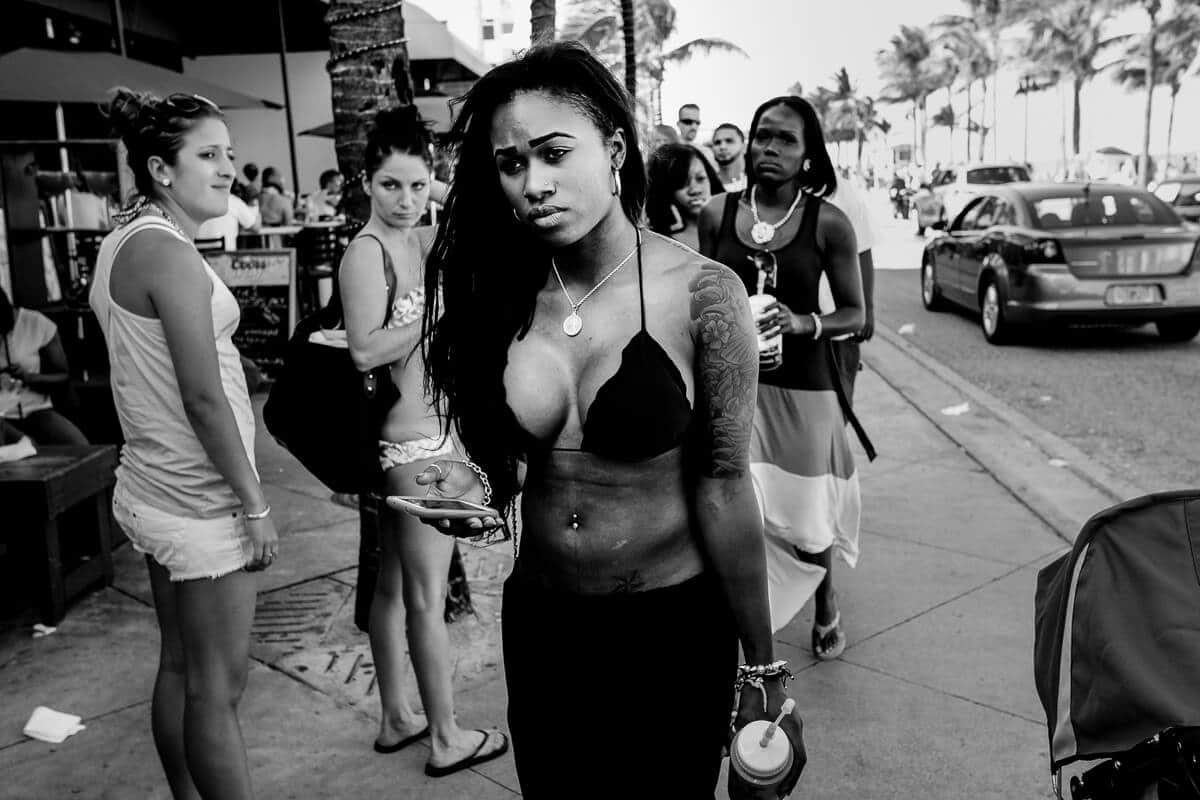
- Your meter gets fooled. A camera's light meter reads reflected light and wants everything to be middle gray. A white wall or a bright sky behind a person throws it off. Sunny 16 is based on the light falling on the scene, like an incident light meter, so bright and dark subjects come out right.
- Manual exposure stays put. In aperture priority, the exposure jumps every time a dark or bright thing enters the frame. With sunny 16 in manual mode, it stays consistent from frame to frame.
- Film cameras without a meter. Many old rangefinders and film cameras have no working meter. Sunny 16 is how people shoot them.
- Less gear. I once owned a Sekonic light meter and got rid of it. It was bulk and one more thing to think about. In the words of my partner Don Springer, it became an intrusion.
Is the sunny 16 rule accurate for film photography and digital photography?
It is accurate to within about a stop, which is enough for negative film and for RAW files on a digital camera. It is a rule of thumb, not a meter.
Negative film has a lot of latitude, especially on the overexposure side, so when in doubt give it more light. Popular film stocks for street work, like ISO 400 black and white film, forgive a stop either way. Just set the camera to the ISO film speed printed on the box. Slide film is less forgiving, and so are JPEGs. On a digital camera, take one test frame and check the histogram. After that, the correct exposure holds until the light changes.
The weak spot is the judgment call. Thin haze and light cloud are easy to confuse, and that is a one stop error. A simple check: can you see the disc of the sun and sharp shadows? That's sunny. Soft shadow edges? Slight overcast.
Sunny 16 on the street: sun and shade
Streets have two exposures at once: the sunny side and the shaded side. By the chart, open shade is four stops darker than full sun, so pick one side and expose for it.
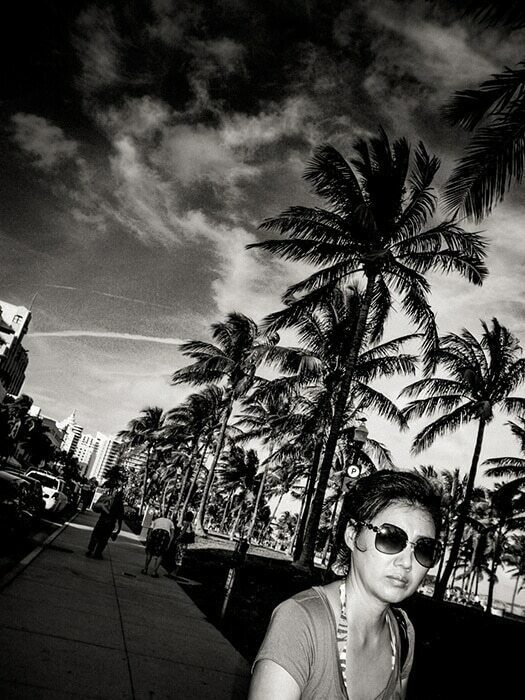
- Expose for the sun and people who step into the shadows go dark, sometimes to silhouettes. Great for graphic light and shadow pictures.
- Expose for the shade (the f/4 row) and the sunlit parts blow out, but faces in the shade look right.
Exposing for the light and letting the shadows go black makes the frame simpler. That idea is the core of light and shadow photography.
Sunny 16 variations: backlight, dusk and the Looney 11
The same logic stretches to other conditions:
- Backlight. Add one stop when the sun is behind your subject and you want their face exposed.
- After sunset. Light drops fast, a stop every few minutes. Sunny 16 stops working and your camera's meter takes over. For proper after-dark settings, go to night street photography.
- The moon. The "Looney 11" rule says f/11 at 1/ISO for a full moon. It is sunny 16 for the moon, because the moon is lit by the same sun.
- Slow shutter on purpose. Want blur in daylight? Stop down to f/16 or f/22 at the lowest ISO, then add a neutral density filter if it is still too bright. The math is in motion blur photography.
Using flash in bright sun? Sunny 16 gives you the ambient exposure, and the flash handles the subject. See flash street photography.
Exposure is the easy part
Sunny 16 takes an afternoon to learn. After that, the camera stops being the problem. What's left is knowing what to point it at.
That is what my street photography course is about: picture patterns and composition, with a Photography Basics bonus that explains how settings change the image and how to control light with any camera. If you're choosing a camera for manual shooting, start with the best camera for street photography.
Frequently Asked Questions
What is the sunny 16 rule?
The sunny 16 rule is a way to estimate daylight exposure without a light meter. On a bright sunny day, set the aperture to f/16 and the shutter speed to the reciprocal of your ISO, so 1/100s or 1/125s at ISO 100. Open the aperture one stop for each step of cloud, down to f/4 in open shade.
What is the sunny 16 rule for ISO 400?
At ISO 400 in bright sun, use f/16 at 1/500s, the nearest setting to 1/400s. Equivalent exposures are f/11 at 1/1000s and f/8 at 1/2000s. Under slight overcast, open one stop: f/11 at 1/500s. Under heavy overcast, f/5.6 at 1/500s. In open shade, f/4 at 1/500s or f/8 at 1/125s.
Is the sunny 16 rule accurate?
It is usually within about one stop, which negative film and RAW files handle easily. Slide film and JPEGs are less forgiving, so check a test frame. The most common error is misjudging the light, like calling hazy sun full sun. Look at the shadows: sharp edges mean sunny, soft edges mean slight overcast.
Does the sunny 16 rule work with digital cameras?
Yes. ISO on a digital camera works like film speed, so the same numbers apply. Set the camera to manual at your chosen ISO and use the chart. Take one test shot and check the histogram. It is useful on digital because the exposure stays consistent while bright or dark subjects move through the frame.
Can you use the sunny 16 rule indoors?
No. Sunny 16 only works in daylight because it is based on the brightness of the sun. Indoor light varies too much from one room or lamp to the next. Indoors, use your camera's meter, or take a test shot at f/2.8 and 1/125s with ISO 1600, then adjust.