
Martin Parr (1952 to 2025) was an English documentary photographer known for saturated color pictures, often lit with flash in daylight, that looked at British leisure and mass tourism with humor and a sharp eye. The lesson you can use from him is to photograph your own culture, including its awkward and funny sides, and to make the color and the details carry the comment.
I'm Olivier Duong. I teach street photography, and I point people to Parr when their work is so polite that it says nothing. He died on 6 December 2025, and his pictures of beaches and buffets already look like a history of how we lived.
What is Martin Parr known for?
Martin Parr is known for loud and often funny color photographs of ordinary people at leisure, from day trippers on the beach at New Brighton to tourists crowding the world's famous sights. He summed up his approach in one line: "I make serious photographs disguised as entertainment."
His series The Last Resort (1983 to 1985) is one of the most discussed bodies of work in British photography. It helped move serious documentary photography in Britain from black and white to color. Gerry Badger called it "a seismic change in the basic mode of photographic expression."
He was also a major figure behind the scenes. He joined Magnum Photos, served as its president from 2013 to 2017 (a post Elliott Erwitt had held in the late 1960s), published around 60 photobooks of his own work, collected photobooks, and co-wrote The Photobook: A History with Gerry Badger. He founded the Martin Parr Foundation, which opened its gallery in Bristol in 2017.
Martin Parr's life: from Epsom to Bristol
Martin Parr was born in Epsom, Surrey, on 23 May 1952. His grandfather George Parr, an amateur photographer and fellow of the Royal Photographic Society, was an early influence, and Parr decided as a teenager that he wanted to be a documentary photographer. He studied photography at Manchester Polytechnic from 1970 to 1973.
In 1975 he moved to Hebden Bridge in West Yorkshire and spent about five years photographing the Methodist and Baptist chapels of the area and the farming communities around them. This early work was in black and white and gentle in tone. It was published much later as The Non-Conformists (2013). His first book, Bad Weather (1982), was also black and white, made partly with an underwater camera and a flash in the British rain.
In 1982 he switched to color for good. He was inspired by American color photographers, above all Joel Meyerowitz, and by the bright John Hinde postcards he had seen while working at a Butlin's holiday camp as a student. With a Plaubel Makina 67 medium format camera and flash, he photographed working class families at New Brighton, near Liverpool, over three summers. The Last Resort came out in 1986. Some critics accused him of mocking the working class.
His answer was to turn the camera on the middle class. The Cost of Living (1989) looked at shopping, craft fairs, school open days and Conservative Party dinner parties around Bristol and Bath. He moved to Bristol with his family in 1987 and lived there for the rest of his life. Small World (1995) looked at mass tourism, and Common Sense (1999) at global consumer culture, shown at 41 venues in 17 countries at the same time.
His entry into Magnum was famously divisive. He became an associate in 1988, and when the vote on full membership came in 1994, Philip Jones Griffiths campaigned against him. Parr got the two thirds majority by one vote. Later he curated the Arles photography festival in 2004 and the Barbican exhibition Strange and Familiar in 2016.
Parr was diagnosed with myeloma in 2021. He died at home in Bristol on 6 December 2025, aged 73. His retrospective Global Warning, which he had been preparing, opened at the Jeu de Paume in Paris in January 2026.
Martin Parr's style: loud color and close details
Parr described the core of his work this way: "The fundamental thing I'm exploring constantly is the difference between the mythology of the place and the reality of it." The postcard promises paradise. His picture shows the crowd and the litter.
- Saturated color. He chose films and processing that made colors loud. The bright color matches his subject: sugar, plastic, souvenirs, sunshine. My guide to color photography covers how to use color on purpose.
- Flash in daylight. On-camera flash, and later a ring flash with a macro lens, flattens shadows and makes everything look vivid and a little artificial. That artificial look is the point. See my guide to flash street photography for how to start.
- Close details. An ice cream dripping onto a hand, or a sunburned neck. He often went close enough that the detail stands for a whole way of life.
- Humor with an edge. His pictures make you laugh, then make you think about class and money. They work through juxtaposition: the dream next to the reality.
- Series, not single hits. He worked in long projects around one theme, and he thought in books. That is why his photographs are remembered as The Last Resort or Small World more than as single frames.
Not everyone liked it. In 2000 the picture editor Colin Jacobson called him "a gratuitously cruel social critic." The Thames & Hudson Dictionary of Photography saw it differently: ironic at times, "nevertheless imbued with a degree of tenderness." That debate is worth having with yourself before you photograph strangers for laughs. My page on whether street photography is creepy gets into the ethics.
Four Martin Parr series to study
I don't reproduce his photographs here. They are protected, and the Magnum Photos profile and the Martin Parr Foundation are the places to see them. Look each series up while you read.
The Non-Conformists (1975 to 1980)
Quiet black and white pictures of chapel life and farming communities in the Calder Valley. Critic Sean O'Hagan wrote that "it's easy to forget how quietly observational Parr was as a black-and-white photographer." The move: spend years with one community close to home before you look for style.
The Last Resort (1983 to 1985)
Families at the seaside in New Brighton: crowded concrete, junk food, babies and sunbathers among the litter. The move: go where people relax and let the color and details tell the story of their day out.
The Cost of Living (1987 to 1989)
The middle class at home and at parties during the Thatcher years. The move: photograph your own class and your own habits, not only people who are different from you.
Small World (1987 onward)
Tourists at famous sites around the world, photographing and posing. One well known frame shows people posing as if to hold up the Leaning Tower of Pisa. The move: at a famous place, turn around and photograph the tourists instead of the monument.
Steal this move: photograph leisure with flash
Here is a Parr exercise for a sunny weekend. It works at a beach, a fair, a food market or any tourist spot.
- Pick a place where people relax. People on a day out are relaxed and full of props: food, souvenirs, sunglasses, inflatables.
- Put a small flash on your camera. Set it to fill in daylight. Start at -1 stop of flash exposure and adjust.
- Go close to the details. A hand holding a drink or a sunburned shoulder. Fill the frame.
- Look for the gap between the dream and the reality. The poster of the perfect beach next to the crowded one. The selfie pose next to the tired face.
- Stay kind. Laugh with people, not at them. If someone asks, show them the picture and delete it if they want.
Use a moderate wide lens, around 35mm, and a small aperture like f/8 so the flash and the depth of field are easy to manage. My street photography settings guide has more, and my list of street photography ideas has other projects to try.
My take: lessons I use from Parr
I'm a traveler, often a tourist myself, and Parr made me look at tourism as a subject instead of a nuisance. These are my photos, not copies of his style, but they come from the same curiosity.
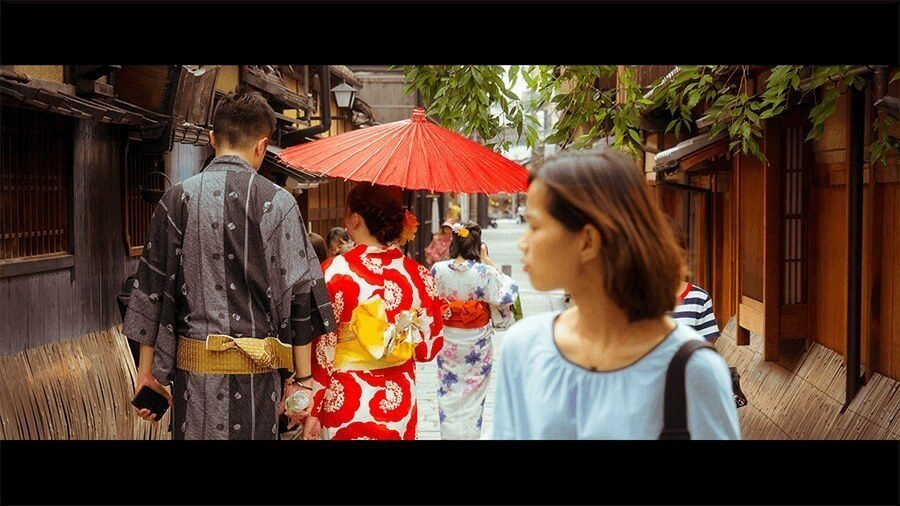
In Kyoto many visitors rent kimonos to walk the old streets. The red umbrella and the patterned fabric look like a postcard, and the woman in a plain blue top in front breaks the spell. That clash between the dream and the day is very Parr.
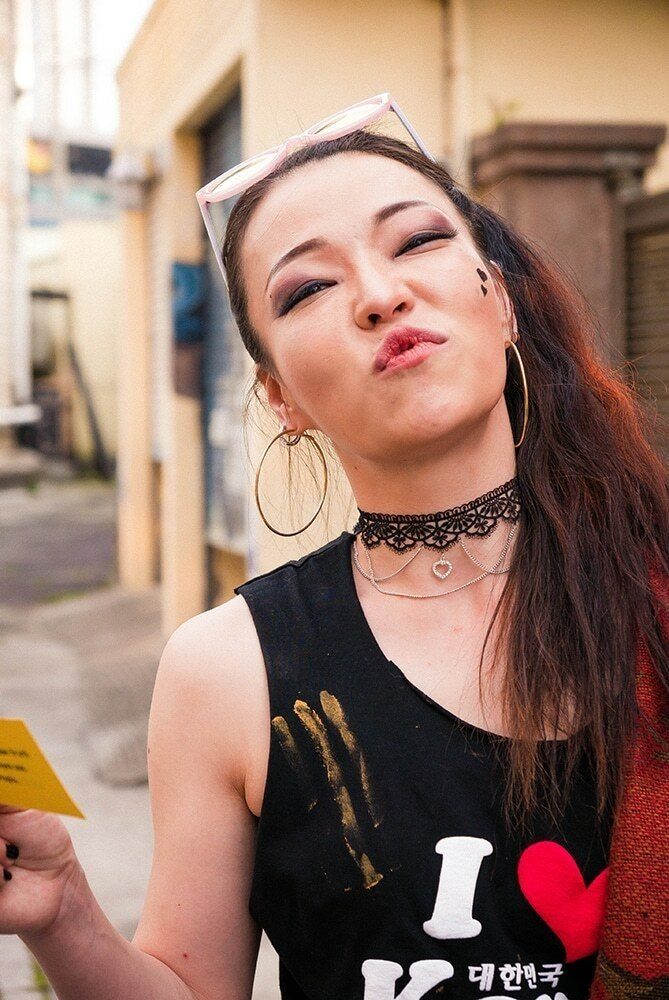
She made the face, I pressed the shutter. The "I love" shirt and the warm color make it a small picture of a certain kind of holiday. Parr taught me that clothes and slogans are part of the story, so I watch them as closely as faces.
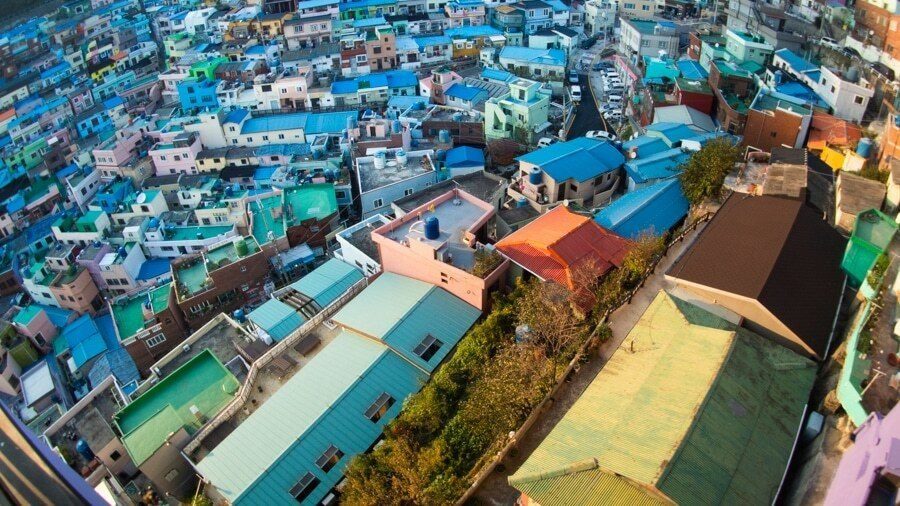
Gamcheon in Busan is famous for its painted houses and it is full of visitors. From above it looks exactly like the brochure. Parr would have turned around and photographed the people taking this picture. Next time, that's what I'll do.
Why Martin Parr matters to your street photography
Many street photographers think the good subjects are somewhere else: in a famous city or in a gritty neighborhood. Parr made a career out of supermarkets and beaches. If you think your town is boring, his work says the opposite. My guide to street photography in a small town builds on that idea.
He also shows that color and humor can be serious. A lot of beginners copy a moody black and white look because it feels artistic. Parr is proof that bright and funny pictures can say just as much about society.
In my online street photography course, Phototactic, we spend time on color coordination and color psychology, because color that means something is hard to fake. We call repeatable structures like "the dream next to the reality" picture patterns. Learn a few and you start seeing them at every beach and souvenir shop. The course has no feedback on your own photos, so the practice is yours to do.
For more masters and the lesson each one teaches, see my list of famous street photographers, and compare Parr with the very different color of Saul Leiter. If you shoot in Britain, my guide to street photography in London is a good start.
Martin Parr books and exhibitions
| Book | Year | Why get it |
|---|---|---|
| Bad Weather | 1982 | His early black and white work in the rain |
| The Last Resort | 1986 | The classic. Start here. |
| The Cost of Living | 1989 | The middle class in the Thatcher years |
| Small World | 1995 | Mass tourism around the world |
| Common Sense | 1999 | Close, saturated details of consumer culture |
| The Photobook: A History (with Gerry Badger) | 2004 onward | Three volumes on the history of the photobook |
His first major retrospective was at the Barbican in London in 2002. The book Utterly Lazy and Inattentive, in which he tells his story through his photographs, came out in 2025, the year of his death. The Martin Parr Foundation in Bristol keeps his archive and his collection of British and Irish photography. For more books, see my list of the best photography books. His line about serious photographs disguised as entertainment is in my collection of street photography quotes.
Frequently Asked Questions
When did Martin Parr die?
Martin Parr died at his home in Bristol on 6 December 2025, aged 73. He had been diagnosed with myeloma in 2021 and kept working after the diagnosis. His last major retrospective, Global Warning, which he had been preparing, opened at the Jeu de Paume in Paris in January 2026.
What camera did Martin Parr use?
For his early black and white work Parr used a Leica M3 with a 35mm lens. For The Last Resort he switched to a Plaubel Makina 67 medium format camera with flash. Later he often used a macro lens and a ring flash for close, saturated details. His gear changed, but daylight flash and strong color stayed central to his look.
What is Martin Parr's most famous work?
The Last Resort, his series on day trippers at New Brighton near Liverpool, photographed from 1983 to 1985 and published in 1986, is his best known work. Small World, on mass tourism, and The Cost of Living, on the English middle class, are also widely known. He published around 60 books of his own photographs.
Is Martin Parr a street photographer?
Parr called himself a documentary photographer, but much of his work was made candidly in public places like beaches and tourist sites, which is why street photographers study him. He worked in long themed projects and books rather than single street pictures. His use of color and daylight flash has influenced many street photographers.
Why was Martin Parr controversial?
Some critics felt his close, saturated pictures of working class families in The Last Resort mocked the people in them. His admission to Magnum in 1994 was opposed by Philip Jones Griffiths and passed by a single vote. Supporters saw his work as honest and tender satire of how everyone lives, including his own middle class.