
Joel Meyerowitz (born 1938) is an American photographer who began photographing the streets of New York in color in 1962, when serious photography was almost all black and white, and became one of the pioneers who made color accepted as art. The lesson you can use from him is to let color and light carry the meaning of a street picture, and to stay open to surprise.
I'm Olivier Duong. I teach street photography, and I point people to Meyerowitz when they treat color as a filter they add later. For him color was the subject. He is also, with Colin Westerbeck, the co-author of Bystander, still the best history of street photography you can read.
What is Joel Meyerowitz known for?
Joel Meyerowitz is known as an early champion of color photography. He shot color on the streets of New York from 1962, alternated with black and white for a decade, and in 1972 committed to color for good. That was several years before MoMA's 1976 William Eggleston show, the moment most histories use for color's arrival in the museum.
He is known for two very different bodies of work. The first is fast, witty 35mm street photography from New York and Europe in the 1960s and 1970s. The second is slow, luminous large format work, above all Cape Light (1978), made with an 8x10 view camera on Cape Cod.
He is also known for Aftermath, his record of Ground Zero after 11 September 2001. He was the only photographer given unrestricted access to the site in the months after the attack. Now in his late eighties, he is still working. In 2026 Cape Light was reissued and his Aftermath photographs went on show at the NSU Art Museum in Florida.
Joel Meyerowitz's life: from art director to street photographer
Joel Meyerowitz was born in the Bronx on 6 March 1938 to working class Jewish parents whose families came from Hungary and Russia. He studied painting and medical illustration at Ohio State University, graduating in 1959, and went to work as an art director at an advertising agency in New York.
In 1962 his job put him on a shoot with Robert Frank, who was photographing for a booklet Meyerowitz was designing. As he tells it, watching Frank move and shoot changed his life, and he quit his job to photograph the streets. He often shot alongside Garry Winogrand in those early years, as he has described in interviews, and he admired Henri Cartier-Bresson and Eugène Atget. He once said: "In the pantheon of greats there is Robert Frank and there is Atget."
From 1966 he spent a year traveling through Europe, photographing in color and black and white. In the early 1970s he taught photography at the Cooper Union in New York. In 1972 he chose color for good. Around the same time he picked up an 8x10 Deardorff view camera, and his work slowed down. Cape Light, made on Cape Cod, came out in 1978 and became one of the best known color photography books ever published.
With the curator Colin Westerbeck he wrote Bystander: A History of Street Photography (1994). After 9/11 he spent months at Ground Zero, and the archive became the book Aftermath (2006). He was inducted into the Leica Hall of Fame in 2017.
He lives with his wife, the English artist and novelist Maggie Barrett, in New York and in Tuscany. His books on method, such as How I Make Photographs (2020), are among the most practical a master has written.
Joel Meyerowitz's style: color and surprise
Meyerowitz talks about the street as a field of events rather than a series of single subjects. His best frames hold several things happening at once, tied together by color and light.
- Color as content. A camel coat against a grey avenue, a red car in a blue dusk. The colors aren't decoration. They are what the picture is about. My guide to color photography covers how to use color on purpose.
- Surprise. He looks for the moment something unexpected breaks the flow of the street, like a fall or a strange coincidence.
- The whole field. Instead of isolating one person, he often shows a wide scene where several small events relate to each other. See my guide to layering in photography.
- Light first, later on. In his large format work the light itself is the subject: dusk and neon over ordinary buildings. My page on light and shadow photography goes deeper.
- Openness. He has often talked about walking without a plan and reacting to what the street offers. Surprise is part of his method.
His switch from a fast 35mm camera to a slow 8x10 is a lesson in itself. The same eye produced very different work when the tool changed. You don't have to stay with one way of working all your life.
Four Joel Meyerowitz photographs to study
I don't reproduce his photographs here. They are protected, and his official website is the place to see them. Look each one up while you read.
Fallen Man, Paris (1967)
A young man lies on the street while passersby stop and stare, and others walk on. The whole street reacts in different ways. The move: when something happens, photograph the reactions around it, not only the event.
Camel Coats, New York City (1975)
Figures in matching camel coats cross a busy Fifth Avenue sidewalk, and the repeated color ties strangers together. The move: watch for one color repeated across different people. My guide to juxtaposition photography covers visual rhymes like this.
Dairy Land, Provincetown (1976)
From Cape Light: a roadside ice cream stand glowing at dusk under a darkening sky. Nothing happens, and the light makes it unforgettable. The move: go back to an ordinary place at the blue hour.
Aftermath, Ground Zero (2001 to 2002)
Wide color views of the ruins and the workers clearing them. The move: when you have access to something important, document it fully and patiently, for years if needed.
Steal this move: walk for color
Here is a Meyerowitz exercise for your next walk. It trains you to see color first.
- Pick a color for the day. Red or yellow, for example. Say it out loud before you leave.
- Walk without a destination. Follow the color. Turn down any street where you see it.
- Wait for a person. When you find a patch of your color, wait for someone to relate to it, by walking past it or wearing it.
- Go wide. Step back and include more of the street, so several small events can happen in the frame.
- Come back at dusk. Return to your best spot when the sky turns blue and the lights come on.
Shoot RAW, underexpose slightly so colors stay rich, and keep your shutter speed at 1/250 or faster for moving people. My street photography settings guide has the details, and night street photography covers dusk and after.
My take: lessons I use from Meyerowitz
I shoot both black and white and color, and Meyerowitz made me ask each time which one the picture needs. These are my photos, not copies of his style, but they use ideas I learned from him.
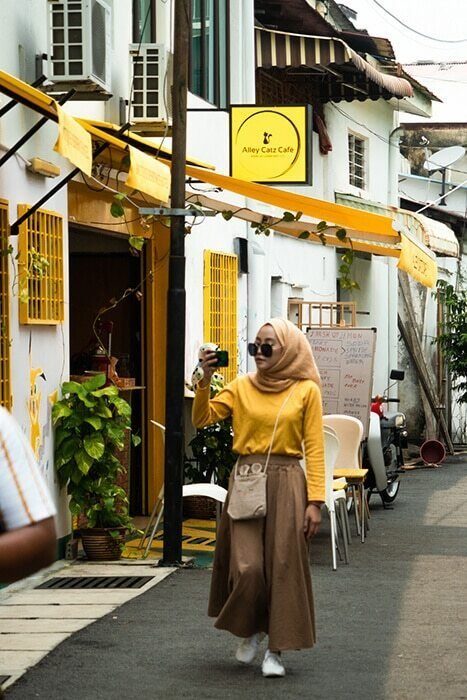
The yellow of her top repeats in the awnings and the signs above. In black and white this is just a woman with a phone. In color it's a rhyme. That's my test for a color picture: if it works equally well in black and white, the color isn't doing anything.
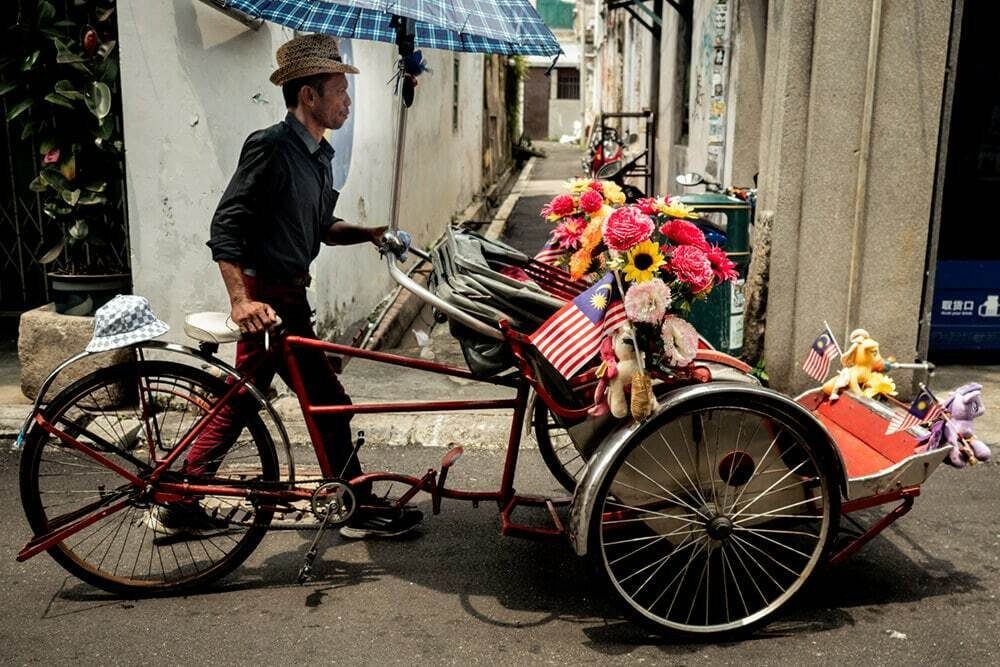
The flowers on the trishaw carry the picture. The street around it is plain, so the color pops. Meyerowitz's New York is full of these single bursts of color moving through a grey city.

This one is closer to his Cape Light side. The people are small, and the dusk light on the painted houses is the real subject. I come back to places like this at the end of the day because of him.
Why Joel Meyerowitz matters to your street photography
Many photographers still treat black and white as the serious choice and color as the casual one. Meyerowitz argued the opposite for 60 years: color holds more information and more feeling, if you use it on purpose. If you shoot color by default, he shows you how to make it mean something.
He also shows that your way of working can change. He went from fast street shooting to slow view camera work and back again, and both bodies of work matter. If you've hit a wall, changing your tool or your pace can reset your eye. My guide to the street photography plateau has more ideas.
In my online street photography course, Phototactic, we spend time on color coordination and color psychology. We call repeatable structures like "one color repeated across strangers" picture patterns. Learn a few and you see them on every walk. The course has no feedback on your own photos, so the practice is yours to do.
For more masters and the lesson each one teaches, see my list of famous street photographers. Read about Robert Frank, who inspired him to quit his job, and Garry Winogrand, who shot beside him. Bystander tops my list of the best photography books, and you'll find more lines from the masters on my photography quotes page.
Joel Meyerowitz books
| Book | Year | Why get it |
|---|---|---|
| Cape Light | 1978 | His classic large format color book |
| Bystander: A History of Street Photography (with Colin Westerbeck) | 1994 | The best history of the genre |
| Aftermath: World Trade Center Archive | 2006 | Ground Zero after 9/11 |
| Taking My Time | 2012 | A two volume retrospective. Start here for the street work. |
| How I Make Photographs | 2020 | Short, practical lessons from him |
His work is in the collections of the Museum of Modern Art, the International Center of Photography, the New York Public Library and the Museum of Contemporary Photography in Chicago. If you want to walk the streets where he started, my guide to street photography in New York lists places to begin, and my Paris guide covers the city of Fallen Man.
Frequently Asked Questions
Is Joel Meyerowitz still alive?
Yes. Joel Meyerowitz was born in the Bronx on 6 March 1938 and is still working in his late eighties. He lives in New York and Tuscany with his wife, the artist Maggie Barrett. In 2026 his Cape Light was reissued and his Aftermath photographs of Ground Zero were exhibited at the NSU Art Museum in Florida.
Why is Joel Meyerowitz important to color photography?
Meyerowitz shot color on the streets from 1962 and committed to it fully in 1972, years before color was widely accepted in museums. His book Cape Light (1978) is one of the most influential color photography books ever published. He argued for color as serious art when most photographers and curators still saw it as commercial.
What camera did Joel Meyerowitz use?
For his street work he used small 35mm cameras, often with color slide film. For Cape Light and much of his later work he used an 8x10 Deardorff view camera on a tripod, which produces huge negatives with fine detail. The change of camera changed his pace and his subjects.
What is Bystander about?
Bystander: A History of Street Photography, written by Colin Westerbeck and Joel Meyerowitz and first published in 1994, traces street photography from the nineteenth century to the late twentieth. It covers Atget, Cartier-Bresson, Frank, Winogrand and many others, and is widely seen as the standard history of the genre.
What did Joel Meyerowitz say about Bruce Gilden?
In a widely quoted interview, Meyerowitz strongly criticized Bruce Gilden's flash-in-the-face method, calling him an aggressive bully and saying the pictures only aim to embarrass people. It is one of the best known disagreements about ethics in street photography. See the Bruce Gilden profile for both sides of the debate.