
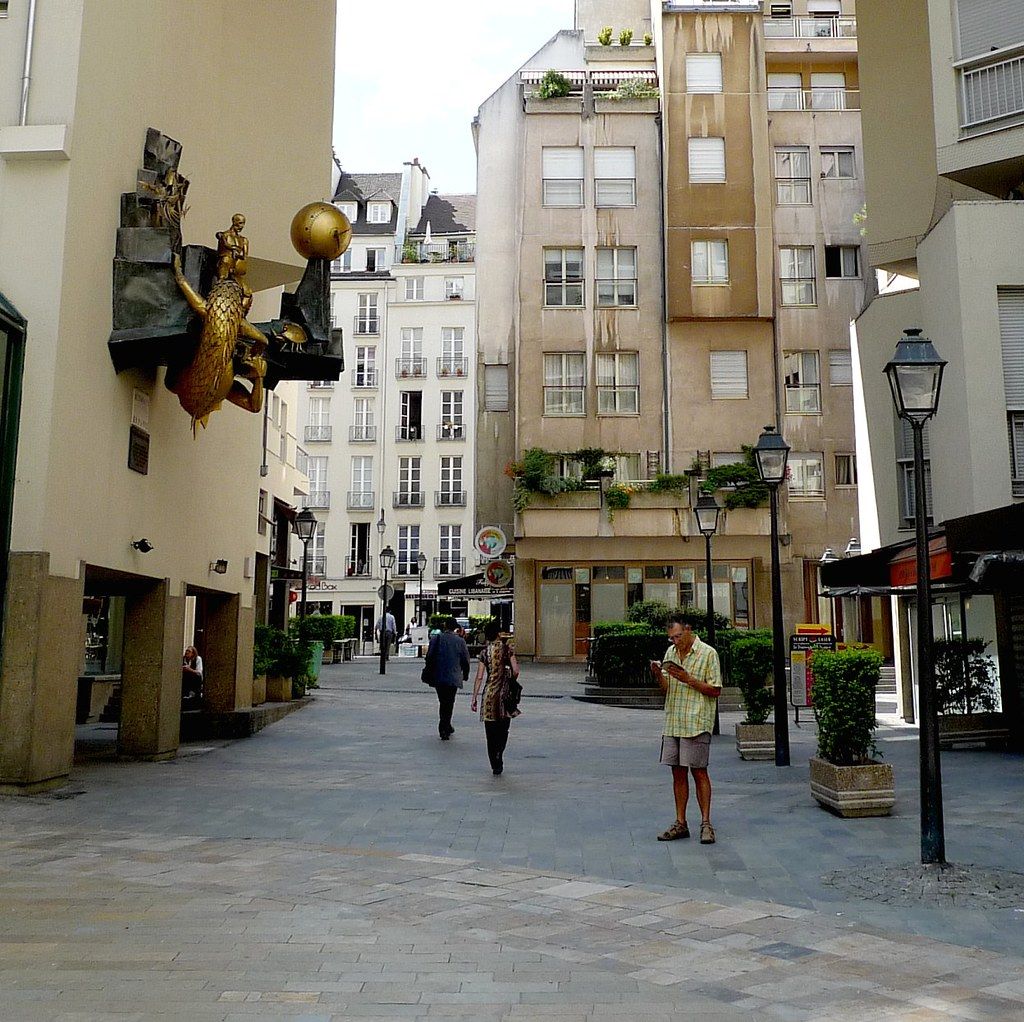
Street Photography in Paris
Where the genre was born, from Atget to Cartier-Bresson: cafes, boulevards and soft light at every corner.
- Spots
- 8
- Best time
- Spring to early autumn
- Lens
- 35mm or 50mm
- Photographing people
- Strict: ask first
Paris is one of the best cities in the world for street photography because the genre grew up here, and the material Atget and Cartier-Bresson worked with is still on the street: café terraces, long boulevards, parks full of movable chairs and pale limestone that bounces soft light into faces. Elliott Erwitt was born here in 1928, and Joel Meyerowitz shot here during his year in Europe in the 1960s. The catch: clichés are everywhere, and French law gives people strong control over how their image is published.
I would treat Paris as two cities. The postcard center, from Rivoli to the Louvre and Notre-Dame, is where you practice timing in crowds. The edges, like Canal Saint-Martin and Belleville, are where the less polished Paris lives, and where F.D. Walker of Shooter Files found much of his best material. Pick a background and wait for the right person to walk into it.
Best street photography spots in Paris
Rue de Rivoli
Rivoli runs for nearly 3 km past the Louvre and the Tuileries toward the Marais, with long stone arcades on its western stretch. The arcades give you frames and pockets of shade to shoot out of. Come in the last hour or two before sunset and walk east: the sun sits behind you and lights the faces of everyone walking toward you. Stand just inside an arcade and use two columns to frame a single walker crossing the bright street. It is a shopping street full of tourists, so work fast and keep your bag zipped.
Tuileries Garden & Louvre
The Tuileries was laid out in 1564 and runs from the Louvre to Place de la Concorde. Parisians drag the green metal chairs into groups around the ponds, which gives you clusters of people to layer. In summer a fairground with a big wheel sets up in the garden. Start at the Louvre pyramid and walk west. Try a low angle from the edge of a pond, with empty chairs in the foreground and people in the middle ground. Watch for clipboard petition scams around the Louvre.
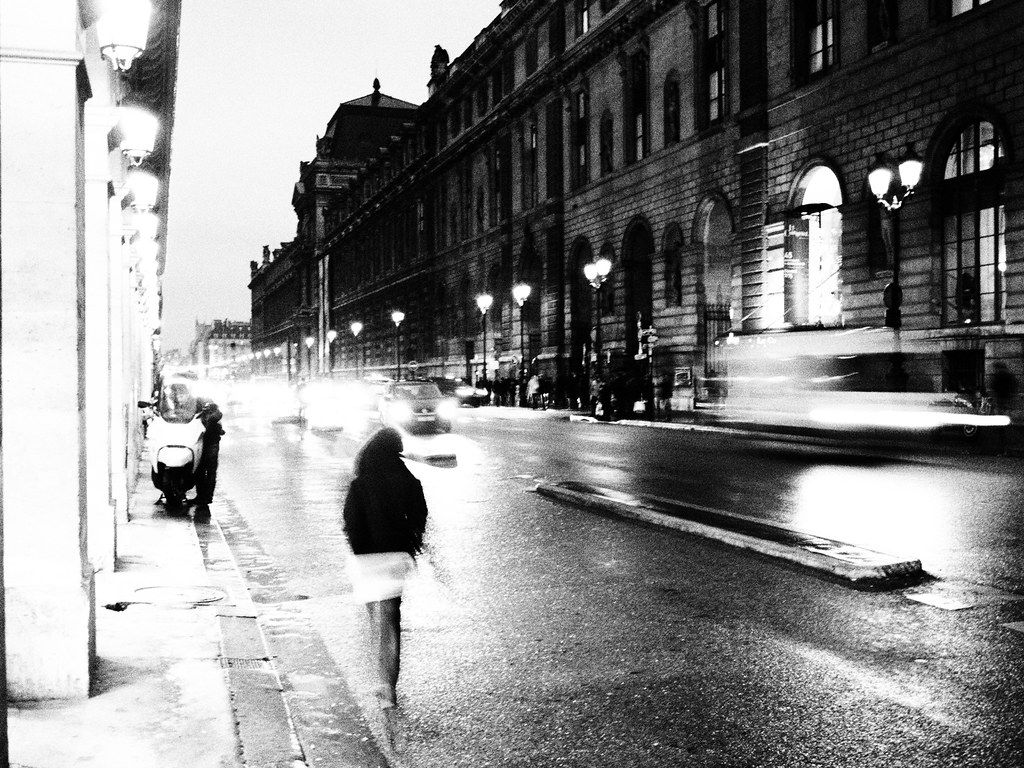
Montmartre & Rue des Abbesses
Montmartre fills with tourists by late morning, so go early. The Wandering Lens suggests arriving while the painters set up, when long shadows cross the cobblestones, and points to Rue Norvins by Le Consulat and Rue de l'Abreuvoir. Rue des Abbesses, lower down, feels more local. The staircases are the best frames on the hill: stand at the top of a flight and wait for one figure to climb into a patch of light. Bracelet sellers work the steps below Sacré-Cœur, so keep walking.
Le Marais
The Marais packs boutiques and café terraces into narrow old streets, and the people here are some of the best dressed in Paris. Rue des Rosiers, the historic heart of the Jewish quarter, is busiest at lunch when the falafel queues form. The streets are shaded most of the day, so look for the one beam of sun that cuts across an intersection and wait for someone to step into it. Shooting straight into terraces full of people eating annoys more than a wide street scene does.
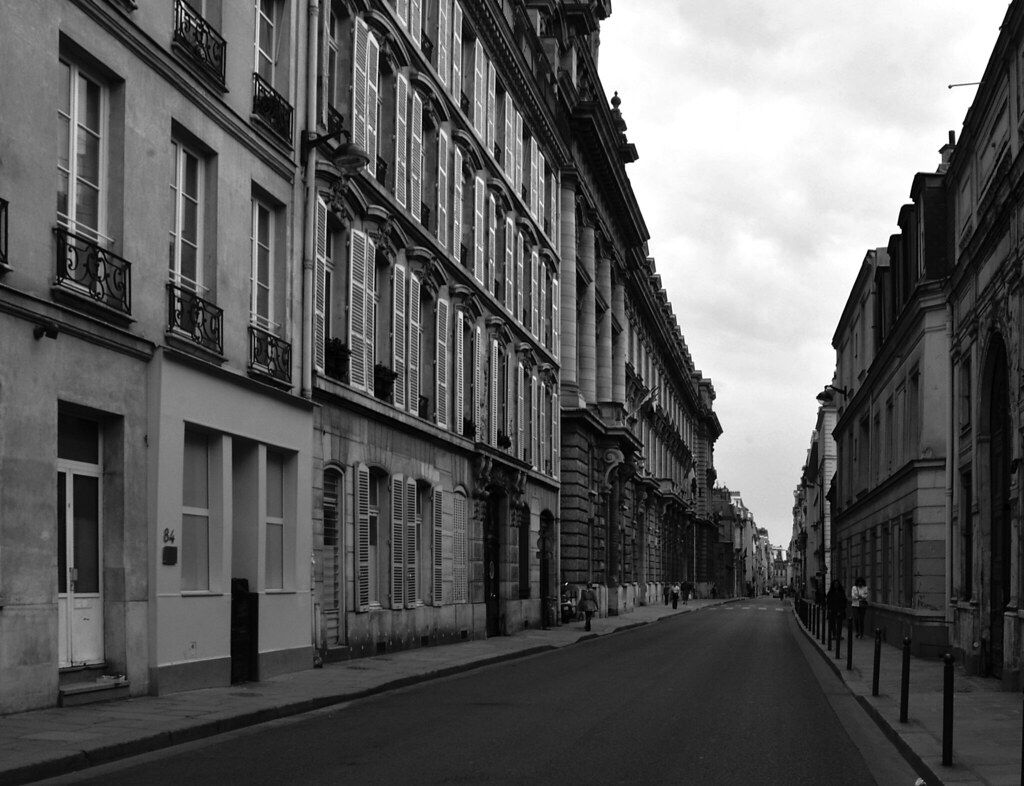
Canal Saint-Martin
The canal runs about 4.5 km, lined with plane trees and iron footbridges. On warm evenings both banks fill with people picnicking with their legs over the edge. Come in the late afternoon and stay until dark. The footbridges are your best vantage point: shoot down onto the quay to get a row of people and the water in one frame, or step back and use the curve of a bridge as a frame. People here are relaxing, not performing, so keep it wide and don't hover over one group.
Latin Quarter & Notre-Dame
Notre-Dame reopened in December 2024 after the 2019 fire, and the square in front of it is crowded again from morning to night. Give the crowd some time, then cross into the Latin Quarter. The green boxes of the bouquinistes along the Seine are a classic frame: readers bent over old prints with the river behind them. At blue hour, shoot from the Petit Pont toward the cathedral and catch people crossing in silhouette. Pickpockets work the queue at the cathedral.
Place des Vosges
The oldest planned square in Paris, inaugurated in 1612, has a garden in the middle and a continuous arcade around its red brick facades. At golden hour the sun comes in low and throws hard stripes of light and shadow across the stone floor. Stand at one end of the arcade and wait for a walker to cross a stripe of light, then expose for the highlights. Musicians often play under the arches on weekends. Picnickers on the lawn are close and relaxed, so ask before you shoot one person up close.
Passage Jouffroy
Opened in 1847, Passage Jouffroy is a covered arcade with a glass roof and a mosaic floor. It sits on Boulevard Montmartre, opposite Passage des Panoramas, and continues north into Passage Verdeau. Light falls softly from the roof by day and turns warm from the shop windows after dusk, which makes this a good plan for a rainy afternoon. Frame someone through a window display so the objects become a layer between you and them. The passage is narrow and people can't easily step out of your frame, so be quick and courteous.
Photographing people in Paris
Strict: local law or custom protects people's image. Ask first, or keep faces out of frame.
Taking a photo of someone in a public place in France is legal. Publishing it is where the risk sits. The droit à l'image, built on Article 9 of the Civil Code, lets people object to publication of an identifiable image of themselves, and The Local notes that posting on social media counts as publishing. The main exceptions are crowd scenes where no one is singled out, and news or public events such as demonstrations. Photographing someone in a private place without consent, and a car counts as one, can be a criminal offense.
Culturally, Parisians expect privacy even in the street, and a close candid shot can read as rude. My approach: make scenes where the city carries the frame, ask when one person fills it and you plan to publish, and delete if asked. This is general information, not legal advice. More on whether street photography is legal.
General information, not legal advice. More in is street photography legal?
What to photograph in Paris
- Café terraces. Chairs face the street, so people watch you as much as you watch them. Shoot The Street suggests taking a front-row seat and shooting back into the shaded terrace, where the light is soft.
- Park chairs. The movable metal chairs in the Tuileries and the Luxembourg get pulled into little groups of friends and readers.
- Style. Paris is a fashion capital, and the Marais and Saint-Germain are full of people dressed with care.
- Arcades and passages that give you frames and hard edges of light.
- Readers at the bouquinistes and on park benches.
- The gritty side. Belleville, Barbès, Pigalle and the Saint-Ouen flea market on weekends are less polished and more mixed than the postcard center.
- Rain. Umbrellas and reflections in puddles, which the World Street Photo Awards suggests for poetic compositions.
A one-day photo walk
- 8:00, Montmartre. Metro to Abbesses (line 12). Work the staircases before the tour groups arrive.
- 10:30, Passage Jouffroy. Walk downhill via Rue des Martyrs, about 30 minutes. Then cross the boulevard into Passage des Panoramas.
- 12:30, Le Marais and Place des Vosges. Metro to Saint-Paul (line 1). Lunch on Rue des Rosiers, then the arcades.
- 15:00, Latin Quarter and Notre-Dame. Walk across Île Saint-Louis, about 20 minutes.
- 17:00, Louvre, Tuileries and Rue de Rivoli. Follow the quays west to the Louvre, about 20 minutes. When the sun gets low, walk east on Rivoli with it at your back. From June to August the sun sets after 21:30, so push this leg later.
- Evening, Canal Saint-Martin. Metro line 11 from Hôtel de Ville to République, then a 5 minute walk to the canal. Stay until dark.
When to shoot
Spring to early autumn. Late afternoon on Rue de Rivoli, then the canal into the evening.
The light
Soft, warm stone reflects light; golden hour on limestone is the classic Paris look.
What to bring
35mm or 50mm prime. The Wandering Lens recommends a 50mm for Paris.
Safety
Moderate (Shooter Files safety score 7/10). Pickpockets on the metro and at tourist sites.
Tips for Paris
- Lens: a 35mm or 50mm prime. The Wandering Lens works Paris with a 50mm, which suits café and arcade distances. See best lens for street photography.
- Settings: in the arcades, meter for the bright street and let people fall into shadow. More on street photography settings.
- Season: April to early October gives you terraces and canal crowds.
- Fête de la Musique, 21 June: free concerts on street corners across the city until late. The best night of the year for crowds and flash.
- 14 July: the military parade on the Champs-Élysées in the morning and big crowds on the Champ de Mars for fireworks at night.
- Metro: it is dense and fast, so ride between neighborhoods and walk inside them. Keep the camera strapped to you, since pickpockets work the trains and tourist sites.
Frequently asked questions
Is street photography legal in Paris?
STRICT. French law protects droit a l'image: publishing an identifiable person without consent can lead to a claim, even if taking the photo in public was legal. Crowds and public events are more tolerated. Get consent for close portraits you plan to publish.
Where are the best street photography spots in Paris?
Start with Rue de Rivoli, Tuileries Garden & Louvre, Montmartre & Rue des Abbesses, Le Marais. Sunlight falls beautifully just before sunset.
When is the best time for street photography in Paris?
Spring to early autumn. Late afternoon on Rue de Rivoli, then the canal into the evening.
What lens should I bring to Paris?
35mm or 50mm prime. The Wandering Lens recommends a 50mm for Paris.
Is Paris safe for street photographers?
Moderate (Shooter Files safety score 7/10). Pickpockets on the metro and at tourist sites.
More street photography in France
Start with the France street photography guide, then pick a city.