
Elliott Erwitt (1928 to 2023) was a French-born American Magnum photographer known for witty black and white pictures of everyday life, especially his photographs of dogs and of the absurd little coincidences of public places. The lesson you can use from him is to look for the joke the street is already telling, and to be ready when two unrelated things line up.
I'm Olivier Duong. I teach street photography, and Erwitt is the photographer I point to when someone thinks a serious photograph has to be a sad one. His pictures make you smile first and think second. That is harder to do than it looks.
What is Elliott Erwitt known for?
Elliott Erwitt is known for humor. His most loved photographs catch irony and absurdity in daily life: a tiny dog in a sweater next to a woman's boots, or people in a museum looking at paintings that seem to look back. Magnum describes his signature as "benevolent irony."
He is especially known for dogs. They were the subject of five of his books, from Son of Bitch (1974) to Elliott Erwitt's Dogs (2008). He photographed them at their own eye level, so they look like people in the frame.
He was also a working photographer for more than 70 years. He shot for magazines like Life and Look, and he did plenty of advertising work. His personal pictures came out of the same camera, on the same trips.
Elliott Erwitt's life: Paris, Milan, Hollywood and New York
He was born Elio Romano Erwitz in Paris on 26 July 1928, to Russian Jewish parents. He spent his childhood in Milan, Italy, and in 1939, when he was ten, his family emigrated to the United States. As a teenager in Hollywood he worked in a commercial darkroom and studied photography at Los Angeles City College.
In 1948 he moved to New York and traded janitor work for film classes at the New School for Social Research. There he met Robert Capa and Roy Stryker, the former head of the Farm Security Administration's photography program. Stryker hired him to photograph for the Standard Oil Company's picture library, and later sent him to document Pittsburgh. Those pictures were published much later as Pittsburgh 1950.
In 1951 he was drafted and served as a photographer's assistant with an Army Signal Corps unit in Germany and France. In 1953 Robert Capa invited him to join Magnum Photos. He stayed a member for the rest of his life, and in the late 1960s he served as Magnum's president for three years.
His career covered almost everything. In 1959 in Moscow he photographed Richard Nixon jabbing a finger at Nikita Khrushchev's lapel during the Kitchen Debate. He photographed the funeral of John F. Kennedy in 1963. From the 1970s he made documentaries, and in the 1980s he made 18 comedy films for HBO. He even invented an alter ego, the pretentious artist "André S. Solidor," to make fun of the art world.
Erwitt died in his sleep at his home in New York on 29 November 2023, aged 95.
Elliott Erwitt's style: timing and a light touch
Erwitt explained his approach on his Magnum profile: "You can find pictures anywhere. It's simply a matter of noticing things and organizing them. You just have to care about what's around you and have a concern with humanity and the human comedy." Here is what that looks like in practice.
- Juxtaposition. Two things side by side that comment on each other: a dog and its owner, a statue and a passerby. My guide to juxtaposition photography covers the idea in depth.
- Low angles for dogs. He often went down to dog height, so the animals fill the frame and the humans become legs and feet.
- Patience in funny places. Beaches, museums, parks, dog shows. Places where people relax and act out a little.
- Simple black and white. Clean compositions with few elements, so nothing distracts from the joke. He also shot color for magazines and later published it in Elliott Erwitt's Kolor (2013).
- Kindness. His humor is gentle. People are funny in his pictures, but rarely humiliated. That is a real choice, and it's a good one to copy.
He also knew how to provoke a moment. He is often quoted as saying he sometimes barked at dogs to get a reaction. The joke still has to be there; he only helped it along.
Four Elliott Erwitt photographs to study
I don't reproduce his photographs here. They are protected, and the official Elliott Erwitt website and his Magnum profile are the places to see them. Look each one up while you read.
New York City, 1946
A small chihuahua in a knitted sweater stands next to a woman's boots, seen from dog height. The dog and the boots are the whole picture. The move: get down low and let an animal and a human detail talk to each other.
Segregated water fountains, North Carolina, 1950
Two drinking fountains side by side, one marked for white people and one for Black people. The contrast between them says everything about the South at the time. The move: juxtaposition isn't only for jokes. Two objects side by side can carry a serious message.
California Kiss, Santa Monica, 1955
A couple kissing, seen in the side mirror of a car parked by the Pacific at sunset. The move: use a mirror to put a small scene inside a bigger one. My guide to framing in photography explains frames within frames.
Nixon and Khrushchev, Moscow, 1959
Richard Nixon pokes his finger at Nikita Khrushchev's lapel during the Kitchen Debate. The gesture became a symbol of the Cold War. The move: watch hands. One gesture can sum up a whole relationship.
Steal this move: hunt for the joke
Here is an Erwitt exercise for a relaxed weekend. It works best in places where people slow down: a park, a beach, a museum, a dog run.
- Go where the props are. Statues, posters, murals and signs. They give you something for a real person to echo or contradict.
- Look for pairs. A person who looks like their dog, or a sign that describes the person under it.
- Wait with the prop in frame. Compose on the sign or the mural first, then wait for someone to complete the joke.
- Get low for animals. Crouch to dog height. It changes everything.
- Keep it kind. Laugh with people, not at them. If the joke only works by humiliating someone, skip it.
You don't need special gear. A small camera and a 35mm or 50mm lens are enough. If approaching people worries you, my guide to how to photograph strangers helps, and my list of street photography ideas has more projects.
My take: lessons I use from Erwitt
On Inspired Eye I once wrote that Erwitt made a career out of photographing dogs, and that animals are one of the best ways to do street photography without humans. These are my photos, not copies of his style, but they come from the same habit of looking for a small joke.
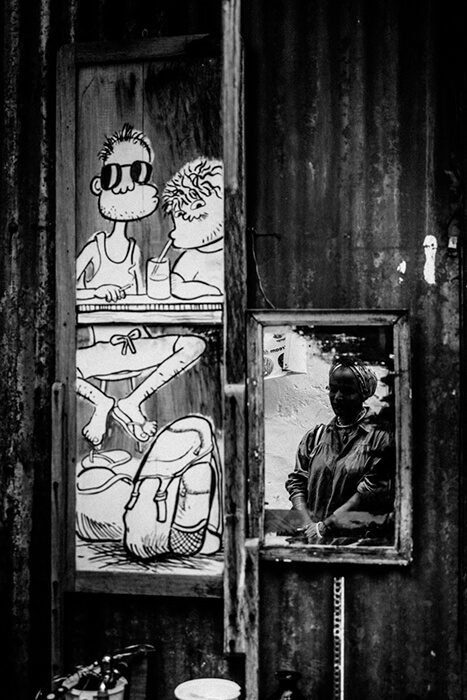
A cartoon couple painted on a door, and below them a framed picture of a real person. The two images comment on each other. Street art is full of these chances, and Erwitt taught me to look at what's next to a mural, not only at the mural.
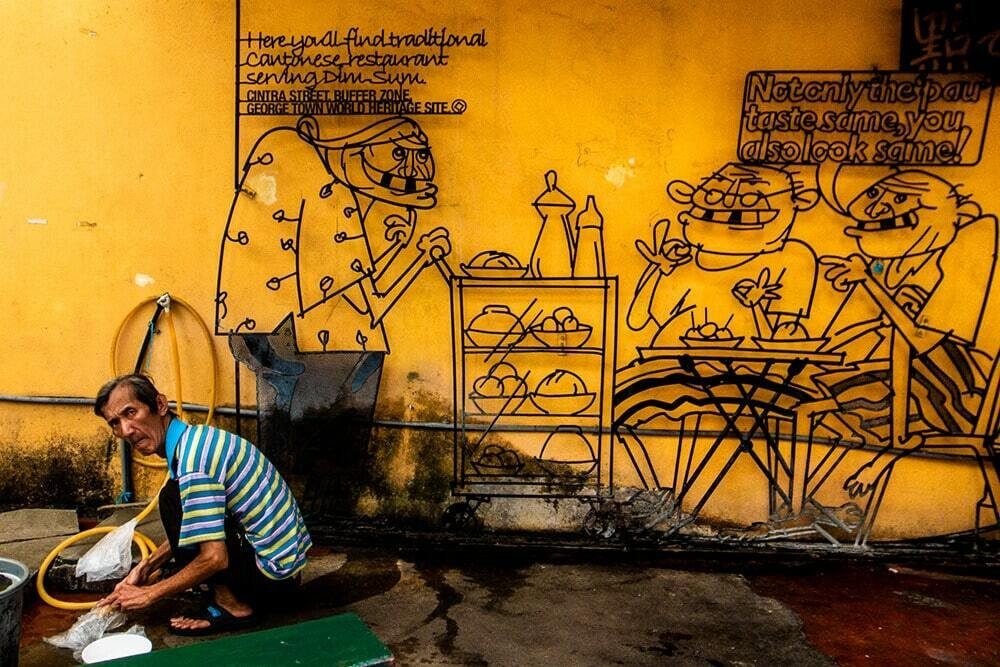
The painted people are having a meal. The real man below them is busy working. That contrast is the whole picture. I composed on the wall and waited for someone to give it a second meaning.
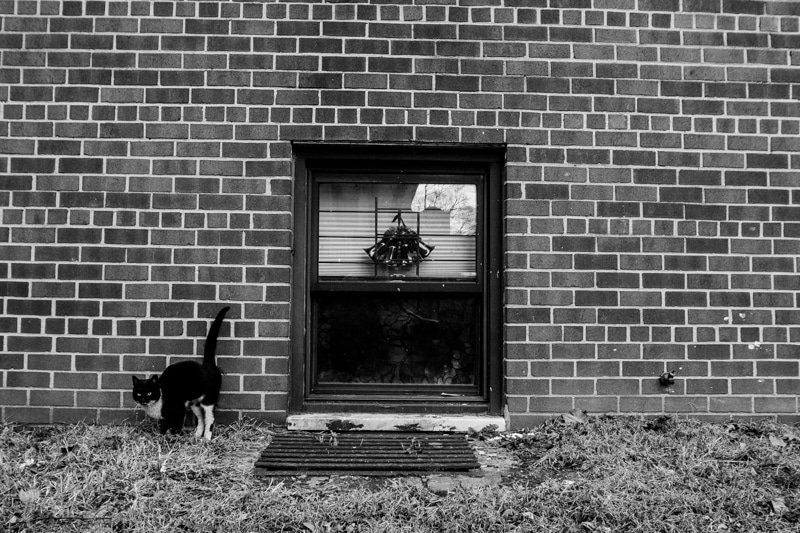
Animals give you gestures people never make in public. This cat stretched just as I passed, right by the door mat, as if it owned the house. That's the kind of small, silly moment Erwitt would notice.
Why Elliott Erwitt matters to your street photography
A lot of street photography online is moody and serious, all dark shadows and lonely figures. Erwitt shows another way. Humor is a real subject, and a funny picture can be just as memorable and just as well built as a sad one.
He also shows how to live as a photographer. He took commercial and magazine work, and his personal pictures came from the same trips. A line often attributed to him puts it well: he was "a professional photographer by trade and an amateur photographer by vocation." If you keep a day job, that is encouraging: you don't need to live from your personal work to make it well.
In my street photography course, Phototactic, we call repeatable structures like "a sign that describes the person under it" picture patterns. Humor in the street is often one of these patterns seen at the right second. The course has no feedback on your own photos, so the practice is yours to do.
For more masters and the lesson each one teaches, see my list of famous street photographers. Compare Erwitt's gentle humor with the sharper satire of Martin Parr, or with the joyful crowds of Garry Winogrand. His lines also appear on my page of photography quotes.
Elliott Erwitt books and exhibitions
| Book | Year | Why get it |
|---|---|---|
| Son of Bitch | 1974 | His first dog book |
| Museum Watching | 1999 | People looking at art, and art looking back |
| Snaps (Phaidon) | 2001 | A huge anthology of over 500 pages. Start here. |
| Elliott Erwitt's Dogs | 2008 | The best of his dog pictures |
| Personal Best | 2010 | His own selection of his best work |
| Pittsburgh 1950 | 2017 | His early documentary commission |
The International Center of Photography in New York showed Personal Best in 2011, and gave him its Infinity Award for lifetime achievement the same year. The Musée Maillol in Paris held a retrospective in 2023. For more books, see my list of the best photography books. If you want to walk his streets, see my guides to New York and Paris.
Frequently Asked Questions
When did Elliott Erwitt die?
Elliott Erwitt died in his sleep at his home in New York City on 29 November 2023. He was 95. He had been a member of Magnum Photos since 1953, when Robert Capa invited him to join, and he worked as a photographer for more than 70 years, from the late 1940s into his nineties.
Why did Elliott Erwitt photograph dogs?
Erwitt found dogs funny and expressive, and they let him comment on people without embarrassing anyone. He often photographed them at their own eye level, so the dog becomes the main character and the owner is reduced to legs or boots. Dogs were the subject of five of his books, including Son of Bitch and Elliott Erwitt's Dogs.
What is Elliott Erwitt's most famous photo?
Several compete for the title. California Kiss (Santa Monica, 1955), a couple seen in a car's side mirror, is one of the best known. Others include the chihuahua beside a woman's boots (New York, 1946) and Nixon poking Khrushchev in Moscow (1959).
What camera did Elliott Erwitt use?
According to Magnum, Erwitt traveled through France and Italy in 1949 with his Rolleiflex. Later he worked mostly with small 35mm cameras, which let him move quickly and quietly, and for commercial jobs he used whatever the assignment needed. His style came from observation, not from gear.
What was Elliott Erwitt's philosophy of photography?
On his Magnum profile he said you can find pictures anywhere, and that it is simply a matter of noticing things and organizing them, with a concern for humanity and the human comedy. A longer line often attributed to him says photography has little to do with the things you see and everything to do with the way you see them.