
Garry Winogrand (1928 to 1984) was an American street photographer known for crowded, often tilted pictures of New York and American public life in the 1960s and 1970s. The lesson you can use from him is simple: shoot a lot with a wide lens, and let the frame surprise you instead of trying to control it.
I'm Olivier Duong. I teach street photography, and Winogrand is the photographer I point to when someone's pictures are neat but dead. His best frames are packed with gestures, and nothing in them looks planned. That looseness came from a very disciplined habit of shooting constantly.
What is Garry Winogrand known for?
Winogrand is known for turning street photography from quiet observation into something you do from inside the crowd. Critic Andy Grundberg wrote that his photographs are "typically crammed with activity" and offer "a multiplicity of viewpoints", with "an almost subliminal order beneath their chaotic surface."
John Szarkowski, the director of photography at the Museum of Modern Art, called him "the central photographer of his generation." In 1967 Szarkowski hung his work next to Diane Arbus and Lee Friedlander in New Documents at MoMA. That show is still used as the moment street photography became personal rather than purely documentary. Szarkowski wrote that these photographers aimed "not to reform life but to know it."
He is also known for sheer volume. When he died he left about 2,500 rolls of undeveloped film and 6,500 rolls developed but never proofed, according to the Center for Creative Photography, which holds his archive. Estimates of his lifetime output run to a million frames or more.
Garry Winogrand's life: from the Bronx to the classroom
Garry Winogrand was born on 14 January 1928 in the Bronx, New York, to a working class Jewish family. His father worked in the leather goods trade and his mother made neckties. After high school he served in the U.S. Army Air Forces, then studied painting at City College and Columbia University. At Columbia a friend showed him the darkroom, and he dropped painting for photography. In 1951 he took Alexey Brodovitch's photojournalism class at the New School.
Through the 1950s and 1960s he worked as a freelance photojournalist and advertising photographer, and his pictures ran in magazines such as Collier's and Sports Illustrated. Edward Steichen included one of his beach photographs in The Family of Man at MoMA in 1955.
His personal work took over. He won three Guggenheim Fellowships between 1964 and 1979, plus a National Endowment for the Arts fellowship in 1975. He photographed the Bronx Zoo and Coney Island Aquarium for The Animals (1969), often while taking his children out. He spent years at press conferences and protests for Public Relations (1977), an idea about events staged for the media.
In the 1970s he taught, first in Chicago at the Institute of Design, then at the University of Texas at Austin, and moved to Los Angeles in 1978. He was diagnosed with gallbladder cancer in early 1984 and died in Tijuana, Mexico, on 19 March 1984, aged 56.
Garry Winogrand's style: wide, close, fast and tilted
Winogrand famously refused to talk about technique. He told an interviewer that how a picture was made is "irrelevant", and that you have to "deal with how photographs look, what's there, not how they're made." Still, a few habits show in every contact sheet.
- A Leica and a 28mm lens. The wide angle put him in the middle of the action. He stood among people, not across the street from them.
- Speed. Film of him at work shows him lifting the camera to his eye and dropping it so fast that, as Tod Papageorge put it, people didn't know whether they had been photographed at all.
- The tilted frame. His horizons often lean. It wasn't carelessness. The tilt makes a static street feel like it's sliding, and it frees the edges of the frame to cut through people and cars.
- Many subjects in one frame. Instead of one hero, he stacked gestures and glances across the picture. Your eye keeps moving. See my guide to layering in photography for how to build this.
- Humor and tension. Animals next to people, crowds next to one odd figure. That is juxtaposition at street speed.
His most quoted line sums up the attitude: "I photograph to find out what something will look like photographed." He added that the better way to say it might be "how the fact of putting four edges around a collection of information or facts transforms it." That's the whole game. The frame changes reality, and you only learn how by shooting.
He also disliked the label "street photography." He's reported to have joked that with a book called The Animals you might as well call him a zoo photographer. My own definition of street photography starts from that same point: it isn't about streets.
Four Garry Winogrand photographs to study
I don't reproduce his photographs here. The estate's work is shown by Fraenkel Gallery, and MoMA holds hundreds of his prints. Look each one up while you read.
Central Park Zoo, New York City (1967)
A well dressed couple walks past the camera, each carrying a chimpanzee dressed like a child. It's funny and uncomfortable at the same time, and people still argue about what it means. The move: when something strange walks toward you, take it straight and full frame. Don't explain it.
Los Angeles, California (1969)
Three young women stride along a sunny sidewalk on Hollywood Boulevard. A man in a wheelchair sits in shadow near a bus stop, and a small boy peers at him from a bench. The Denver Art Museum, which owns a print, points out how the women's paths follow the stripes of light. The move: find a strong light pattern and wait for several people to fall into it. My guide to light and shadow photography covers the setup.
World's Fair, New York City (1964)
A row of women sits on a bench, talking and looking in different directions, while a couple walks past behind them. The move: a bench or a wall lines people up for you. Shoot the row, then wait for one gesture to break it.
Albuquerque, New Mexico (1957)
A small child stands at the end of a driveway in a new suburb, with a tricycle, open desert behind. The frame is wide and empty compared with his New York crowds. The move: give a small figure a huge space and let the setting tell the story.
Steal this move: shoot to find out
This is a Winogrand exercise for one busy afternoon. It works best at an event or a crowded market.
- Go wide. Use 28mm, or the main lens on your phone. Set zone focus at about 2 meters and f/8 so you never think about focus. My street photography settings cheat sheet has the numbers.
- Get inside the crowd. Stand where people pass within arm's length, not at the edge. If nerves stop you, read how to overcome the fear of street photography first.
- Shoot anything that makes you curious. Don't decide in advance if it's a good picture. Press the shutter and find out.
- Let the frame tilt. Try a few frames where the horizon leans on purpose. Keep the ones where the tilt adds energy.
- Look much later. Winogrand often waited a long time before looking at contact sheets, so he could judge the pictures and not his memory of the moment. Wait at least a week before you edit.
Expect a low keeper rate. That's normal, and my article on street photography hit rate explains why one good frame from a whole day is a fine result.
My take: lessons I use from Winogrand
My own work isn't a copy of his, but Winogrand pushed me to get close with a wide lens and to accept a frame that isn't perfectly level. These are my photos, not his.
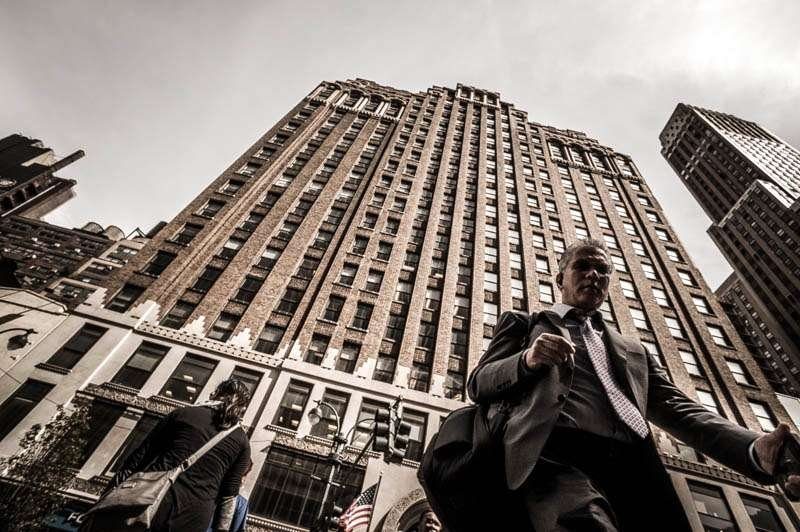
A 28mm lens distorts what sits near the corners. Winogrand used that pull on purpose, and so did I here. Put a hand or a face near the edge and the frame gets tension for free.
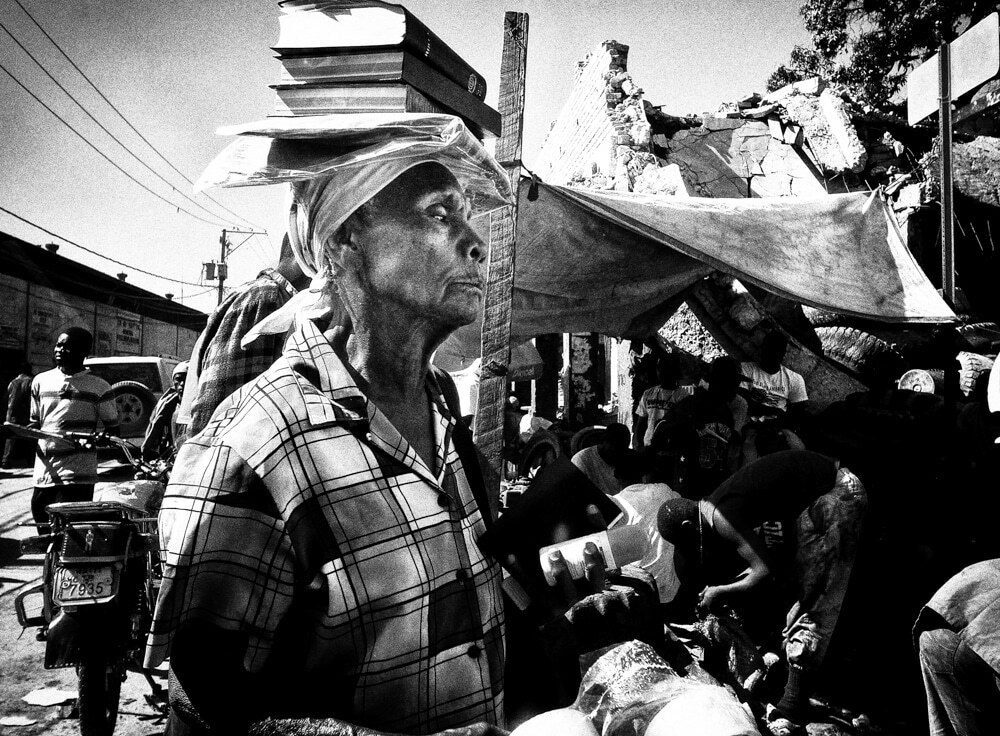
In a crowd I look for one face that anchors the frame and then let everything else pile up around it. The man looking up gives your eye a place to start. The loads and hands around him keep it moving.
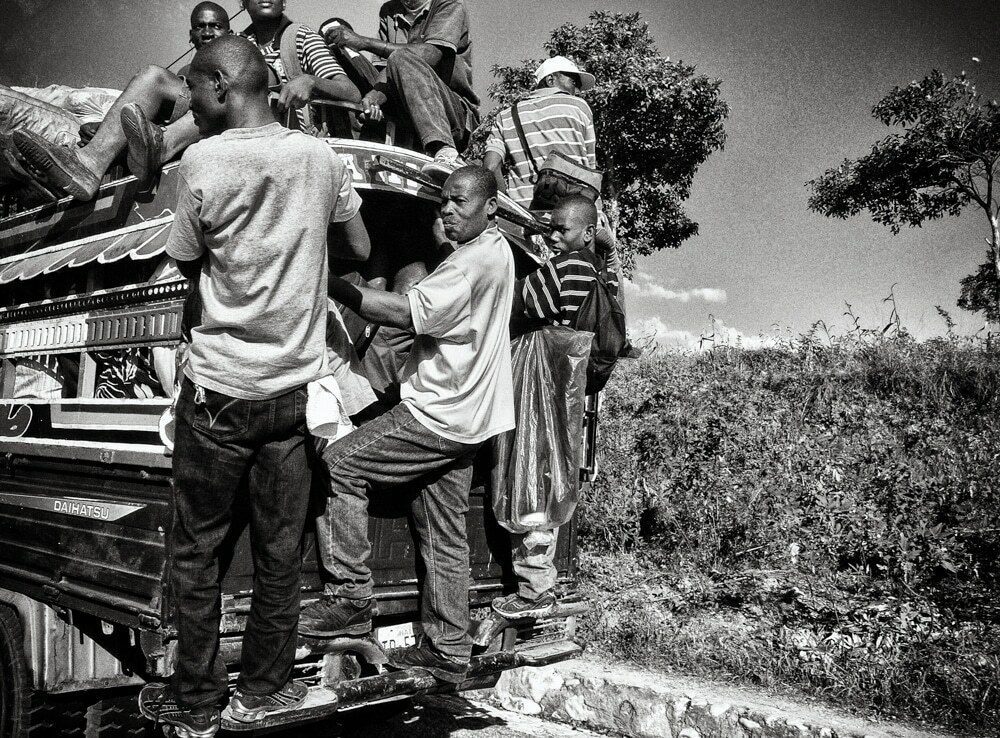
This frame works only because of the gestures: arms reaching, heads turning, someone climbing. Winogrand's pictures are full of these small moves. If you want more on reading them, see my guide to emotion and gesture in street photography.
Why Garry Winogrand matters to your street photography
A lot of beginners freeze because they want every frame to be good before they press the shutter. Winogrand shows the opposite approach. You shoot to learn what the camera sees, then you edit hard. His famous work came from that volume.
He also proves that a busy frame can work. Many composition guides tell you to simplify. Winogrand filled his pictures and still held them together, because every person in the frame is doing something.
My co-author on Phototactic, Don Springer, met Winogrand and photographed alongside him. One bonus in my street photography course is a two hour interview where Don talks about what Winogrand responded to most on the street and which focal length he preferred. The rest of the course teaches picture patterns, the repeatable structures you can see in crowded frames like his. There's no feedback on your own photos in the course, so the practice is yours to do.
For the other photographers in the New Documents circle and beyond, see my list of famous street photographers. Winogrand is the New York photographer above all, and if you want to walk the same streets, my guide to street photography in New York lists places to start. For more reading, my list of the best street photography books puts his books in context, and my collection of photography quotes includes his, with sources.
Garry Winogrand books and exhibitions
| Book | Year | Why get it |
|---|---|---|
| The Animals (MoMA) | 1969 | Zoo pictures full of humor and odd pairings |
| Women Are Beautiful | 1975 | His most criticised book, useful to understand the debate around him |
| Public Relations (MoMA) | 1977 | Protests and press events. Great for crowd pictures. |
| Stock Photographs: The Fort Worth Fat Stock Show and Rodeo | 1980 | People and their show animals in Texas |
| Winogrand: Figments from the Real World (MoMA) | 1988 | Szarkowski's retrospective. Start here. |
| The Man in the Crowd (Fraenkel Gallery) | 1998 | Many previously unpublished New York pictures |
| Garry Winogrand (SFMOMA / Yale) | 2013 | Leo Rubinfien's retrospective catalogue, including late work |
MoMA gave him solo shows from 1969 up to the 1988 retrospective. A big retrospective opened at SFMOMA in 2013 and travelled to other US museums and to Paris. The Brooklyn Museum showed Garry Winogrand: Color in 2019. The 2018 documentary Garry Winogrand: All Things Are Photographable, directed by Sasha Waters Freyer, shows him at work and aired on PBS American Masters.
Frequently Asked Questions
What camera and lens did Garry Winogrand use?
Winogrand worked mostly with a Leica rangefinder and a 28mm wide angle lens, which let him stand close and fit a lot of activity into one frame. He shot huge amounts of 35mm black and white film. He refused to treat equipment as important, saying you should judge how photographs look, not how they were made or with what camera.
What did Garry Winogrand say about photography?
His best known line is "I photograph to find out what something will look like photographed." He explained that the real subject was how putting four edges around a collection of facts transforms it. He also disliked the term street photography and joked that his book The Animals would make him a zoo photographer.
Why did Garry Winogrand tilt his camera?
Winogrand never gave one tidy explanation, but the tilted frames are part of his style. A leaning horizon adds movement and tension to a scene, and it lets the edges of the frame cut across people and objects in new ways. It also came from shooting very fast, raising the camera and pressing the shutter without slow, careful leveling.
How many photos did Garry Winogrand leave undeveloped?
When he died in 1984 he left about 2,500 rolls of undeveloped film and around 6,500 rolls developed but never proofed. Counting everything unedited, that is close to 300,000 frames he never really saw. Some of this late work was shown after his death in MoMA's 1988 retrospective and in the 2013 SFMOMA exhibition.
What was the New Documents exhibition?
New Documents was a 1967 exhibition at the Museum of Modern Art in New York, curated by John Szarkowski. It put Garry Winogrand next to Diane Arbus and Lee Friedlander. Szarkowski said their aim was not to reform life but to know it. The show is often seen as a turning point toward personal, less political documentary and street photography.