
Ernst Haas is known for pioneering color photography in the 1950s and for using slow shutter speeds to turn movement into streaks of color, most famously in his bullfight pictures. The move you can use is to drop your shutter speed on purpose so motion becomes the subject instead of a mistake.
I'm Olivier Duong. I teach street photography, and Haas is the photographer I send people to when all their frames look frozen and a bit stiff. He shows that a photograph can feel like music or painting, not only like a record of a moment.
What is Ernst Haas known for?
Ernst Haas is known as one of the first great artists of color photography. At a time when serious photographers worked in black and white and color was seen as commercial, he used color film to make poetic, often abstract pictures. His images ran in LIFE and Vogue, and in 1962 the Museum of Modern Art in New York gave him its first solo exhibition dedicated to color photography.
He is also known for motion. Blurred motion and selective focus were his tools for turning a scene into feeling. He talked about "transforming an object from what it is to what you want it to be."
His book The Creation (1971) sold more than 350,000 copies, which makes it one of the most successful photography books ever published.
Ernst Haas's life: from Vienna to Magnum Photos and LIFE magazine
Ernst Haas was born in Vienna on 2 March 1921. His parents valued the arts: his father enjoyed photography and his mother wrote poetry. He studied art and literature at school, then one year of medicine, which he was forced to leave because of his Jewish ancestry. As a young man he wanted to be a painter or an explorer.
He only took up photography after his father's death in 1940, learning in the darkroom by printing old family negatives. He got his first camera in 1946 at 25, trading a block of margarine for a Rolleiflex on the Vienna black market. He later described the photographer as "almost a painter in a hurry, overwhelmed by too many constantly changing impressions."
Homecoming and Magnum
In 1947, working for the magazine Heute, often alongside Inge Morath, he made black-and-white photographs of returning prisoners of war arriving by train in Vienna, and families searching for missing relatives among them. The photo essay, "Homecoming", ran in Heute and in LIFE. Robert Capa saw it and invited him to join Magnum Photos, whose members already included Henri Cartier-Bresson, George Rodger, David "Chim" Seymour and Werner Bischof. LIFE also offered him a staff photographer job. He turned it down because he wanted to stay free: "I don't think there are many editors who could give me the assignments I give myself."
Color in New York
Haas moved to New York in 1950 and lived there for the rest of his life. In 1953 LIFE published "Images of a Magic City", a 24-page color photo essay on New York spread over two issues, the magazine's first major color essay. Critic Andy Grundberg said those images "brought photography into the precincts of abstract expressionism."
The color film was scarce and expensive then, and many curators did not yet accept color as art. In 1957 LIFE published "Beauty in a Brutal Art", his color pictures of bullfights in Spain, which marked the start of his motion studies. After Chim died in 1959, Haas became president of Magnum. The 1962 exhibition at MoMA, realized by John Szarkowski at the end of Edward Steichen's time as director of photography, had around 80 prints, including his motion studies. He had already been part of Steichen's The Family of Man in 1955.
Later work
Haas worked as a stills photographer on films including West Side Story, The Misfits, Moby Dick and Hello, Dolly!, and directed a creation sequence for John Huston's The Bible. That work fed into The Creation. He hosted a TV series called The Art of Seeing in 1962. In the 1970s he built audiovisual slideshows that set his color pictures to music. He died of a stroke in New York on 12 September 1986. He received the Hasselblad Award shortly before his death. His archive is licensed through Getty Images, and the Ernst Haas Estate is run by his children.
Ernst Haas's color photography: color as feeling, motion as form
Critic A.D. Coleman described Haas as "a lyric poet pursuing a photographic equivalent of gestural drawing, utilizing such photographic effects as softness of focus, selective depth of field, and overexposure to telling effect." That's a good summary of a style you can study piece by piece.
- Blurred motion. Slow shutter speeds turn a bull or a crowd into sweeping shapes. When he first sent his blurred bullfight shots to the lab, they told him the film was unusable. LIFE ran them over 12 pages.
- Reflection and abstraction. Puddles, car paint, shop windows and wet streets let him break New York into color fields. Reflections show up across his New York in color work.
- Selective focus. A sharp detail against soft color, or everything soft, so the viewer feels the scene instead of reading it.
- Saturated color. He moved from the Rolleiflex to a 35mm Leica in the late 1940s and used it for the rest of his career. For color he mostly shot Kodachrome and printed with the dye transfer process when he could, for control over hue and saturation.
His influences came from painting and poetry more than from photo magazines. That shows. His pictures often look like abstract art made with a camera, which is why they sit comfortably between photojournalism and fine-art photography.
A line often credited to him says it best: "I am not interested in shooting new things. I am interested to see things new."
Ernst Haas photographs to study
I don't reproduce his photographs here. They are protected. The Ernst Haas Estate site and Getty Images hold large selections. Look each one up while you read.
Homecoming, Vienna (1947)
Black and white. Returning prisoners of war and the people waiting for them, some holding up photos of the missing. The move: find the emotion in the faces around the event, not only in the event itself. Haas was a photojournalist before he was a colorist, and the feeling is there from the start.
Images of a Magic City, New York (1953)
New York in color, with reflections and street signs turned into shapes of color. The move: photograph the city as color and form, not as a list of buildings. Reflections are the easiest door in.
La Suerte de Varas, Pamplona, Spain (1956)
One of his bullfight pictures. A slow shutter turns the bull and the mounted picador into a swirl of motion and color. The move: pick a subject that moves fast, drop the shutter speed well below what freezes it, and let the blur carry the energy.
The Creation (1971)
A book of 106 color photographs of nature, from volcanoes to water, arranged like a poem about the creation of the world. The move: sequence your images so they build a feeling together. It is a lesson in editing as much as shooting.
Steal this move: slow the shutter and let color move
Here is a motion exercise based on Haas's approach. Most street photographers set 1/125s or faster and never leave it. That's a good default. This exercise is about leaving it on purpose.
- Set shutter priority. Start at 1/15s. Try 1/8s and 1/4s once you're comfortable.
- Keep ISO low and stop down. In daylight you may need f/11 to f/16, or an ND filter, to get a slow shutter speed without overexposing.
- Find color that moves. A yellow taxi, a red coat, a crowd under neon signs, a cyclist.
- Choose sharp or swirl. Hold the camera still against a wall for a sharp background with blurred people. Or pan with one subject so it stays sharper and the background streaks.
- Shoot a lot. Motion blur is unpredictable. Expect a small percentage of keepers.
My street photography settings guide covers the exposure side if you need it.
My take on the idea
I've spent a lot of time shooting at night, where slow shutter speeds are often forced on you. Haas taught me to treat that blur as a choice, not a failure.
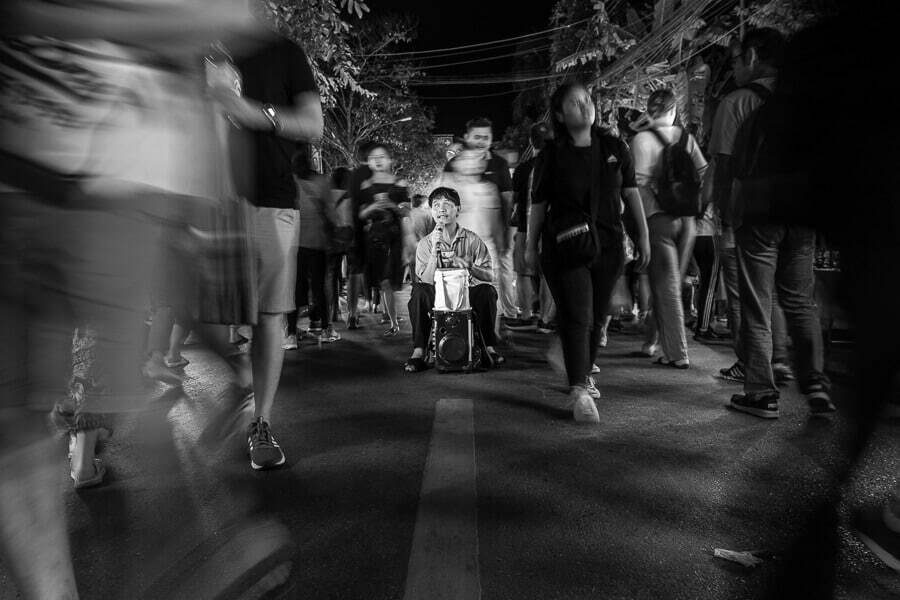
Here there was enough light for my fast lens to keep some parts sharp, and a slow enough shutter speed to make passersby blur. That contrast between still and moving is what makes the frame work.
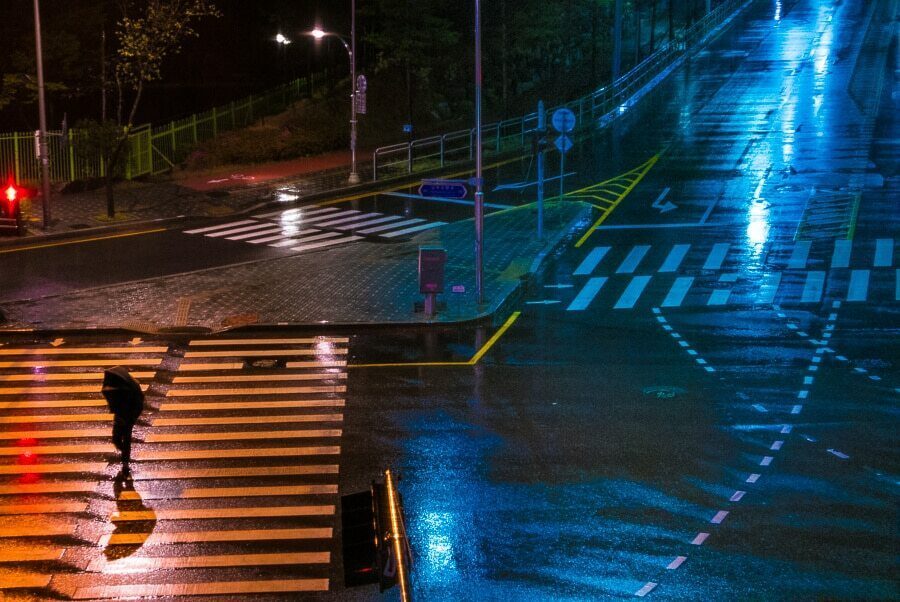
Night gives you colors you never see by day. A green shop sign next to a blue one creates contrast on its own. This is the Haas idea I use most: look for colors that are normally unseen. Plain midday colors are the most familiar, and so they're usually the most boring.
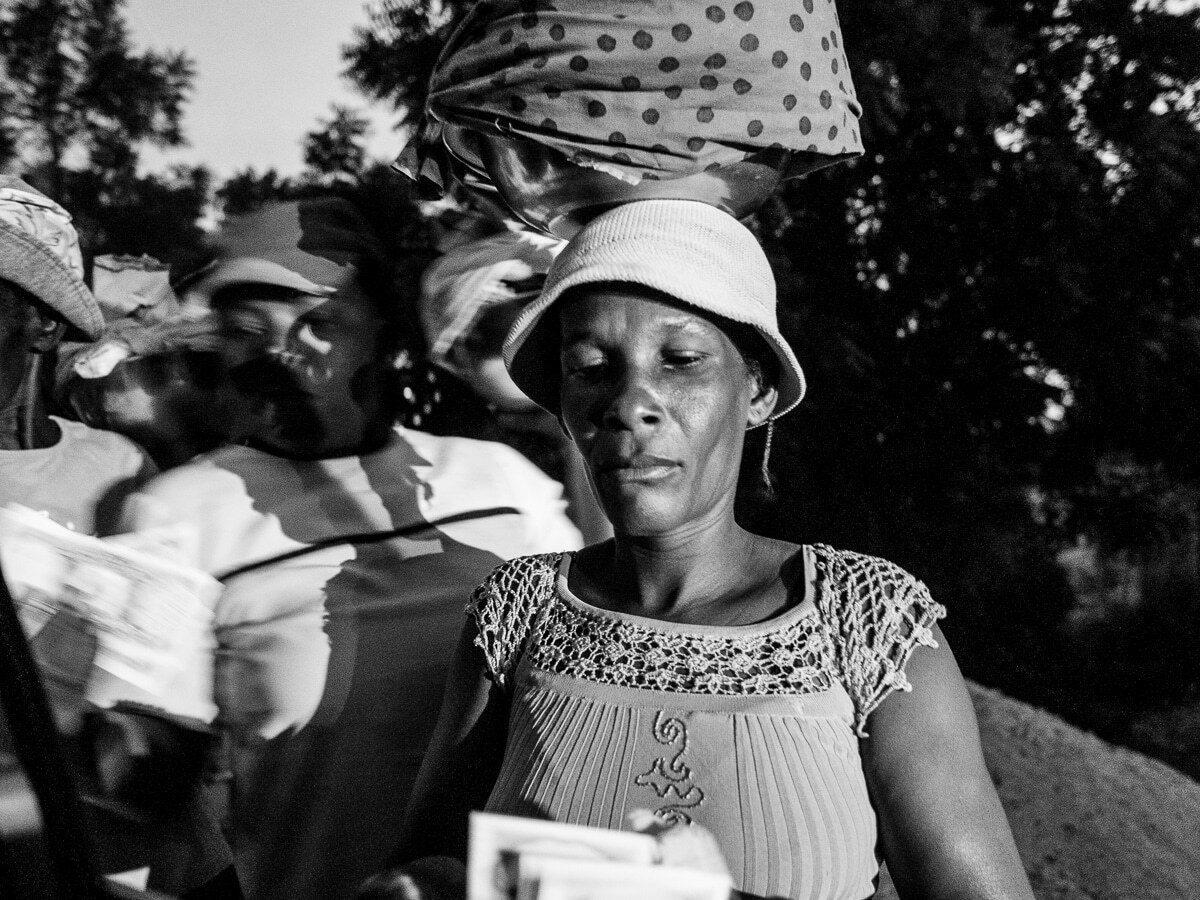
In this one the slow shutter was a result of low light, not a plan. It still works because the sharp woman in front anchors the frame. If you get a shot like this by accident, learn from it and do it again on purpose.
Why Ernst Haas still matters
Plenty of street photographers feel their pictures are all alike: sharp frames of one person walking. Haas broke that habit. Blur and color were his subject as much as people were.
He also wrote something to his Magnum colleagues that I think every photographer should read once a year: "Every one of us is struggling with his own style. Changes don't come purely by will power alone, but they never come by being satisfied." He ended with: "Don't cover, discover!" That letter and lines from other masters are in my photography quotes.
In my street photography course, Phototactic, we teach picture patterns, the repeatable structures behind strong images, plus lessons on color and contrast. "Sharp subject against a blurred crowd" is one such pattern. The course also comes with a camera basics bonus that covers shutter speed and the other settings. It's a video course with no feedback on your own photos, so the shooting is on you.
For more masters and one lesson from each, see my list of famous street photographers. If you're headed to the city where Haas lived, my guide to street photography in New York has places to start.
Frequently Asked Questions
What was Ernst Haas famous for?
Ernst Haas was famous for pioneering color photography as an art form in the 1950s and for his blurred motion pictures, especially of bullfights. His 1953 LIFE essay on New York, Images of a Magic City, was the magazine's first major color essay, and in 1962 he had MoMA's first solo exhibition devoted to color work. He also served as president of Magnum Photos.
What cameras did Ernst Haas use?
Haas got his first camera, a Rolleiflex, in 1946 by trading margarine on the Vienna black market. In the late 1940s he switched to a 35mm Leica rangefinder and used Leica cameras for the rest of his career. For color he mostly used Kodachrome film, and he printed his color work with the dye transfer process whenever he could.
What was Ernst Haas's early life like?
Haas was born in Vienna in 1921 to a family that loved the arts. His father enjoyed music and photography and his mother wrote poetry. His schooling was disrupted after Germany annexed Austria in 1938, and he had to leave medical school because of his Jewish ancestry. He started photography after his father died in 1940.
What techniques did Ernst Haas use in color photography?
Haas used slow shutter speeds to create blurred motion and selective focus to soften scenes. Reflections helped him break the city into color shapes, and he sometimes overexposed for effect. He shot Kodachrome on a Leica and made dye transfer prints for precise control of color. The aim was to show feeling, not just record what was there.
What exhibitions featured Ernst Haas's work?
His photographs were included in Edward Steichen's The Family of Man at the Museum of Modern Art in 1955. In 1962 MoMA gave him a ten year survey of his color photography, its first solo exhibition devoted to color work, with about 80 prints. His estate continues to show his work, and his archive is licensed through Getty Images.