
Photographer Fan Ho is known for his black and white street photography of Hong Kong in the 1950s and 1960s, built from hard light, deep shadow and clean geometry. The move you can use today is simple: find the light first, then wait for a person to step into it.
I'm Olivier Duong. I teach street photography, and Fan Ho is the photographer I point people to when they say their pictures look like everybody else's. His photos don't depend on rare events. They depend on seeing where the light falls and having the patience to stay there.
What is Fan Ho known for?
Fan Ho is known for turning ordinary streets, markets and alleys of Hong Kong into scenes that look staged for a film. Shafts of sun cut through smoke. A lone figure crosses a patch of light. Walls and stairs split the frame into sharp shapes.
His use of light and shadow is the signature. Most of Fan Ho's photographs are mostly shadow, with one bright area that holds a person. Your eye has nowhere else to go. That is why his pictures feel calm even when the street was crowded.
The second thing he is known for is patience. He picked a location, studied the light, then waited for the right subject to walk in. He described it this way in a 2014 interview with The Independent: "At the beginning you must find the ideal location. Then you must be patient to find the right subject that arouses your interest, even if it's just a cat."
Fan Ho's life: from Shanghai to Hong Kong and cinema
Fan Ho (何藩) was born in Shanghai on 8 October 1931. When war broke out in 1941 his parents were stranded in Macau for several years, and he was left in the care of a family servant. The family moved to Hong Kong in 1949.
He started young. His first pictures were made with a Kodak Brownie his father had left at home. At the age of 14 his father gave him a Rolleiflex twin-lens reflex camera, a K4A model, and he used that same Rolleiflex throughout his career. He was largely self-taught and developed his film in the family bathtub.
His photos show a fascination with urban life. His subjects were the people of Hong Kong, photographed candidly: street vendors, hawkers, workers and children playing in the street, many only a few years younger than he was. Over the 1950s and 1960s he built a body of work documenting the city as it turned into a major metropolitan center.
The photographic society circuit made him famous. From 1956 he won over 280 awards from international exhibitions and competitions. He became a Fellow of the Photographic Society of America and of the Royal Photographic Society. The Royal Society of Arts in England made him a Fellow too, and photographic societies from Singapore to France, Italy and Belgium gave him honorary membership. The Photographic Society of America named him one of the "Top Ten Photographers of the World" between 1958 and 1965.
Then he moved into Hong Kong cinema. He joined Shaw Brothers in 1961, starting as a continuity assistant on The Swallow, and later acted in several Shaw films, including the role of the monk Tripitaka in their Journey to the West cycle. After leaving Shaw in 1969 he directed over 20 films for studios in Taiwan and Hong Kong, and five of his films were later kept in the permanent collections of national film archives. He saw the two crafts as one. "Photography and filmmaking are like sisters," he told HK Magazine in 2012. "One is still and one is moving." Three of his films were chosen for the official selection of international film festivals, Cannes among them, and he sat on the jury of the Golden Horse Film Festival and Awards.
He moved to San Jose, California in 1995. His photographs came back into view when Modernbook Gallery in Palo Alto showed them in 2000, his first solo exhibition since the 1960s. Books followed: Hong Kong Yesterday (2006) and A Hong Kong Memoir (2014). He died in San Jose on 19 June 2016, aged 84. Portrait of Hong Kong was published after his death, in 2017.
Fan Ho's style: light and shadow, geometry and the lone figure
When I look at Fan Ho's photography I see two layers working together. There is the stage, made of light and architecture. Then there is the actor, usually one small human figure. The stage is built first. The actor is waited for.
Light as the subject
Fan Ho treated light like a material. Morning sun through smoke. A shaft of light down an alley. The bright edge of a wall catching the last sun of the day. He exposed for the bright part and let everything else fall into black. That mix of smoke and light is what people associate with him, and it's why his black and white photographs feel so graphic.
Geometry that holds the frame
Walls, stairs, railings and rooftops give his frames strong lines, level ones and diagonal ones. The verticals and horizontals feel stable. The diagonal adds tension and energy. Gallery owner Laurence Miller said his photographs "felt like direct descendants of the Bauhaus, yet they were made in Hong Kong. They were abstract and humanistic at the same time."
A small human being in a big space
His figures are often tiny. That scale is what gives the photos their drama and atmosphere. A small person in a big space of light and dark reads as a feeling, loneliness or the passing of time, rather than as a report of what happened on that street.
Freedom in the darkroom
Fan Ho did not treat photography as a pure record. He cropped hard and he worked his prints. Later in life he also made new prints by compositing old negatives, and many of those were published for the first time in A Hong Kong Memoir. Know this before you compare your straight shots to his.
Three Fan Ho photographs and the move each one shows
I don't reproduce his work here. The images belong to the Fan Ho Trust and estate, and the family's official site, fanho-forgetmenot.com, is the best place to see them. Look each one up while you read.
Approaching Shadow (1954)
His most famous work. He asked a cousin to pose by a wall at Queen's College in Causeway Bay, then added the large diagonal shadow in the darkroom. He said the shadow symbolized that "her youth will fade away" because "everyone has the same destiny". A print sold for a record HK$375,000 in 2015. The move: one strong diagonal of shadow against a bright wall, with the person placed right at the edge where light meets dark. The idea came first. The picture was built to carry it.
Lines & Forms (1959)
People strolling around railway lines. The title tells you what he cared about. The move: let the lines of the place divide the frame, then place people inside the shapes those lines create. For more on this, see my guide to leading lines.
On the Stage of Life (1954)
The title is a good summary of his whole method. The street is a stage and the light is the spotlight. The move: treat a bright patch of pavement or wall as your stage and wait for someone to enter it.
Other titles worth looking up on the official site include Sun Rays (1959), Smokey World (1959), Back Alley (1956) and Along the Tracks (1960).
Steal this move: find the light, then wait
This is the exercise I'd give anyone who wants to learn from Fan Ho. It works in any city with sun and buildings.
- Go out when the sun is low. Early morning or late afternoon gives you long, hard shadows. Midday light rarely works for this.
- Find a pool of light surrounded by shadow. A gap between buildings, a sunlit wall, light coming down a staircase or through a window.
- Expose for the bright part. Use exposure compensation of about -1 to -2 stops, or meter on the light. The shadows should go almost black.
- Compose the empty stage. Put the light where you want the person to be. Check your lines and edges before anyone shows up.
- Wait. Let several people pass. Shoot each one. Keep the frame that has the best gesture and position.
I call this a trap shot. You set the frame, then let the street fill it. Here is what a sequence looks like when I work a spot this way.
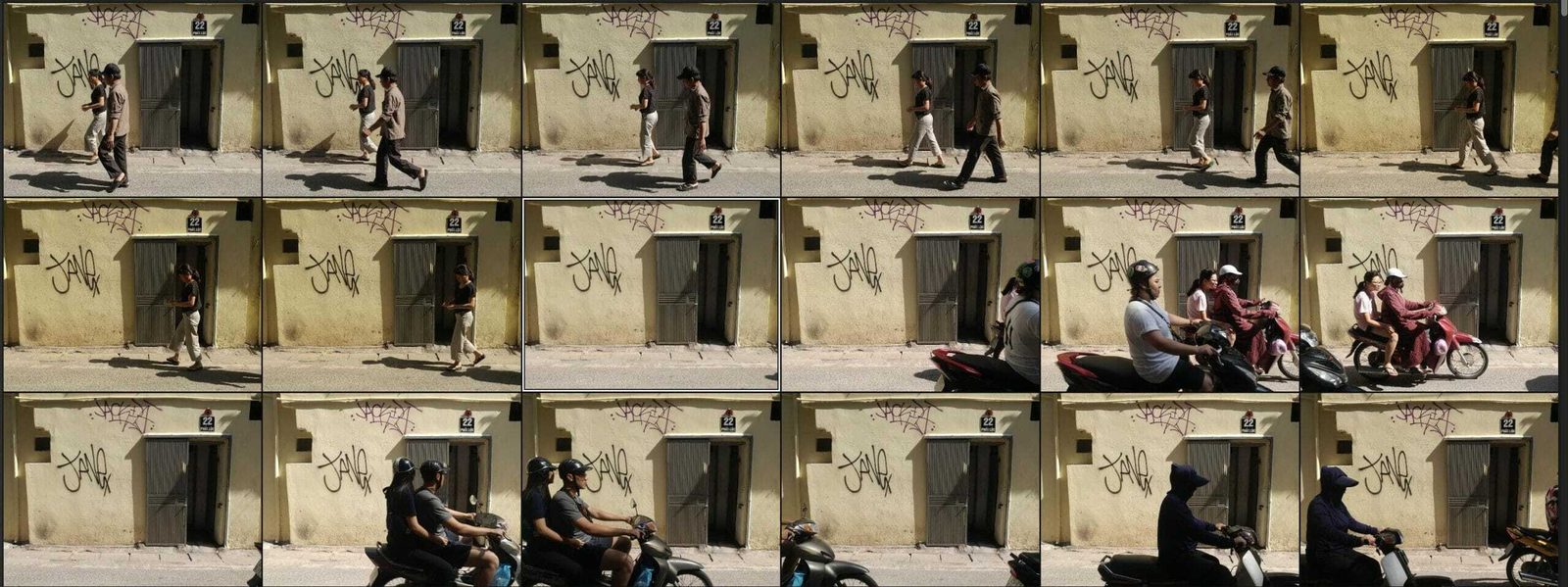
The point is not to copy his Hong Kong. It's to copy his order of operations: light and composition first, the person second. That order is what separates a planned photograph from a lucky snapshot.
My take on the idea
I'm not Fan Ho, and I shoot mostly with small digital cameras rather than a Rolleiflex. But his way of seeing shaped how I look for light. Here are two of my own frames that use the same idea.
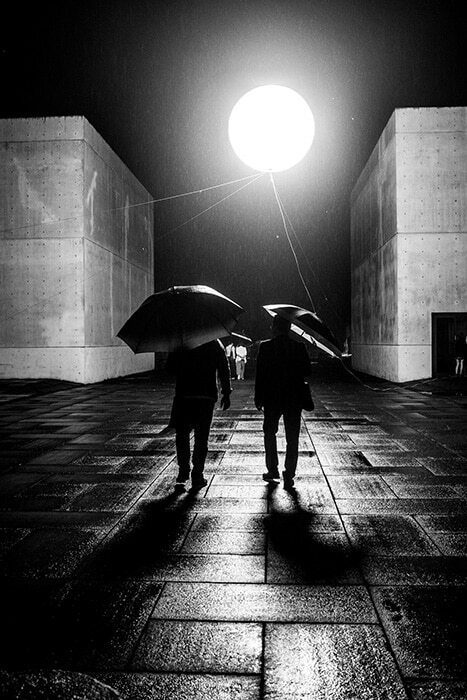
In the frame above the light does most of the work. One big round light and the wet pavement turn two people with umbrellas into silhouettes with long shadows. Without that light it would be a snapshot of two people walking.
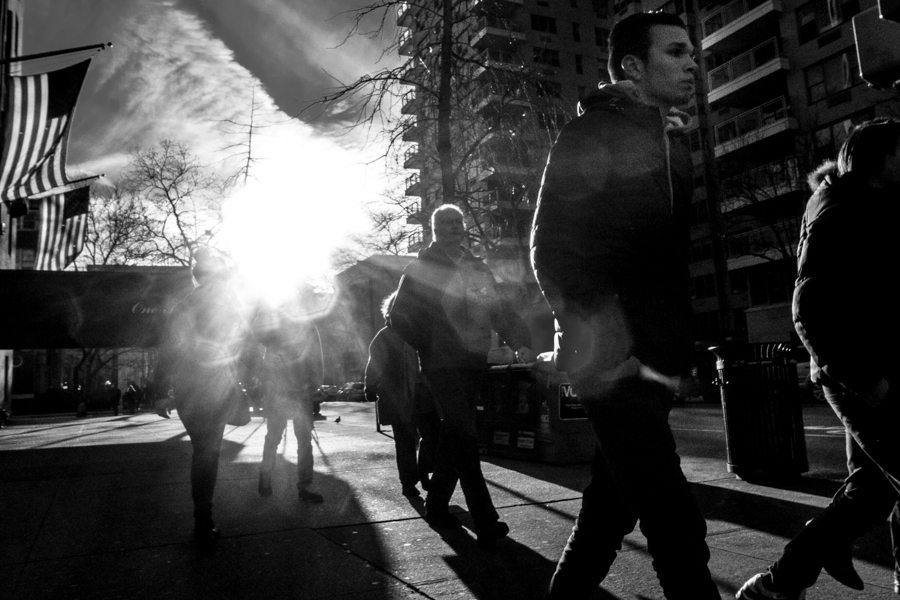
In New York, tall buildings cast huge shadows most of the day. If you watch where the sun breaks through and wait there, you'll get frames like this. If you want to try it yourself, my guide to street photography in New York lists spots, and the Hong Kong street photography guide covers the city Fan Ho photographed.
Why Fan Ho still matters for street photographers
A lot of street photographers feel stuck. On Reddit one wrote: "Everybody kind of takes the same photos of the same subjects with the same styles these days." Fan Ho is a good source of inspiration for that feeling, because his pictures come from seeing, not from subjects. He was a Hong Kong street photographer who could capture the essence of a place with almost nothing in the frame.
Hong Kong street photography today looks nothing like the city he shot. The street vendors and the smoke are mostly gone. Yet his photos still teach, because the principles don't depend on the place. Light and shadow exist in every city, and so do people walking into them.
Fan Ho was not a photojournalist, and he has a clear place in the history of street photography. He is sometimes called the "Cartier-Bresson of the East". I think the comparison only goes so far. Henri Cartier-Bresson is famous for catching the peak of action, the decisive moment. Fan Ho built his frames more slowly and cared more about mood than action. Both matter, and it helps to know which one you're doing.
In my online street photography course, Phototactic, we call these repeatable structures picture patterns. "Pool of light plus lone figure" is one of them. Once a pattern is in your head, your eye starts spotting it without effort. The course teaches the patterns and the composition principles behind them. It doesn't include feedback on your own photos, so the practice is up to you.
Fan Ho books and where to see his work
| Book | Year | What's in it |
|---|---|---|
| Thoughts on Street Photography | 1960 (new edition 2025) | His early writing on how to photograph the street |
| Hong Kong Yesterday | 2006 | 1950s and 1960s Hong Kong street photographs |
| The Living Theatre | 2009 | More of the street as a stage |
| A Hong Kong Memoir | 2014 | Includes many composited prints shown for the first time |
| Portrait of Hong Kong | 2017 | 153 street photographs selected from negatives he chose before he died |
To see the photographs, start with the family's official site. His prints have been shown by galleries including Modernbook in Palo Alto and Laurence Miller Gallery in New York City. Blue Lotus Gallery helped his family publish his last book, and some of his work is in the collection of the San Francisco Museum of Modern Art. For more masters and the lesson each one teaches, see my list of famous street photographers, and my guide to light and shadow photography for the technique side. His line about finding the stage first is in my collection of street photography quotes, and more books to study are in my list of the best street photography books.
Frequently Asked Questions
What camera did Fan Ho use?
Fan Ho used a Rolleiflex twin-lens reflex camera, a K4A model his father gave him at age 14, for his whole photographic career. Before that he made his first pictures with a Kodak Brownie his father had left at home. The Rolleiflex shoots square medium format film, which suits his graphic, carefully built compositions.
Did Fan Ho win any awards?
Yes. From 1956 Fan Ho won over 280 awards in international photography exhibitions and competitions. He was a Fellow of the Royal Photographic Society and the Photographic Society of America, among other societies, and the Photographic Society of America named him one of its Top Ten Photographers of the World between 1958 and 1965.
Where can I see Fan Ho's work?
The best starting point is the official website run by his family, fanho-forgetmenot.com, which shows his street photographs and portraits. His books, such as Hong Kong Yesterday and A Hong Kong Memoir, collect most of his best known images. Galleries such as Blue Lotus Gallery have also exhibited and sold his prints.
Is Fan Ho's work still relevant today?
Yes. The Hong Kong he photographed has mostly disappeared, but his method has not aged. Find strong light, build the frame from lines and shadow, then wait for a person to complete it. Any street photographer in any city can practice that today, and it is one of the fastest ways to make photographs that look less like everyone else's.