
Film street photography means shooting candid life in public places on film, almost always 35mm, with a small camera and ISO 400 black and white film. Load Ilford HP5 Plus or Kodak Tri-X, then zone focus at about 3 meters with f/8 and 1/250s in daylight.
I'm Olivier Duong. I shoot digital today. Film has tempted me many times, and it has cost me money. I've owned an Olympus XA, a Pentax Auto 110, a Fuji 6x9 and a custom 4x5. So this guide gives you both sides. It shows how to shoot 35mm film on the street, and how to tell whether film will change your pictures or just your spending. Every film guide on this site links from here.
What is 35mm film photography?
35mm film photography, the most common kind of analog photography, is shooting on 135 film, the roll film that comes in a small metal cassette and gives a 24x36mm negative. That frame size is where the term "full frame" comes from on digital cameras. A roll holds 24 or 36 exposures, so the number of frames is fixed before you start, and the film is 35mm wide including the sprocket holes, which is how the format got its name. Where digital photography records light on a digital sensor, film records it on a light-sensitive emulsion that becomes a film negative after developing.
There are a few formats worth knowing before you buy anything:
- 35mm (135 film). The street format. Small cameras, cheap film, 36 frames a roll. Almost every film street photographer you have heard of shot it.
- Half frame. Still 35mm film, but each picture uses half the frame, so a 36 exposure roll gives you about 72 pictures. The Pentax 17 and Kodak Ektar H35 are new half-frame cameras.
- 120 film (medium format). A wider roll with a bigger negative and only 8 to 16 frames. Beautiful detail, but the cameras are bigger and slower. Vivian Maier and Fan Ho both worked with twin-lens Rolleiflex cameras on 120.
- Large format. Single sheets of film in a camera on a tripod. Not a street tool. I learned that the expensive way.
You also choose the type of film. Each film stock has its own speed, grain and colour, so the stock you load shapes the picture as much as the camera does. Negative film, in black and white or colour, gives you a negative that the lab turns into prints or scans. Black and white is the classic street choice, and Kodak Portra or Kodak Gold are common colour picks. Slide film, also called reversal film, gives a positive image on the film itself, but it has almost no exposure latitude, so it punishes mistakes. For the street, stick to negative film. It forgives a stop or two of exposure error, and on the street you will make those errors every day.
Why shoot street photography on film?
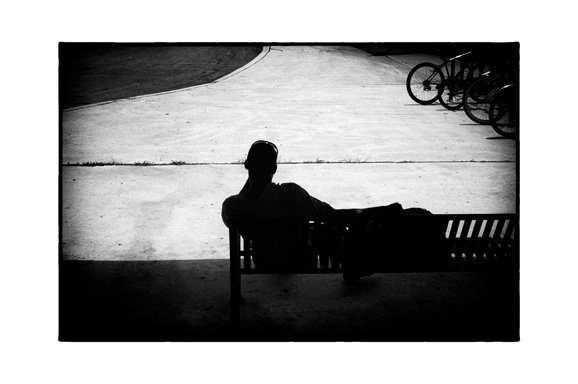
The best reason to shoot film on the street is what it does to your attention. You can't check the back of the camera, and you only have 36 frames. That combination changes how you shoot.
I first felt this on a digital camera, the Epson R-D1, a rangefinder built to handle like a film camera. You could flip its screen around and forget it existed. I wrote at the time that cameras are not innocent: they produce psychological effects on the photographer. With a normal digital camera, you can always check the last frame and adjust, and that tends to make you careless. I caught myself skipping the histogram and just correcting from the preview. With film, you know you can't fix it after the fact, and you know your frames are limited. So you pay attention to the light and the timing before you press the shutter, not after.
There are other good reasons:
- The look. Grain, the way negative film holds highlights and shadows, and the slight imperfection of a scanned negative. It is a unique look, even if a modern sensor records finer detail. You can imitate it digitally, but many photographers prefer to get it straight from the film.
- A slower pace. Winding on between frames gives you a beat to think. People who shoot bursts on digital often find that pause makes them more selective.
- Delayed judgment. You see your photos days or weeks later. By then you have forgotten how the moment felt, so you judge the picture instead of the memory. That is a real help when you learn to edit your own work.
- Quiet, small cameras. A film point and shoot or a small rangefinder draws less attention than a big digital body with a zoom lens. That helps if you struggle with fear of street photography.
Is film better than digital for street photography?
No. Film is not better than digital for street photography. It is different, and the difference only helps if the limits of film fix a problem you actually have.
I use one argument on myself every time the urge comes back. You want film for the dynamic range and the colours, right? Then what happens after you shoot? You get the film developed, and then you get it scanned. The moment you scan a negative, you have a digital file again. So a lot of the talk about film quality ends at the scanner. If you make fine art prints in a darkroom, that argument doesn't apply to you. For most of us, it does.
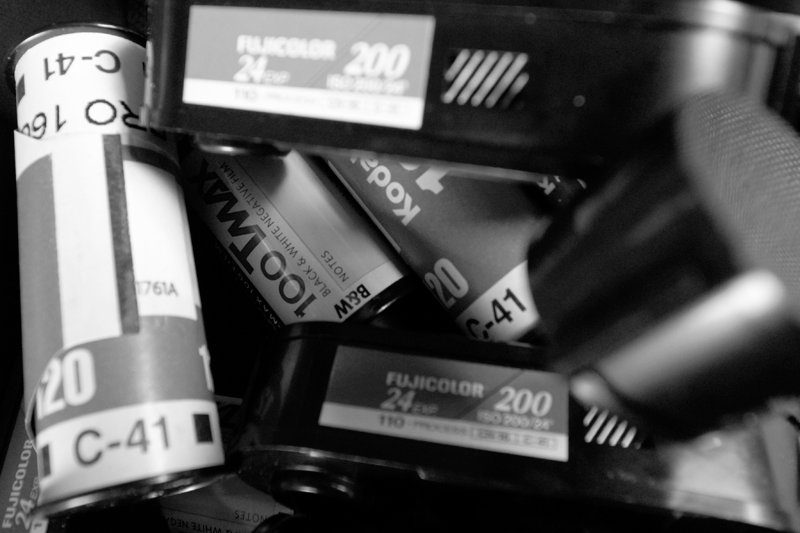
That photo is from a time when I had gear acquisition syndrome, and "maybe I should try film" was the most expensive lie I told myself. I bought a custom 4x5 camera with backs and film, shot fewer than 10 frames, and sold it at a big loss. I shot two rolls with a Fuji 6x9 and sold it with 19 rolls of Ilford HP5 still in the box.
So test the idea honestly. Film is worth it if you want the process: the limits, the wait, the physical negative, maybe home developing. It is not worth it if you want it to fix boring photos. A new format never fixes that. If your street photos feel flat, why your street photos are boring will help more than a Leica M6.
What you need to start shooting film
You need a working film camera, a few rolls of film, and a lab that develops and scans. Everything else can wait.
- A 35mm camera. A point-and-shoot camera with autofocus and auto exposure is the easiest start if you are new to film photography. A manual SLR like the Pentax K1000, Canon AE-1 Program, Nikon FM2 or Minolta X-700 gives you full creative control, and its lens mount takes cheap old lenses. A rangefinder camera is smaller and quieter again. My full list with prices is in the best film camera for beginners.
- Film. Start with an ISO 400 film stock. Kodak Tri-X, Kodak T-Max 400 or Ilford HP5 Plus for black and white, Kodak UltraMax 400 or Portra 400 for colour. The reasons are in the best film for street photography.
- A lab. A local lab or a mail-in lab develops the film and scans the negatives. Ask for the higher scan resolution if you want to crop or print.
- A light meter, maybe. Most cameras have one built in. If yours doesn't, use a phone light meter app or the sunny 16 rule.
Buy used cameras from a shop that tests them and gives a warranty, like KEH or a local camera store, rather than an untested eBay listing. Old cameras fail in boring ways, like rotten light seals or a sticky shutter. A tested camera saves you a wasted first roll.
How much does 35mm film photography cost?
Expect to pay roughly $25 to $40 per roll of 35mm film, all in, once you add developing and scanning. That works out to around 65 cents to $1.10 per frame. Film itself is often the smaller part of the bill.
US prices, as reported in mid to late 2026 by PhotographyTalk and Pellica. Prices move, so treat them as a guide.
| Item | Typical price (US, 2026) |
|---|---|
| Kentmere Pan 400 or Kodak Gold 200, 36 exp. | about $8.50 to $9.50 |
| Kodak Tri-X 400 or Ilford HP5 Plus, 36 exp. | about $9 to $11.50 |
| Kodak Portra 400, 36 exp. (in a 5-pack) | about $17 to $18 per roll |
| Develop and scan at a mail-in lab | about $14 to $20 per roll |
| Black and white developed at home | a few dollars of chemistry per roll, plus about $70 to $100 of kit |
Two habits cut the cost a lot. Develop black and white film at home, since it is the easiest process to learn. And shoot half frame, which doubles the number of pictures per roll. Shooting fewer, better frames also helps, and film forces that habit on you anyway.
Camera settings for film street photography
The simplest street settings for film are ISO 400 film, f/8, 1/250s in daylight, and the focus preset to about 3 meters (10 feet). Then you forget the camera and watch the street.
That is zone focusing. At f/8 with focus set to 3 meters, a 28mm lens keeps everything from about 1.5 meters to the far distance acceptably sharp, and a 35mm lens covers about 2 to 7 meters. You don't need to focus for each shot. It is how photographers worked fast on manual cameras for decades, and it still beats most autofocus for candid moments. The full method, and how to adjust as light changes, is in street photography settings.
A few rules that are specific to film:
- Expose for the shadows on negative film. Negative film handles overexposure much better than underexposure. When in doubt, give it one more stop of light.
- Use the sunny 16 rule as a backup. In bright sun at ISO 400, f/16 at 1/500s is correct. Open up one stop for each step of cloud. Details in the sunny 16 rule.
- Push when the light drops. You can shoot HP5 or Tri-X at ISO 1600 and ask the lab to push the film two stops. You get more grain and contrast, which suits a lot of street work at dusk and night photography.
- Don't change ISO mid-roll. The whole roll is developed the same way, so pick your speed before you load it.
How to shoot your first roll of film on the street
Shoot your first roll in one place you know well, in good daylight, with one setting. You want to learn how the film responds, not fight the conditions.
- Load ISO 400 film in the shade, not in direct sun, and make sure the rewind knob turns as you advance. If it doesn't, the film isn't catching.
- Set f/8, 1/250s and a 3 meter zone, or put a point and shoot on auto with the flash off.
- Pick a spot with good light and let the scene come to you. The ideas in street photography ideas work the same on film.
- Take one frame per moment, two at most. That is the discipline film gives you.
- Write down what you did for tricky frames: backlight, shade, a pushed exposure. When the scans come back, you will know why some frames worked.
- Rewind before you open the back. Every film shooter ruins one roll this way. Try not to make it your first.
Don't judge film on your first roll. Your hit rate will be low, and that is normal. Mine is low on digital too. What matters is what you learn from the contact sheet, so read street photography hit rate before you despair.
Developing and scanning your film
You can send your film to a lab or develop it yourself. Most beginners should use a lab for the first few rolls, then try home developing with black and white.
A lab develops colour negative film in C-41 chemistry and black and white film in its own developer. They then scan the negatives and send you files, usually by download link. The scan resolution matters more than people expect. A basic scan is fine for a phone screen. For cropping or printing, pay for the larger scan.
Black and white film is the easiest to develop at home. You need a changing bag, a developing tank with reels, a thermometer and chemicals. No darkroom is needed, only a dark bag to load the tank. Colour C-41 is possible at home too, but temperature control is stricter.
To scan at home, you can use a flatbed scanner with a film holder or photograph the negatives with a digital camera and macro lens over a light panel. After that, edit the scans like any other file. My street photography editing guide covers the workflow, and black and white photography covers tone.
Film street photographers worth studying
Most of the history of street photography was made on film, so you have a huge library to learn from. Study what these photographers saw, not which camera they held:
- Henri Cartier-Bresson shot 35mm on a Leica, mostly with a 50mm lens, and built his work around the decisive moment.
- Garry Winogrand shot so much 35mm film that he left thousands of rolls undeveloped when he died in 1984.
- Vivian Maier shot mostly square 120 film on a Rolleiflex and left many rolls unprocessed, which were only developed after her work was found.
- Fan Ho made his Hong Kong pictures of light and shadow in the 1950s and 1960s on a twin-lens Rolleiflex.
- Saul Leiter and Ernst Haas showed what colour film could do on the street when most serious photographers still shot black and white.
- Josef Koudelka made his Gypsies and Exiles work in hard black and white.
- Daido Moriyama is known for grainy, high-contrast black and white, often shot on small compact cameras.
Look at them for their seeing. The film gave them grain and tone. It didn't give them the picture. For more names, see famous street photographers.
Film street photography guides on this site
- Best film camera for beginners: point and shoots, half-frame cameras, SLRs and rangefinders, with used prices and what to check before you buy.
- Best film for street photography: the black and white and colour stocks worth loading, with push processing notes.
- How to make a photo zine: turn your best frames into a small printed booklet, from selection to staples.
- Photography portfolio: how to pick and present your best frames once you have a body of work.
- Best photography books: the photobooks of the film era masters worth studying.
- Gifts for photographers: film, cameras and books for the film shooter in your life.
- The sunny 16 rule: exposure without a meter, which many old film cameras need.
- Black and white photography: seeing in tones, the heart of most film street work.
- Best camera for street photography: digital cameras for when you want the film feel without the lab bill.
Where my course fits if you shoot film
Film changes the process. It doesn't teach you what to point the camera at. That is what my online street photography course, Phototactic, is about: composition and emotion, and learning to see picture patterns before they happen. It is camera-agnostic. The bonus Photography Basics course explains settings on the principle that all cameras behave the same way, so everything applies to a film SLR as much as to a Ricoh GR.
One student, Ray Smith, wrote that one of his favourite frames came from "the first roll of film I shot while going through your course." The camera stays the same. What you notice changes. The course is recorded video lessons. It has no feedback on your own photos and no community, so if you want someone to review your negatives, look for a local club or a workshop as well.
Frequently Asked Questions
Is 35mm film photography making a comeback?
Yes. Demand has grown enough that new film cameras keep launching, like the Kodak Ektar H35 and Pentax 17 half-frame cameras, the Rollei 35AF from MiNT, and the Kodak EC35 in 2026. Eastman Kodak also began selling its own Ektacolor Pro films in 2026. Prices have risen with demand, so film costs more per frame than a few years ago.
How expensive is it to shoot 35mm film?
In 2026, a roll of 35mm film costs about $8.50 to $18 depending on the stock, and developing plus scanning at a US lab adds roughly $14 to $20. That puts most rolls at $25 to $40 all in, or about 65 cents to $1.10 per frame. Home developing black and white film cuts that sharply.
Is 35mm film hard for beginners?
No. A point and shoot film camera with autofocus is as easy as a phone once the film is loaded. A manual SLR takes a few rolls to learn, because you set aperture and shutter speed yourself, but that teaches exposure faster than any auto mode. Start with ISO 400 negative film, which forgives mistakes.
What ISO film is best for street photography?
ISO 400 is the best all-round film speed for street photography. It gives fast enough shutter speeds for moving people and enough depth of field for zone focusing in daylight. Ilford HP5 Plus and Kodak Tri-X are the classic black and white choices, and both can be pushed to 1600 or 3200 at night.
How many photos are on a roll of 35mm film?
A standard roll of 35mm film has 24 or 36 exposures, and careful loading can squeeze out one or two extra frames. A half-frame camera, like the Pentax 17 or Kodak Ektar H35, takes two pictures per frame, so a 36 exposure roll gives you about 72 photos.
Does anyone still develop 35mm film?
Yes. Local camera stores and mail-in labs still develop 35mm film, both colour C-41 and black and white, and most also scan the negatives and send you digital files. Some pharmacies stopped in-store processing, so a dedicated film lab is usually the better choice. You can also develop black and white film at home.