
Alex Webb (born 1952) is an American Magnum photographer known for dense, vibrant color street photographs in which several people and slices of hard light share one frame, mostly in the Caribbean and along the US and Mexico border. The lesson you can use from him is to build a picture in layers, front to back, and to wait until every part of the frame holds something.
I'm Olivier Duong. I teach street photography, and Webb is the photographer I point to when someone's pictures have one subject in the middle and nothing else going on. His frames are the opposite. They are so full that you keep finding new things, and yet they hold together.
What is Alex Webb known for?
Alex Webb is known for complex color photographs of chance moments, often in places with social or political tension such as Haiti, Mexico, the US and Mexico border and Istanbul. His pictures combine saturated color and several separate actions in one frame.
He has been a full member of Magnum Photos since 1979 and has published more than 15 books of his own, from Hot Light/Half-Made Worlds (1986) to The Suffering of Light (2011), a survey of 30 years of his color work. With his wife, the photographer Rebecca Norris Webb, he has made several joint books, including Brooklyn: The City Within (2019).
He is still working. In 2026 a new exhibition paired his archival photographs of Mexican streets with a recent commission on young people in Oaxaca, and the Chrysler Museum of Art in Norfolk, Virginia lists his work in a show running into early 2027.
Alex Webb's life: from Harvard to Haiti
Alex Webb was born in San Francisco on 5 May 1952 and grew up in New England. He got interested in photography at The Putney School, a high school in Vermont. In 1972 he attended the Apeiron Workshops in Millerton, New York, where he met the Magnum photographers Bruce Davidson and Charles Harbutt.
He studied history and literature at Harvard, graduating in 1974, and took photography classes at the Carpenter Center for the Visual Arts at the same time. That year he began working as a photojournalist and joined Magnum as a nominee. He became an associate in 1976 and a full member in 1979.
His early work was in black and white, photographing small town life in the American South. Then he began working in the Caribbean and Mexico. The light and color there changed his work. In 1978 he switched to color, and he has worked in color ever since. For about 30 years he shot Kodachrome slide film, which he has talked about in interviews.
His books follow his travels: Haiti in Under a Grudging Sun (1989), Florida in From the Sunshine State (1996), the Amazon (1997), the US and Mexico border in Crossings (2003) and Istanbul in Istanbul: City of a Hundred Names (2007), with a text by Orhan Pamuk. His Mexico work is collected in La Calle (2016).
He received a Guggenheim Fellowship in 2007, and his work has been shown at the Whitney Museum of American Art and the Metropolitan Museum of Art. He lives and works in Brooklyn with Rebecca Norris Webb. Together they wrote Alex Webb and Rebecca Norris Webb on Street Photography and the Poetic Image (2014).
Alex Webb's style: layers and hard light
Webb describes his method in plain words on his Magnum profile: "For what does a street photographer do but walk and watch and wait and talk, and then watch and wait some more." The waiting is the secret behind the complexity. These are the habits you can see in his pictures.
- Several layers. A figure close to the lens, another in the middle, a third far back. Each layer has its own action. My guide to layering in photography breaks this down step by step.
- Hard tropical light. Harsh sun cuts the frame into bright blocks and black shadows. He uses the shadows to hide the clutter and to separate the layers. See my page on light and shadow photography.
- Saturated color as structure. A red wall, a blue door, a yellow shirt, a green sign. Color divides the frame into zones the eye can read. My guide to color photography covers color on purpose.
- Edges that matter. People are cut by the frame edge or peek in from a corner. Nothing is centered for comfort.
- Many frames per scene. His complex images come from staying in one place and shooting a lot while the scene changes. My guide to working the scene explains the habit.
The risk of this style is chaos. A layered frame with nothing connecting the layers is just clutter. Webb's pictures work because each part has a clear shape, and the color and light hold them together.
Four Alex Webb books to study
I don't reproduce his photographs here. They are protected, and his Magnum Photos profile is the place to see them. These books show the style best.
Hot Light/Half-Made Worlds (1986)
His first book, from the tropics. You can watch the style being born: color and heat, with people stacked in the frame. The move: go where the light is hard and learn to use shadow as a shape.
Crossings (2003)
Photographs from the US and Mexico border over many years. Tension and many small scenes at once. The move: return to one place for years, and the complexity of the place shows up in your frames.
The Suffering of Light (2011)
The survey of three decades of color work, and the best single book to start with. It is on my list of the best photography books. The move: study how each picture separates its layers with light or color.
La Calle (2016)
Street photographs from Mexico made between 1975 and 2007. The move: learn one country's streets deeply. If you go, my guide to street photography in Mexico City is a good start.
Steal this move: build a frame in layers
Here is a Webb exercise. It takes patience more than luck, and it works in any busy street with strong light.
- Find a stage. A market street or a plaza with hard sun and some shade. Stay in one spot.
- Set your background first. Pick a wall or a scene with a color or a shape you like. That's your back layer.
- Wait for a middle layer. Someone walking or standing in the middle distance, in the light.
- Add the front. Step closer to something near the lens: a person, a shoulder, a hand, a shadow. Let it cut into the edge of the frame.
- Shoot many frames. Keep shooting as people move. Most frames will fail. One of them might hold all the layers at once.
A 28mm or 35mm lens helps, because you need to be close to the front layer and still see the background. Stop down to f/8 so several planes are sharp, and expose for the highlights so the shadows go dark. My street photography settings guide has more.
My take: lessons I use from Webb
I lived in Southeast Asia for years, where the light is hard and the streets are full, and Webb's books were never far from my mind. These are my photos, not copies of his style, but each one uses an idea I learned from him.
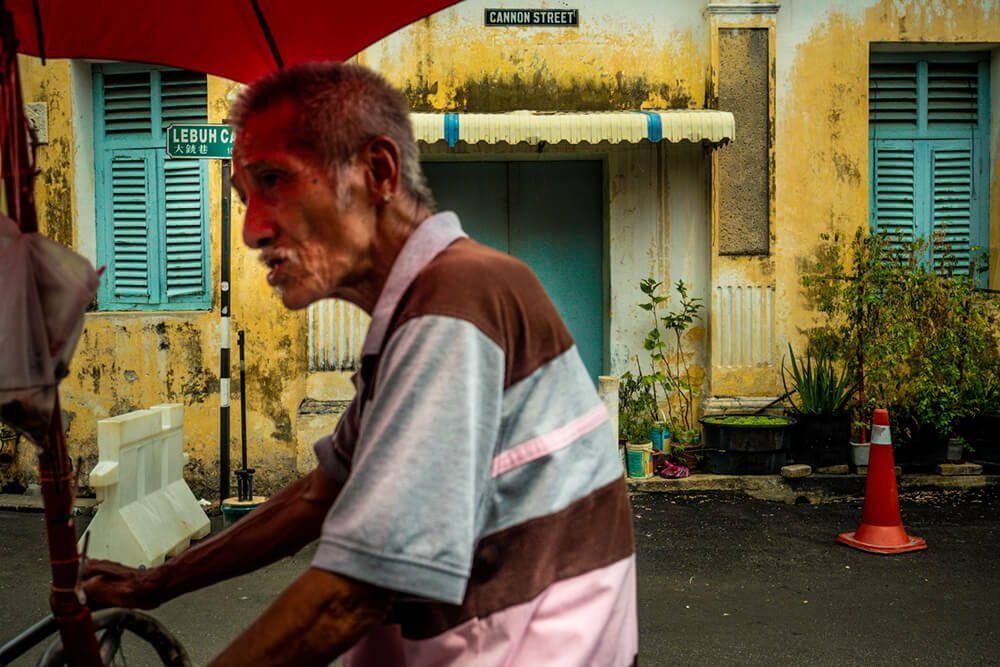
The yellow wall and teal shutters are a stage. The man in front is the near layer. Webb would probably wait for a third figure in the doorway behind. I didn't, and that's the lesson I take from comparing my frame to his: one more layer, one more minute.
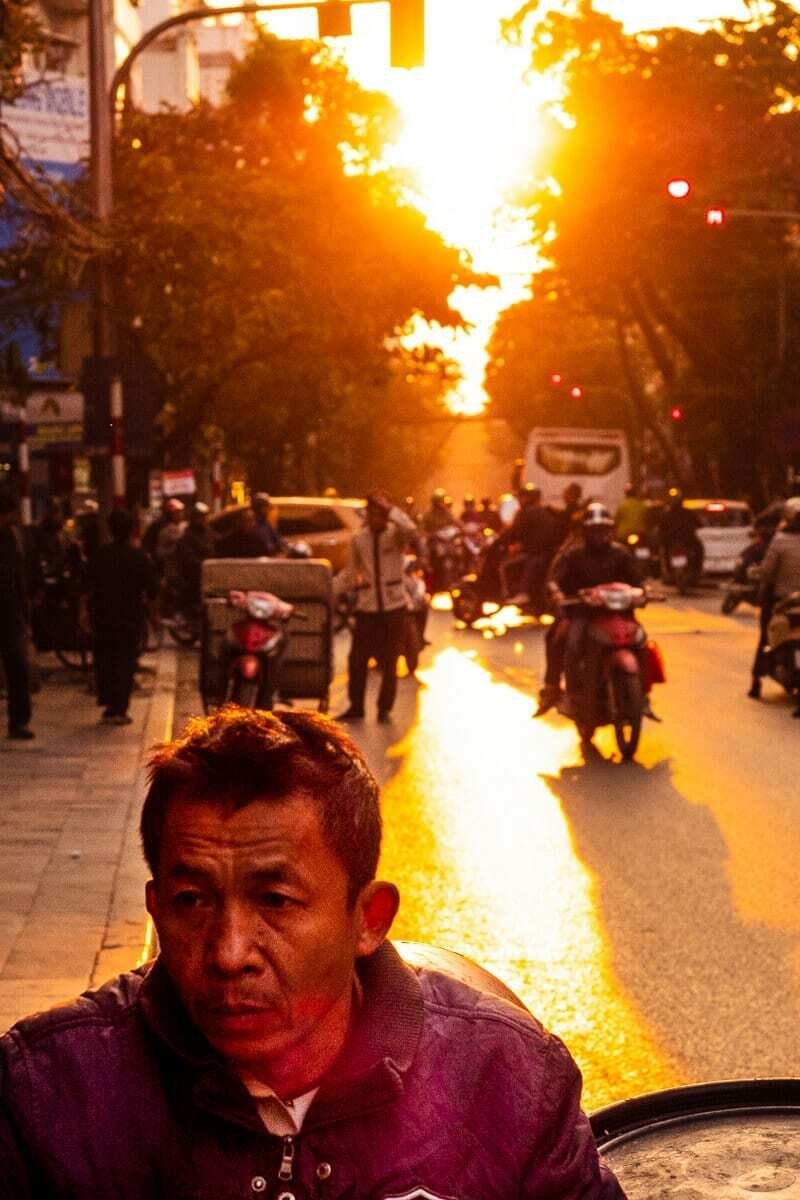
Here the layers are clearer. A face low in the frame is the near layer, and the traffic under the setting sun is the far one. Hard backlight turns the whole scene orange and separates the planes.
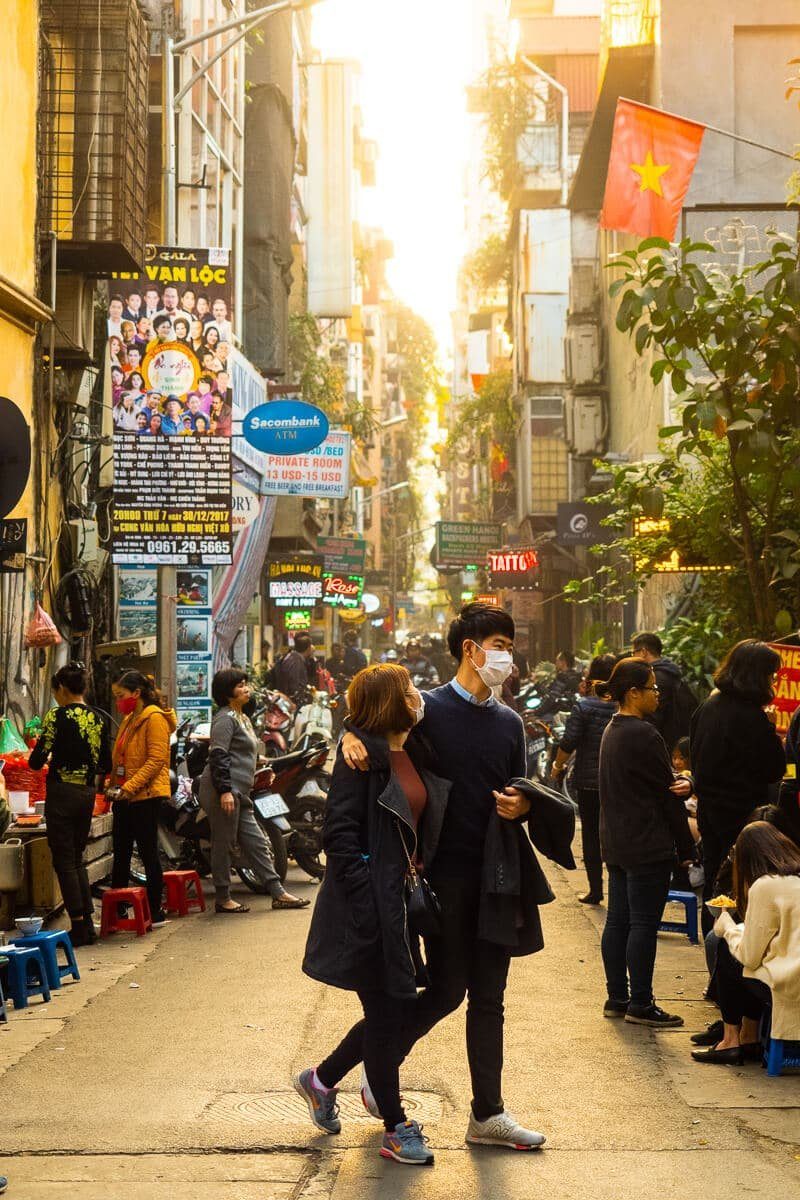
Alleys are natural stages for layers because people are spread along a line. Stand still at one end, let people walk into their places, and shoot as the scene changes.
Why Alex Webb matters to your street photography
Many photographers I talk to are stuck with pictures that have one idea. A person walks past a wall. Done. Webb shows the next level: several ideas in one frame, organized so the eye can travel through them. It's the hardest kind of street photograph to make, and the most rewarding to study.
He also proves that patience beats luck. His complex frames look like miracles, but they come from walking and from waiting a long time in one place. If your hit rate worries you, my page on the street photography hit rate explains why failed frames are part of the method.
In my street photography course, Phototactic, we teach composition through picture patterns, repeatable structures such as "near figure against a color wall." Learn a few and you start seeing layered frames before they happen. The course has no feedback on your own photos, so the practice is yours to do.
For more masters and the lesson each one teaches, see my list of famous street photographers. Compare Webb's heat with the quiet color of Saul Leiter and the color in motion of Ernst Haas, or with Joel Meyerowitz, another American color pioneer.
Alex Webb books
| Book | Year | Why get it |
|---|---|---|
| Hot Light/Half-Made Worlds | 1986 | His first color book |
| Under a Grudging Sun | 1989 | Haiti in the late 1980s |
| Crossings | 2003 | The US and Mexico border |
| Istanbul: City of a Hundred Names | 2007 | Istanbul, with a text by Orhan Pamuk |
| The Suffering of Light | 2011 | The 30 year survey. Start here. |
| On Street Photography and the Poetic Image (with Rebecca Norris Webb) | 2014 | Their practical book on how they work |
| La Calle | 2016 | Mexico, 1975 to 2007 |
He also won the Leica Medal of Excellence in 2000, and his work is held by museums such as the Whitney and the Metropolitan Museum of Art. For quotes from him and other masters, see my page of photography quotes.
Frequently Asked Questions
What camera does Alex Webb use?
Alex Webb is usually described as working with Leica rangefinders, and he shot Kodachrome slide film for about 30 years, until the film was discontinued. The gear matters less than his method: waiting in one place and shooting many frames as a scene develops.
Is Alex Webb still alive?
Yes. Alex Webb was born in San Francisco in 1952 and lives and works in Brooklyn, New York, with his wife and creative partner Rebecca Norris Webb. He is still photographing and exhibiting. In 2026 a new exhibition paired his archival Mexico photographs with a recent commission in Oaxaca.
What is Alex Webb's style?
Webb's style is complex, layered color street photography. His frames hold several people or actions at different distances, often split by hard light and deep shadow, with strong saturated colors. He worked mostly in the Caribbean, Mexico, the US and Mexico border and Istanbul. He began in black and white and switched to color in 1978.
When did Alex Webb join Magnum?
Alex Webb joined Magnum Photos as a nominee in 1974, became an associate member in 1976 and a full member in 1979. He had met Magnum photographers Bruce Davidson and Charles Harbutt at the Apeiron Workshops in 1972, while he was still studying history and literature at Harvard.
What is the best Alex Webb book to start with?
The Suffering of Light (Aperture, 2011) is the best first book because it covers 30 years of his color work in one volume. If you want practical advice, Alex Webb and Rebecca Norris Webb on Street Photography and the Poetic Image (2014) explains how they think and work. Crossings and La Calle are strong single projects.