
Brassaï is known for photographing Paris at night in the early 1930s: foggy streets under gas lamps, cafés, bars and the people who lived after dark, collected in his 1933 book Paris de nuit (Paris by Night). The move you can use is to treat darkness as your main material and build each night photograph around one source of light.
I'm Olivier Duong. I teach street photography, and his is the first name I give people who say they can't shoot at night. He worked with glass plates and a tripod, and he still made some of the most famous night images ever published. Low light was never the problem. It was the point.
What is Brassaï known for?
Brassaï is known as "the eye of Paris", a name that came from an essay by his friend, the writer Henry Miller. His photographs of Paris by night show empty, shadowed streets, lamps in fog and the city's nightlife: dance halls, bars, brothels, workers and lovers.
He was more than a night photographer. He also photographed the city's high society and its opera, made portraits of artist friends such as Pablo Picasso and Salvador Dalí, and would devote decades to photographing graffiti scratched into the city's walls. Each graffito became a small, unexpected face or sign in the stone. He never stopped drawing and making sculpture, he wrote books, and he made films.
His style sits between documentary and art. He was an artist first, and his photographs are more than documentation. The Surrealists admired his work, and he published in the Surrealist magazine Minotaure, and his night images still shape how people picture Paris in the 1930s.
Brassaï biography: from Transylvania to Paris
Brassaï was born Gyula Halász on 9 September 1899 in Brassó, Transylvania, then part of the Kingdom of Hungary and today Brașov in Romania. His father was a professor of French literature, and the family lived in Paris for a year when he was three.
His training in Budapest and Berlin was artistic, not photographic. He studied painting and sculpture at the Hungarian Academy of Fine Arts in Budapest and served in a cavalry regiment until the end of the First World War. In 1920 he moved to Berlin, where he worked as a journalist for Hungarian papers and studied at the art academy in Charlottenburg.
He moved to Paris in 1924 and stayed for the rest of his life. He taught himself the French language by reading Marcel Proust, lived among the young artists of Montparnasse and worked as a journalist. He would befriend Henry Miller and French writers such as Léon-Paul Fargue and Jacques Prévert. He stayed close to the Hungarian circle in Paris too, including the painter Lajos Tihanyi and later Tihanyi's nephew, the photographer Ervin Marton.
His walks through the city late at night led him to photography around 1929, by most accounts, when the New Photography of the interwar years was changing what a camera could do. At first he used it to add pictures to his articles. His fellow Hungarian André Kertész helped him learn. He took the pseudonym Brassaï, meaning "from Brassó", after his hometown. He later wrote that he used photography "to capture the beauty of streets and gardens in the rain and fog, and to capture Paris by night."
Paris de nuit came out in 1933, with text by Paul Morand, and made him famous. MoMA's Brassaï collection page lists the prints the museum holds. He went on to shoot for Harper's Bazaar and was a founding member of the Rapho agency. The Museum of Modern Art in New York gave him a solo exhibition in 1948 and showed his work again in the 1950s and 1968. In 1970 and 1974 the Rencontres d'Arles festival honoured him, the second time as guest of honour. He married Gilberte Boyer in 1948 and became a French citizen in 1949 after years of being stateless.
His later publications include Graffiti (1961), Conversations with Picasso (1964), Henry Miller: The Paris Years (1975) and The Secret Paris of the 30s (1976), which finally published many of his more private night photographs. His short film Tant qu'il y aura des bêtes is reported to have won an award at the 1956 Cannes Film Festival. Brassaï died on 8 July 1984 near Nice, in the south of France, and is buried in Montparnasse Cemetery in Paris.
How Brassaï photographed Paris by night
What amazes me about him is how hard his tools were. His first camera was a Voigtländer Bergheil that took 6.5 × 9 cm glass plates, one at a time. At night he worked on a tripod with long exposures, often several minutes. To time them he is said to have smoked a cigarette, a Gauloise for one kind of light and a Boyard if it was darker.
That slowness shaped his style.
- Light sources as subjects. Street lamps, lit windows, shop fronts and café signs are often the brightest and most important part of the frame.
- Fog and rain. Mist spreads the light and softens the city. Wet cobblestones double every lamp.
- Stillness. Long exposures turned moving people into ghosts or erased them. Many of his outdoor night photographs show empty streets and bridges.
- Flash for people. Inside bars and dance halls he often used flash to freeze people, which gives those pictures their hard, direct look.
- Working with his subjects. Some of his café and street scenes were set up with people he knew. He cared more about the truth of the atmosphere than about pure candid capture.
You don't need glass plates today. A modern camera sees in the dark far better than anything he had. But his main idea still matters: night photography is about where the light is, not about how high your ISO goes.
Famous Brassaï photographs, image by image
I don't reproduce his photographs here. They are protected, and many are still sold through a gallery or at auction. The J. Paul Getty Museum holds many of his prints, and museum collections such as MoMA and Tate show more. Look each one up while you read.
Morris Column, Avenue de l'Observatoire (1934)
An advertising column and street lamps in fog, glowing in the dark. The city almost disappears around the light. The move: go out on a foggy or rainy night and make the light itself the subject.
Lovers in a Small Café, Quartier Italie (around 1932)
A woman and her lover kissing at a café table, doubled by the mirrors behind them. Every photograph in this series rewards slow looking. The move: use a mirror or reflection to show the same moment twice, so the picture has more than one layer. My guide to layering in photography covers how to stack planes like this.
Bijou at the Bar de la Lune, Montmartre (around 1932)
A portrait of an older woman loaded with jewellery, seated in a Montmartre bar. The flash makes every detail sharp and a bit harsh. The move: at night, get close to one strong character and let the light show their texture.
The original 1933 publication of Paris de nuit is also worth studying as a whole, not image by image. The presentation works as a sequence: a walk through the city from dusk to dawn.
Steal this move: shoot the city at night
This exercise takes his idea into modern night street photography. It works in any city with street lights.
- Set your limits before you leave. Find the slowest shutter speed you can hand hold without shake (I'm good to about 1/30s with a larger camera) and the highest ISO whose grain you accept. Most modern cameras are fine at ISO 3200, many at ISO 6400.
- Open up. Use f/1.8 to f/2.8. A slow lens makes night work very hard.
- Be like a fly. Stick to the light: street lamps, shop windows, food stalls, neon signs. Put yourself where the light is and wait for people to walk into it.
- Brace or blur. Lean the camera on a wall or bench for slower speeds. When you can't avoid blur, make it part of the picture.
- Look for weather. Fog and rain are your friends. They spread light and add reflections.
- Accept grain. A grainy photo is better than a blurry one or no photo at all.
My street photography settings guide has a night starting point. If you go to Paris, my Paris street photography guide covers where to shoot.
My take on the idea
I love shooting at night. It's messy and frustrating and that's part of the fun. These are three of my own night frames, each using an idea you can see in his work.
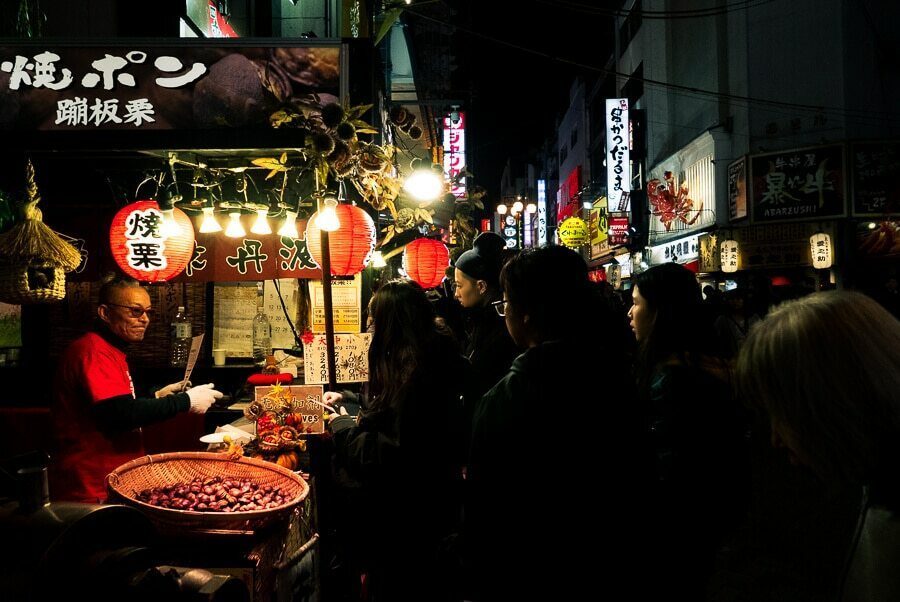
When darkness falls, I do what I call being like a fly: I go where the light is. Vendor stalls and shop fronts give your camera enough light to work, and they gather people.
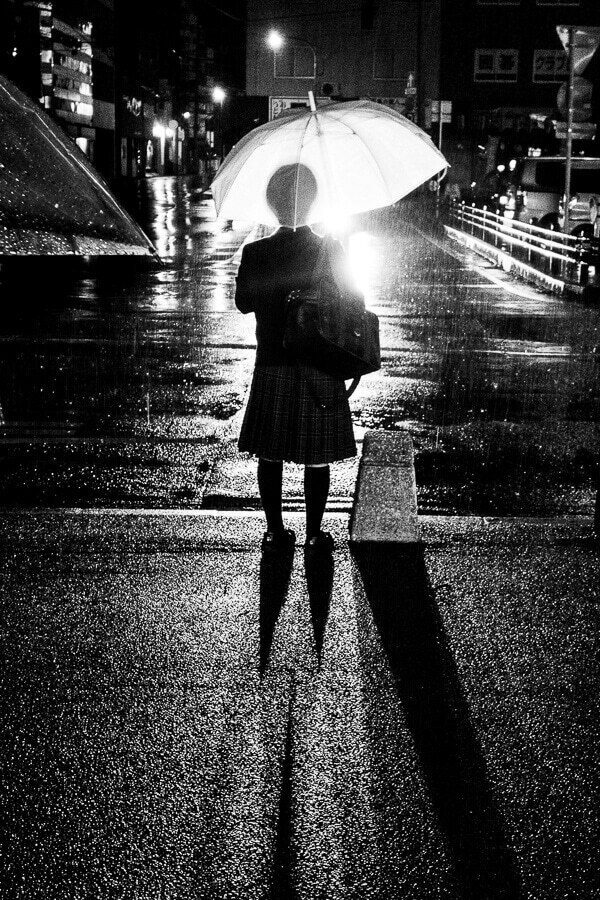
Rain is a gift at night. The lamp lights the umbrella from above and the wet road gives back what's left. It's the same mood Brassaï found in fog.
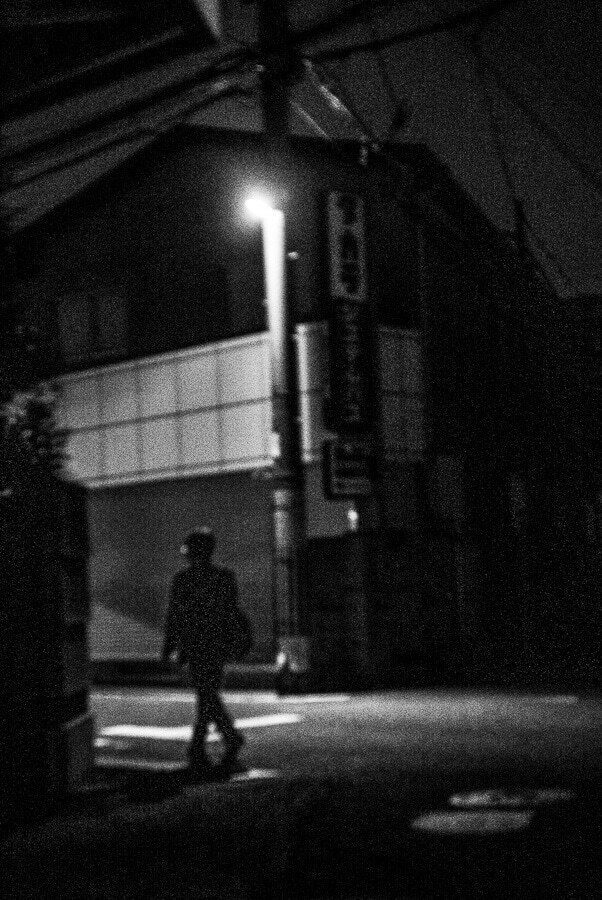
This one was made with manual focus, with barely any light, as someone walked past. It's grainy and soft. I kept it because the mood is right, and mood is what he taught me to look for at night.
Why his nocturnal photography still matters
A lot of street photographers put the camera away when the sun goes down. He built his reputation on exactly those hours. Night strips a city down to light and shadow, and that makes it easier to see, not harder.
He also shows that a street photographer can be patient and deliberate. He worked slowly, planned his light and returned to the same streets. That's the opposite of running around hoping for luck.
In my online street photography course, Phototactic, we teach how to make the most of any time of day, plus picture patterns: repeatable structures such as "lone figure in a pool of light" that you learn to spot fast. A bonus camera course covers the settings you need in low light. It's a video course with no feedback on your own photos, so the night walks are on you.
He sits in a line of photographers of the city of Paris that includes Eugène Atget before him and André Kertész beside him. For more masters and the lesson each teaches, see my list of famous street photographers and the wider list of famous photographers, and my guide to light and shadow photography for the technique side.
Brassaï publication and exhibition history
| Publication | Year | What's in it |
|---|---|---|
| Paris de nuit (Paris by Night) | 1933 | The night photographs that made his name, with text by Paul Morand |
| Graffiti | 1961 | Decades of wall markings, plus two conversations with Picasso |
| Conversations avec Picasso | 1964 | His memoir of years of talks with Picasso |
| Henry Miller: The Paris Years | 1975 | His book about his friend Miller |
| The Secret Paris of the 30s | 1976 | The more private night work in bars and brothels |
Major exhibitions include his 1948 solo show at the Museum of Modern Art, which travelled to George Eastman House and the Art Institute of Chicago, and the 1998 retrospective organized by the Museum of Fine Arts, Houston, which later travelled to the J. Paul Getty Museum. In 1979 he was inducted into the International Photography Hall of Fame. For reference, the Victoria and Albert Museum alone lists over 400 items by him, and new exhibitions of his work keep opening in Europe and the US.
For more books to study, see my list of the best street photography books. Lines from other masters are in my street photography quotes.
Frequently Asked Questions
What was Brassaï's real name?
Brassaï's real name was Gyula Halász. He was born in 1899 in Brassó, Transylvania, then part of Hungary and now Brașov in Romania. He chose the pseudonym Brassaï, which means "from Brassó", after his hometown. He moved to Paris in 1924 and became a French citizen in 1949. He died in 1984.
What kind of photography did Brassaï do?
Brassaï is best known for night photography of Paris in the 1930s, from foggy empty streets to cafés, bars, dance halls and brothels. He also photographed high society, made portraits of artists such as Picasso, Dalí, Matisse and Giacometti, photographed graffiti for decades and shot for Harper's Bazaar. His work sits between documentary street photography and art.
Did Brassaï know Picasso?
Yes. Brassaï and Pablo Picasso shared a long friendship. He photographed Picasso and his sculptures and wrote a memoir of their talks, Conversations avec Picasso, published in 1964 and later translated into English as Conversations with Picasso. His book Graffiti (1961) also included two conversations with Picasso.
Did Brassaï use flash photography?
Yes, for many interiors. Outdoors at night he usually relied on existing light and long exposures on a tripod with glass plates, sometimes several minutes long. Inside bars, cafés and dance halls he often used flash to freeze people, which gives many of those pictures their sharp, direct look. His first camera was a Voigtländer Bergheil.
Where can I see Brassaï's work?
Major collections include the J. Paul Getty Museum, the Museum of Modern Art in New York, the Art Institute of Chicago, Tate and the Victoria and Albert Museum in London. His books Paris de nuit and The Secret Paris of the 30s are the best way to see his night work at home. Exhibitions of his photographs still tour today.