
Street Photography in Athens
Athens puts ancient ruins and graffiti side by side under hard Mediterranean light, and its people are expressive and mostly relaxed about cameras.
- Spots
- 8
- Best time
- April to June and September to October
- Lens
- 28mm or 35mm
- Photographing people
- Generally allowed
Athens is very good for street photography because it puts ancient stone and fresh graffiti in the same few blocks, under hard Mediterranean light. You can photograph tourists under the Acropolis in the morning and a butcher under a bare bulb an hour later, a ten minute walk away. f.d. walker, who shot 100 cities for his guides, calls it a mix of tourism and edgy urban decay. Local photographer Angelos Giotopoulos says the strong light and tall buildings make shadows that turn shooting into painting with light.
The people help too. Greeks talk with their hands, and many are relaxed about a camera. The downside is heat. July and August are hot and crowded, so I'd plan the day around the early morning and the last two hours of light, and spend midday in the market halls and shaded arcades.
Best street photography spots in Athens
Monastiraki Square
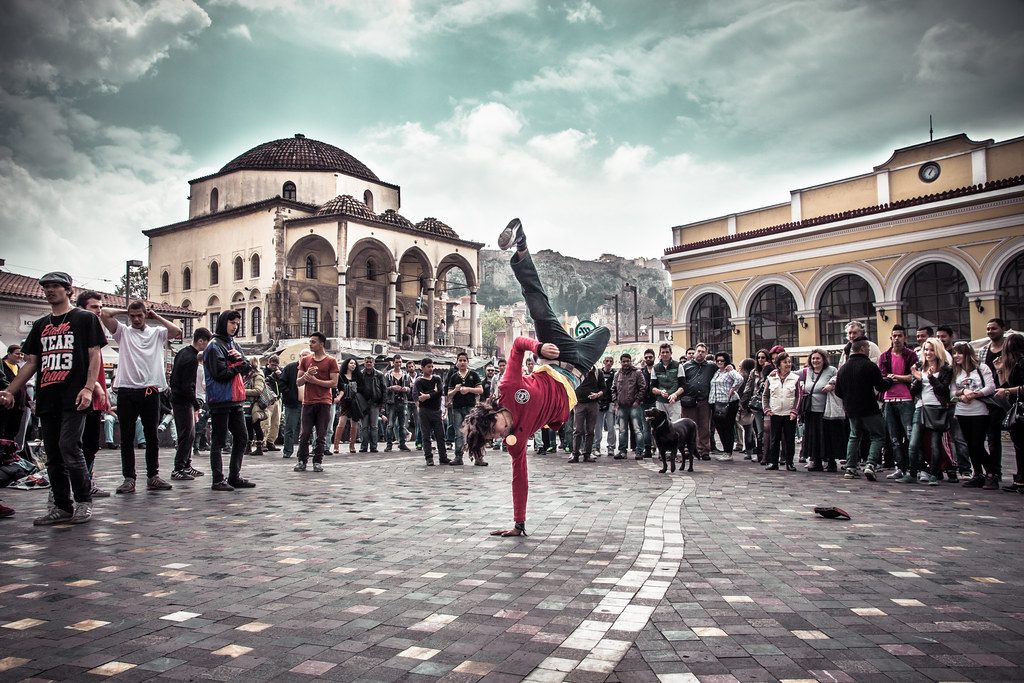
Monastiraki is where I'd start. The square sits under the Acropolis, next to a metro exit, and it is full from morning to night with tourists, vendors, buskers and locals cutting through. f.d. walker calls it his favorite starting point, because every direction leads somewhere different: ruins on one side, graffiti and flea market lanes on the other. Stand at the edge of the square with the Acropolis behind the crowd and wait for one person to separate from the flow. The flea market streets toward Avissinias Square are best on weekend mornings. Keep your bag zipped. Pickpockets work this square and the metro.
Ermou Street
Ermou runs about a kilometer and a half from Syntagma Square down to Monastiraki. It is the city's main pedestrian shopping street, so it has shoppers, street musicians and office workers at every hour. The small Kapnikarea church sits in the middle of the street, and people flow around it on both sides. That is a good frame: the old stone church against shop windows and shopping bags. Late afternoon puts the sun low down the street and backlights the walkers. It is crowded, so work close with a wide lens and let people fill the frame. Watch for scooters crossing at side streets.
Varvakios Central Market
The central market on Athinas Street is the rawest light in the city. In the meat hall, carcasses hang under bare bulbs, and butchers shout prices across the aisles. f.d. walker describes the atmosphere as surreal, and the Athenian Explorer says the same about the meat section. Go in the morning, when trade is busiest, and expose for the lit meat and faces, not the dark aisles. A fast prime helps. The fish hall floor is wet and slippery, and vendors are working, so do not block the aisle. The market is closed on Sundays.
Psyrri
Psyrri is a few minutes north of Monastiraki. It mixes old metal and leather workshops with bars and some of the most painted walls in Athens. By day, look for a craftsman in a doorway against a mural, or a delivery scooter passing a wall of tags. At night the lanes fill with people eating and drinking outside, lit by shop signs. That is good for slower shutter speeds and silhouettes. The Athenian Explorer points out that the area blends old Athens trades with current street culture. Some streets are quiet and dim after midnight, so stay on the busier ones.
Omonia Square
Omonia is where the city stops performing for visitors. f.d. walker found it one of the most interesting areas for character and one of the dodgier ones. The streets around the square are multicultural, with a Pakistani market that local photographer Eva Balasi compares to another continent. Archaeologist and photographer Alexis Efstathopoulos likes the old arcades for architecture and light. Go in daylight. Work the arcades, where people walk from shade into sun. Be discreet here. Do not photograph people who look like they would rather not be seen, including drug users, and keep your camera close.
Plaka & Anafiotika
Plaka is the old neighborhood wrapped around the base of the Acropolis. Anafiotika, above it, was built by workers from the island of Anafi, so it looks like a Cycladic village: whitewashed walls and blue doors, with cats on the steps. The lanes are tiny and fill with tourists by late morning, so go early or near sunset. I'd pick one white wall with a strong shadow and wait for a person or a cat to walk into it. Remember that people actually live here. Keep your voice down and do not point a lens into windows.
Exarcheia
Exarcheia is the political and student neighborhood north of the center. The walls are covered in posters and stencils, and the square and cafes are full of locals day and night. The Athenian Explorer calls it the place where the city's raw side becomes fully visible. It is strong for graffiti with people passing in front of it. It is also a place where some residents are wary of cameras and of being identified. Ask before any close portrait. Put the camera away if a protest or a police operation starts.
Mount Lycabettus
Lycabettus is the highest point in central Athens. You can walk up the paths from Kolonaki or take the funicular. At the top you get the whole city spread out, with the Acropolis in the middle, and a crowd of people watching the sunset. That crowd is the street picture: silhouettes of couples and phones against the orange sky. Arrive 45 minutes before sunset to find a spot on the wall. A short telephoto compresses the Acropolis behind the city. The path down is dark after sunset, so bring a light or take the funicular.
Photographing people in Athens
Taking photos of people in public places is generally legal in Greece. The limits are about use. Article 57 of the Civil Code protects personality, which covers privacy and a person's image, and Lexology's summary of Greek publicity rights notes that using someone's photo in advertising needs their consent unless they are part of a group or a minor part of the image. EU data protection law also applies to identifiable people. Never photograph police, military or protests up close. This is general information, not legal advice.
In practice, f.d. walker rated Athenians as very photo friendly, among the friendliest big cities in Western Europe. Reactions vary, though. Some visitors report being told off, and residents of Exarcheia and the rougher streets near Omonia can be wary. I'd shoot the scene with a smile and ask when you want a face. See how to photograph strangers.
General information, not legal advice. More in is street photography legal?
What to photograph in Athens
- Hard shadows. Sun on pale walls and narrow streets gives deep black shapes to frame a single figure.
- Tourists at the ruins. Selfie sticks and sun hats in front of 2,500 year old columns. f.d. walker suggests thinking like Martin Parr here.
- Graffiti. Psyrri, Gazi, Kerameikos and Exarcheia are covered in it. Use it as a background, not the subject.
- Market life. Butchers and fishmongers on Athinas Street.
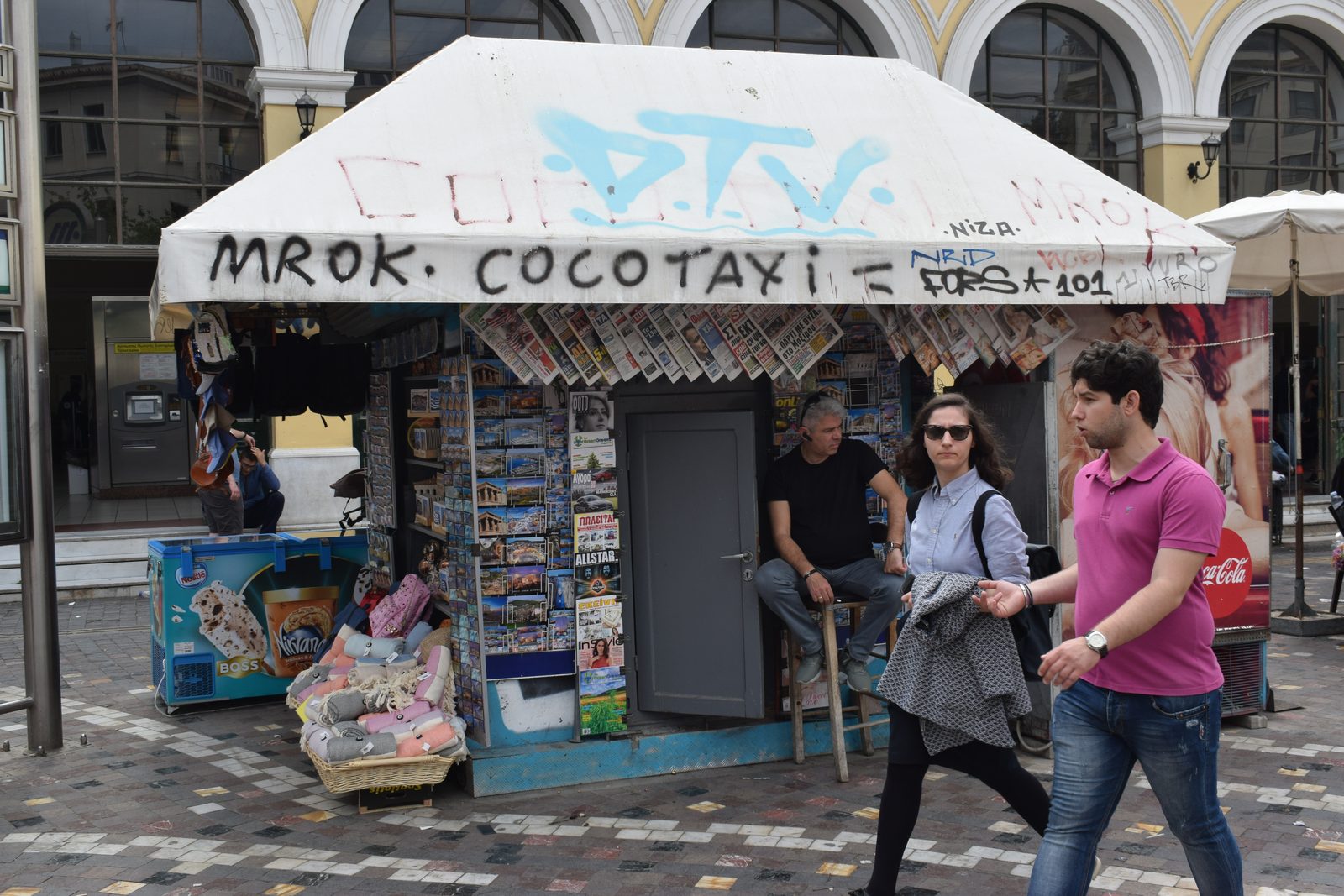
- Kiosks. The small periptero kiosks on corners, with owners and customers talking.
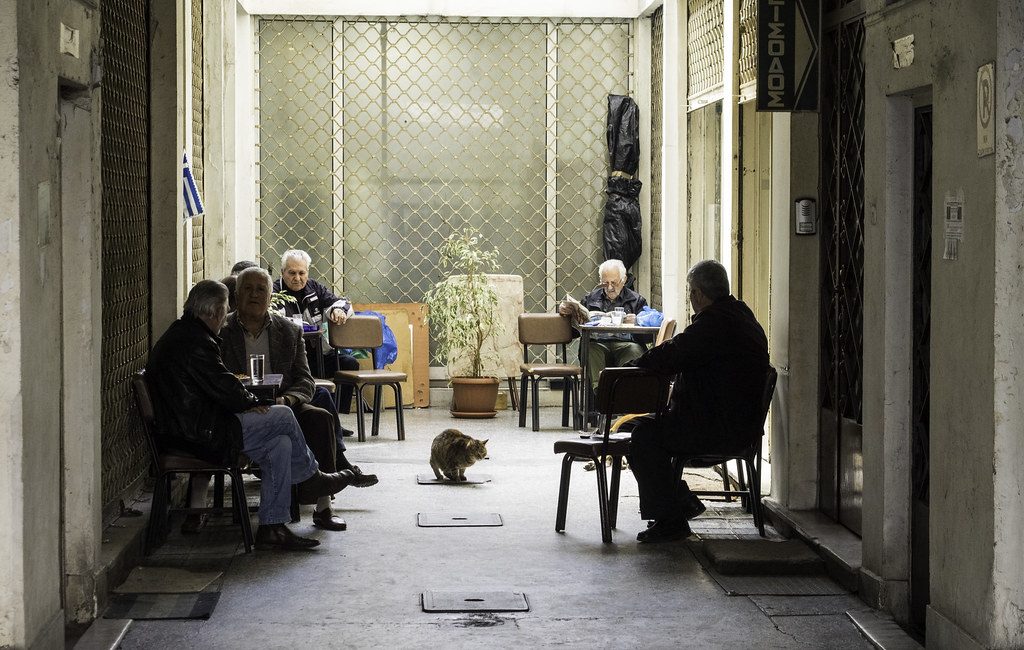
- Cafe culture. Men with frappe and worry beads outside neighborhood cafes in Kypseli and Exarcheia.
- Neoclassical decay. Faded mansions and abandoned buildings in Victoria and Metaxourgeio.
A one-day photo walk
- 8:00, Plaka and Anafiotika. Start in the quiet lanes before the tour groups arrive. About 1.5 hours.
- 9:30, Monastiraki Square. A 10 minute walk downhill. Work the square and the flea market lanes.
- 10:30, Varvakios Central Market. Walk 5 minutes north up Athinas Street. Stay an hour in the halls while trade is busy.
- 12:00, Omonia. Another 5 minutes north. Arcades and shade at midday. Lunch nearby.
- 15:00, Psyrri. Walk back south, about 10 minutes, for murals and workshops.
- 17:30, Ermou Street. Low sun down the street toward Syntagma.
- Sunset, Mount Lycabettus. Metro from Syntagma to Evangelismos, then walk up or take the funicular from Kolonaki. Allow 40 minutes.
When to shoot
April to June and September to October. Summer is very hot and crowded; shoot early morning and the last two hours before sunset. Orthodox Easter night is a strong event.
The light
Bright, dry sun and tall buildings throw deep, hard shadows for most of the year. Midday is harsh; low sun on pale stone is the city's strength.
What to bring
A 28mm or 35mm prime for the narrow streets. A fast lens for the dim market halls.
Safety
Generally safe. Pickpockets on the metro and in Monastiraki. Omonia and some streets around it feel edgy; stay alert and go by day.
Tips for Athens
- Season: April to June and September to October. Midsummer heat is intense, so carry water and plan shade breaks.
- Orthodox Easter: on the Saturday night, churches fill and crowds light candles at midnight. The date moves, usually in April or early May.
- Lens: a 28mm or 35mm prime for the lanes, a short telephoto for Lycabettus. See best lens for street photography.
- Exposure: in hard sun, expose for the highlights and let shadows go black. In the market, use a fast lens and higher ISO. More in street photography settings.
- Sundays: the central market is closed, but the Monastiraki flea market streets are busy.
- Metro: lines 1 and 3 meet at Monastiraki. Pickpockets work the trains, so keep your camera on you.
- Police: do not photograph police, military posts or the guards' barracks. The Evzones changing of the guard at Syntagma is the public exception.
Frequently asked questions
Is street photography legal in Athens?
Photographing people in public is generally legal in Greece. Personality rights (Civil Code article 57) and data protection law limit publishing intrusive images and commercial use without consent. Do not photograph police or military. Some residents, notably in Exarcheia, are wary of cameras.
Where are the best street photography spots in Athens?
Start with Monastiraki Square, Ermou Street, Varvakios Central Market, Psyrri. Busy square and flea market streets below the Acropolis. The natural starting point for a day.
When is the best time for street photography in Athens?
April to June and September to October. Summer is very hot and crowded; shoot early morning and the last two hours before sunset. Orthodox Easter night is a strong event.
What lens should I bring to Athens?
A 28mm or 35mm prime for the narrow streets. A fast lens for the dim market halls.
Is Athens safe for street photographers?
Generally safe. Pickpockets on the metro and in Monastiraki. Omonia and some streets around it feel edgy; stay alert and go by day.